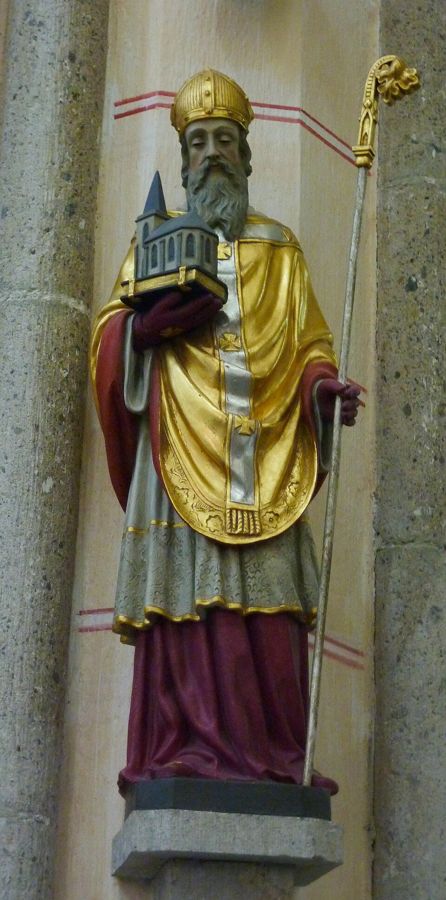
Baring-Gould’s sources: Roman and York Martyrologies. Canonised by Pope Honorious HI. Authorities: — William of Newbury (b. 1136, d. 1208) in his History of his Own Times. He was not only a contemporary, but also a Yorkshire man, a native of Bridlington, and he wrote his history at the request of his patron Roger, abbot of By land. John of Brompton, abbot of Jervaux, in Yorkshire (d. 1x93) • also John of Hexham (ab. in 1170), who wrote a continuation of the history of Simeon of Durham, from 1130 to 1154; also an old life given by Capgrave.] The father of S. William was Count Herbert; his mother, Emma, sister of King Stephen. William was constituted treasurer of York, and obtained considerable popularity in the city. On the death of Thurstan, the archbishop, in 1140, the election of a successor fell on Henry de Coille, nephew of King Stephen, but as the Jane 8.] •S. William.
…pop 2 would not consent to his appointment unless he resigned all his other honours, the electors chose William, also a nephew of the king; but some of the electors formed a party to oppose him, and sent Walter the archdeacon to the king to state their objections. William, earl of York, however, favoured the treasurer, and detached a troop of horse to waylay the archdeacon, and arrest him. Stephen invested S. William with the temporalities [the lands and income attached to a bishopric] of the see of York [a bishop’s “see” is his diocese, named from his seat (Latin sedes)]. But the archdeacon appealed to the pope, Innocent II., and declared the freedom of the electors to have been hampered by an order from the king, communicated by the earl of York, requiring them to elect William; and charged William with having bought the archbishopric. The pope ordered the dean of York to take oath that he had not received the mandate of the king, and William that he had paid no money for the see, also that the case should be tried by the Bishop of Winchester, the papal legate [an official representative sent by the pope] in England William and the Archdeacon Walter returned from Rome, and the court was formed at Winchester, but no one appeared to prove the charge against S. William, and he was consecrated by the legate.
But in the mean time Innocent II. was dead (a.d. 1143), and after the rapid succession of Celestine II. and Lucius II., Eugenius III. mounted the chair of S. Peter in 1145. He was a Cistercian [strict Benedictine reform begun at Cîteaux in 1098] monk, and was ambitious to place a Cistercian in the important see of York. He accordingly refused to acknowledge S. William, against whom his master, S. Bernard, had taken part with extreme violence, and whom he had even charged with perjury. Urged by S. Bernard, Pope Celestine had refused to give S. William the pall, and acknowledge him as archbishop, but Lucius II., on the contrary, ratified his appointment, and sent him the pall. Eugenius III. eager to place one [Jane 8L of his own order in the great see of York, annulled the appointment of S. William, and appointed Henry Murdac, monk of Clairvaux. William then went to Sicily to the court of Roger, the king, and some nobles, relatives of S. William, angry at the part taken by the English Cistercians against their kinsman, fell on the farms of the abbot of Fountains, and burnt them. The nomination of Henry Murdac by the pope did not please the electors to the see of York, and the majority chose Hilary, bishop of Chichester, only a small minority voting for the Cistercian. Eugenius, however, refused to acknowledge any one save Murdac, and consecrated him, and invested him with the pall at Treves [Trier in Germany], where he then was.
S. William returned to England, and took up his residence with the Bishop of Winchester, spending his time in prayer. But King Stephen, highly incensed at the action of the pope, did all in his power to annoy Murdac, and through his influence the citizens of York shut their gates against him.
Eugenius III. died in 1153, and in the same year died Henry Murdac. Eugenius was succeeded by Conrad, Cardinal of S. Sabina, who had taken the part of S. William before, but ineffectually, against the prevailing vehemence of S. Bernard. Now, as Pope Anastasius IV., he at once confirmed the saint in the see of York, and sent him the pall S. William was received at York with great enthusiasm. The people crowding over the Ouse bridge to welcome him on his entry, broke it down, and were precipitated into the river. Providentially none were drowned. S. William did not remain many months in the see, for he died in 1154.
His tomb speedily became a resort of pilgrims, and so many miracles were supposed to be wrought by the oil contrived to flow from it, that he was canonized by Honorius III. JnutB.) S. William.
The hymn sung on the festival of S. William,1 at York, says that he died of poison, but there is no allusion to this in the York Breviary lessons. John of Newbury says he died of fever. Gervase of Dover says he was killed by poison in the chalice at mass.
The great S. William window in Yprk Minster is in the north end of the upper or choir transept It is of five lights, and of great height, and divided into a great number of compartments, each representing a miracle or subject from the life of the saint It was put up about the middle of the 15th century.
In the Dodsworthy MSS., in the Bodleian Library, is a copy from “ a table in the re vestry in the cathedral church of York,” containing an account of all the miracles of S. William, and apparently in the order of the representations in the window.
A curious diary of certain tourists in 1634, printed from the “ Lansdowne ” MSS., 213, so far as it relates to Yorkshire, in Cartwright’s “ Chapters in the History of Yorkshire,”8 gives some curious additional information relative to the body of S. William at a date long subsequent to the destruction of shrines by the commissioners of Henry VIII. “After our forenoon’s and afternoon’s devotions were finished,” say these tourists; “ the remaining part of the day was chiefly spent in the cathedral in viewing the many rarities, riches, and monuments of that sacred building. The sanctum sanctorum beyond the stately rich high altar and the gilded partition wherein S. William’s In eum pacificum, Et ut ipsum prlvent vita, celeb rantis aconita Propinant in calice i Toxicatur a profan is, ille potns, ilk panls Per quem peril toxicnm.”
shrine formerly was: his tombe seven foot long, sometime covered all over with silver.... Upon the breaking up of the monument King James commanded his bones, which are large and long, to be kept, as they are, in the vestry.” What has become of them since is not known. B.IVLIANA FALCONERIA, Qrd. Jcrw-ruTTi 3. AC J^lcrcnf-uc.