Baring-Gould’s sources: Roman Martyrology. Usuardus, Ado, Ac. York Kalendar. Hrabanus Maorus on Nov. 6, the day on which he died. Benedictine Martyrologies. Authorities A Life by Alcuin, with homily on the feast of S. Willibrord, and elegy on S. Wilgis, father of S. Willibrord, by Alcuin (d. 804), 1 published by Mabillon, Acta SS. O.S.B. t. iiL; another Life by Theofrid, abbot of Eptemach (d. 1090), a rewriting of the former, only printed in part in Mabillon, Surras, &c. Mention by About the year 690 a Northumbrian of noble birth, named Ecgbert, left his native land, to study in retirement among the famous schools of Ireland. Taking up his abode in a monastery in Connaught, he became eminent for his piety and learning, but was long prostrated by a severe illness. Recovering, contrary to all expectations, he made a vow that, instead of returning to his country, he would devote himself to the service of the Lord.
The condition of the heathen tribes in Northern Germany and along the Frisian coast, was at this time a subject of deep solicitude in many Irish monasteries. Ecgbert was filled with a desire to proceed thither, and proclaim the message of salvation. Selecting, therefore, the most zealous of his brethren, he made every preparation for the voyage. But on the very eve of his embarkation a storm shattered the vessel which was to have conveyed him and his companions.
Thus discouraged, Ecgbert was not willing to give up his 1 Addressed to Beonrad, Abp. of Sens, abbot of Epternach, who died 796. Nov. y.] S. WUlibrord.
project altogether. A vision bade him remain in Ireland and “ instruct the monasteries of Columba; ” perhaps the consciousness that his own health was delicate satisfied him that he was not fit for the work. He therefore began to look out for other labourers to carry out the task he was not himself competent to execute. At last his eye rested on a Northumbrian countryman of his own, named Willibrord, whose education, commenced in the monastery of Ripon, had for twelve years been carried on under his own direction in Ireland.
Willibrord was the son of Willgis, a man of Saxon birth, who had left his wife and family and lands and retired to the dreary flats of Holdemess, where he had built an oratory to S. Andrew, and established himself as a hermit. Willibrord had been given, when a mere child, by his father to the abbot of Ripon, so that he had grown up under ecclesiastical discipline horn his cradle.
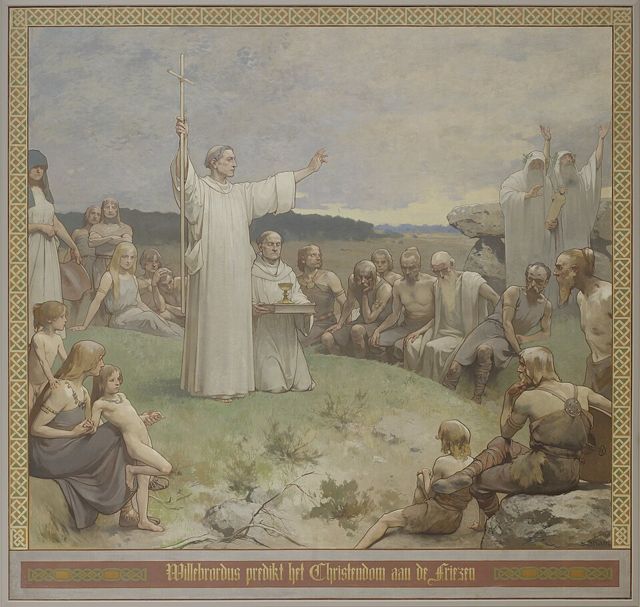
Yielding to the solicitations of Ecgbert, Willibrord agreed to select twelve companions, and sail for Friesland to labour at the conversion of the barbarous people dwelling in that dreary land of marshes.
The vessel in which he sailed carried him safely to the Frisian shores, where he was heartily welcomed by Pepin of Herstal, who had been lately successful in several engagements against Radbod, a powerful native prince, and an energetic supporter of heathenism.
Beginning his labours in that part of Frisia [the North Sea coast of the Netherlands and Germany] which Pepin had wrested from his adversary, Willibrord showed such aptitude for the work of evangelization, that Pepin insisted on sending him to Rome to receive episcopal ordination from Pope Sergius, as well as his apostolic benediction for the work. Willibrord reluctantly complied, and went to Rome laden with presents from Pepin to the Pope. Sergius ordained him in the year 696, under the name of Clemens, and his seat as archbishop was fixed at Utrecht. According to Bede [English monk and historian (d. 735)] this was not his first, but his second journey to the capital of western Christendom. His first was undertaken almost immediately after his arrival in Frisia, to obtain relics [the bodily remains of a saint, or objects they used, kept with honor] for the chinches he hoped to found. Furnished with these valuable commodities, he returned to Frisia, and laboured so effectually that Pepin sent him to Sergius to be consecrated archbishop. Alcuin omits the first journey altogether. Willibrord established himself at Utrecht, and succeeded in bringing into the net of the Church the population of Frankish Frisia, and in building several churches and monasteries, which he filled with brethren who came over to him from Ireland.
In the following year the archbishop resolved to sail to Denmark, and plant there the Christian faith. The terror, however, inspired by Ongund, a Danish viking, rendered his efforts utterly useless, and he was fain to content himself with finding thirty boys, whom he resolved to take back with him to Utrecht, and educate as future missionaries to Denmark. On his return, a severe storm drove him for shelter to the shores of Heligoland. The island was then probably of greater extent than it is now, the sea had not gnawed away so much of its chalk cliffs as to reduce it to a mere islet. It was then known as Forsetesland, and was dedicated to Forseti, son of Baldr and Nana, the god of judgments. So sacred indeed was it accounted, that it was deemed unlawful to touch any animal living there, or, except in reverent silence, to drink of its sacred well. The archbishop, however, having to wait some time for a favourable wind, killed several of the sacred cattle to provide food for the crew, and baptized three of his companions at the holy spring. The natives, horror-struck at his audacity, expected the god to strike the desecrator with immediate death. Nothing, however, occurred, and they hastened to complain of outrage to Radbod, who was then in the island. That chief instantly summoned Willibrord into his presence, and in a rage ordered that the lot should be cast and one of the party of the archbishop should be sacrificed to appease the offended deity. The sentence was carried into execution, but the enraged chief did not dare to incur Pepin’s resentment by laying hand on the bishop or any of the clergy. Willibrord spoke plainly to Radbod: “ It is not a god but a demon whom thou adorest There is but one God, who made heaven and earth and sea, and all things therein. He who worships this God with sincerity shall receive eternal life. I am His servant, and I testify unto thee this day that thou must abandon these dumb idols which thy fathers have worshipped, and believe in God Almighty, and be baptized in the fount of life, and wash away thy sins. If thou obeyest my words, thou shalt enjoy eternal life with God and the Saints; but if thou despisest me and the way of salvation, know assuredly that thou shalt suffer eternal punishment with the wicked one whom thou obeyest.”
Radbod marvelled at the boldness of the preacher, and sent him with an honourable escort to Pepin. On his way back he visited the low island of Walcheren, which maintains a constant struggle with the sea. He succeeded in establishing several churches there. Whilst preaching there he found an idol which the inhabitants revered greatly. Fired with zeal, and undeterred by the disastrous consequences of his interference with popular superstition in Heligoland, he threw it down and chopped it to pieces. The priest coming up was so filled with fury, that he aimed a blow at S. Willibrord with his sword and struck him on the head, but with the flat, not the edge of the blade, so that he was unwounded. Fear of Pepin prevented the idolaters proceeding to greater extremities.
S. Willibrord was joined in 720 by S. Boniface [English missionary to Germany, martyred 754], who spent three years in Friesland, and then went on into Germany. Bede, writing in 730, says: “ Willibrord, sumamed Clement, is still living, venerable for his old age, having been bishop thirty-six years, and sighing after the rewards of the heavenly life, after many conflicts in the heavenly warfare.” Alcuin speaks of his noble appearance, beautiful face, and the cheerfulness which was manifest in his countenance and conversation.
On the death of Pepin he was ably supported by his successor, the redoubted Charles Martel. He visited unmolested every part of his diocese, built churches, and founded monasteries for men and women, and gradually spread the knowledge of the Gospel among the people, and succeeded in somewhat softening their barbarous manners. The news of his success had ere this reached England, and many AngloSaxons left their native land and eagerly associated themselves in his labours. Thus Adalbert came and settled in the north of Holland, Werenfrid in the neighbourhood of Elste, Plechelm, Otger, and Wiro amongst the people of Guelders. Two brothers named Ewald bore the lamp of truth among the old Saxons of Westphalia, and there suffered martyrdom.1 Wulfram, bishop of Sens (March 20th), fired with the zeal of missionary work, came to assist him, and proved of essential use. He succeeded in baptizing the son of Radbod, and almost conquered the obstinacy of the pagan king. As Radbod was about to descend into the regenerating stream, “ Where are my ancestors?” he asked. Wulfram incautiously replied, “ In Hell.” “ Then,” said Radbod withdrawing his foot from the water, “ rather will I be in hell with a race of heroes than in heaven with a pack of beggars.” The obstinacy of this old chief perplexed Wulfram not a little. A last effort to overcome his scruples was made when he lay on his death-bed. But this also was frustrated by an S. Willibrord.
incident, too curiously illustrative of the ideas of the times to be omitted. “One day,” writes the biographer of Wulfram, “while Radbod was lying sick, the Evil One, who is sometimes permitted to transform himself into an angel of light, appeared to him, crowned with a golden diadem, studded with brilliant gems, and arrayed in a robe spangled with gold. While the chief trembled with astonishment, his visitor asked him reproachfully, * Tell me, who has so seduced thee, that thou wishest to give up the worship of thy gods, and the religion of thy ancestors ? Be not deceived: continue constant to the faith thou hast been taught, and thou shalt assuredly sit down in the golden mansions of bliss, which I have appointed for thee in the world to come. And now that thou mayest know the truth of my words, go to-morrow to that Bishop Wulfram, and ask of him where is that mansion of eternal splendour which he promises thee if thou wilt receive the Christian faith, and when he fails to show it thee, then let two messengers, one of each faith, be sent, and I will lead the way, and show them the mansion of eternal glory, which I am about to give thee hereafter.* “In the morning Radbod did as he was bid, and told Wulfram of his vision. But the latter was not to be duped. ‘ This is an illusion of the devil,’ said he, * who wishes all men to perish, and none to be saved. But be not thou deceived, hasten to the font, believe in Christ, and receive the remission of thy sins. As for the golden mansions which thy visitor has promised thee, believe him not, for he it is that seduceth the whole world; by his pride he fell from his place in heaven, and from a beneficent angel became the enemy of mankind.* Radbod replied that he was willing to be baptized, but he should like first to see the mansion which his own deity had promised him. Thereupon Wulfram sent the messengers, his own deacon and a heathen Frisian, They had not gone far before they met one in human form, who said to them, ‘ Make haste, for I am about to show you the glorious abode which his god has prepared for Prince Radbod/ “ The messengers followed their guide, and after a long journey they came to a street paved with different kinds of marble, at the end of which was a golden house of marvellous beauty and splendour; entering it, they beheld a throne of immense size, and their guide addressing them, said, * This is the mansion and glorious palace, which his god has promised to bestow on Prince Radbod after his death/ The deacon, astonished at the sight, made the sign of the Cross, and replied, * If these things have been made by Almighty God, they will remain for ever; but if they be the work of the devil, they will spedily vanish/ He had no sooner spoken these words than their guide was instantly changed into the form of the Prince of Darkness, and the golden palace into mud, and the messengers found themselves in the midst of a huge morass, filled with reeds and rushes. A tedious journey of three days brought them back to Wulfram, and they recounted to him what had befallen them.” 1 But it was too late. This message could not reach the ears of the old chief, who lay dead at the time. But the news of this vision was diligently circulated, and eagerly believed by all who had suffered in any way by the exactions of the late king. What was busily circulated and believed by some, was soon accepted by all, and the Frisians came in crowds to receive the rite of baptism. The death of Radbod led to the reduction of the Frisians to subjection by the strong arm of Charles Martel, and the fear they entertained of that arm no doubt quickened their convictions. S. Willibrord had baptized Charles, and the great mayor of the palace always held him in high honour, and did all that lay in his power to support him. ‘ Vit. Wulframmi.
S. Willibrord. Some miracles are recorded of S. Willibrord of no remarkable interest At a place called Heyligel he found that there was no good water, and he and his companions were parched with thirst. He bade a hole be dug in his tent, and it gradually filled with passably good water, which is not surprising in a district so low as to be scarce above the level of the rivers. This fountain still bears the name of the well of S. Willibrord.
On one of his journeys he turned his horses loose in a meadow to rest themselves and eat the grass. The owner of the land objected, and drove the horses out. “ Do not be angry,” said Willibrord, “ have a drink and let us be friends,” and he offered him his bottle of wine. “ I will neither drink your wine nor accept your friendship,” answered the man. “ Well then,” said S. Willibrord, “ if you will not drink with me, you shall not drink at all” The man was shortly after attacked with hydrophobia. He once gave twelve men to drink from one pocket flasket of wine. They all professed that they had had quite enough of his wine. We should be more certain that this was a miracle if we knew what the quality of the wine was which he offered them. If that from the vineyards on the Meuse near Li^ge, a very small bottle would prove quite sufficient for a considerable number of winedrinkers.
S. Willibrord died on November 7th, 739, and was buried in the monastery of Echtemach, in the district of Luxembourg. There his body still remains enshrined.
On Tuesday in Whitsuntide at Echternach is witnessed annually a pilgrimage of a very extraordinary description to the shrine of S. Willibrord. This is the famous dancing procession of the Jumping Saints — “ Springende Heiligen.” It consists of a long train of pilgrims dancing three paces forward, and then two back, led by a band which plays a VOL. xiii. 12 traditional air, and the clergy and choir. The procession starts from the bridge over the Sure. The pilgrims follow the clergy, and are divided into three groups of children, adults, and old people. After an hour, the foot of the ascent to the church is reached, and it takes about an hour to mount the sixty steps which lead to it, jumping up three, and then backwards two with a bound. The procession of dancing cross-bearers, priests, and people then dances into the church, dances round the altar and shrine of S. Willibrord, out at the door, and separates at the crucifix in the cemetery. This pilgrimage is very popular at the present day. In 1869 there were 8,000 in the procession of dancers. M. Bourquet, in his “Guide du Voyageur en Ardenne,” relates that an old man of eighty, considering himself indebted to S. Willibrord for some favour, exhibits his gratitude by assisting in the jumping procession, and says that he has taken part in it for forty years. It is believed to be efficacious in cases of rheumatism and lumbago. Some of the less religious members of the community of Echtemach think it would be well if the dancing were severed from the pilgrimage, and performed in the cabarets in place of the church.1 Another extraordinary religious pilgrimage takes place on the same day in another part of Luxembourg, and is called “ the Immovable Pilgrimage.” The inhabitants of seven parishes of Trfeves and Luxembourg assemble on one spot; then, after having remained immovable for seven minutes, they take thirty steps forward, and then halt again for seven minutes, and so on, not reaching their destination much earlier than the dancing procession. But as this has no relation to S. Willibrord, nothing further need be said of it The suburb of Antwerp dedicated to S. Willibrord celebrates his festival on the Sunday after the Feast of the 1 See a full account of it in Krier: “ Die Spring-procession in Echternach.'’ 5. Engelbert.
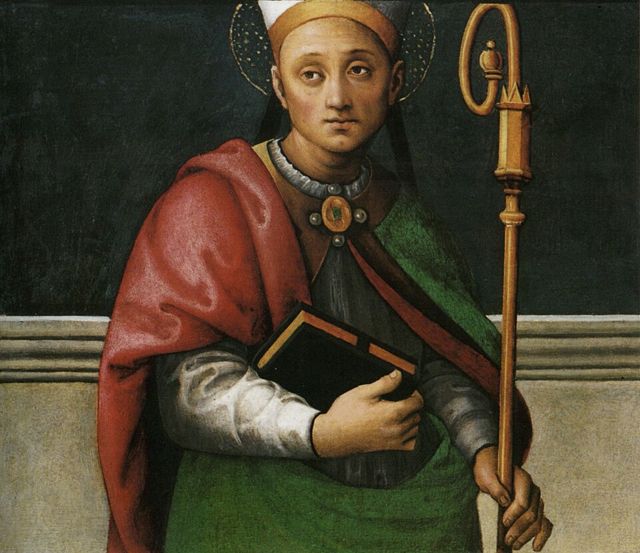
Nativity of Our Lady (September 8), with processions, " the grotesque magnificence of which attracts annually an increasing crowd of the curious.” 1 S. Willibrord is represented as an archbishop, holding the church of Utrecht in his hand, a barrel of wine which is said to have filled miraculously to supply his necessities, the bottle from which he satisfied twelve thirsty men, and the fountain he discovered, at his feet. The portable altar of S. Willibrord is preserved in the church of Our Lady “ ad Martyres” at Trfeves.