Baring-Gould’s sources: Anglican Martyrologies; Saussaye, in his Gallican Martyrology, the Belgian Martyrologies. His translation from the old wooden church at Landevenec, to a stone one, is commemorated on April 28th, and to Montreuil-sur-Mer, on August 1st. Authorities:—Three Lives; the first by an anonymous writer, given by the Bollandists, is full of fable, and by no means early. The second is still less trustworthy, and is given by Surius. The third is by Gurdestin, Monk of Landevenec. The life by Albert le Grand is deserving of notice, but the historical particulars are not accurate. There is great difficulty about this saint. It is probable that there were two of his name, and only by this means can the very different accounts of his life be reconciled. One Winwaloe is a native of Brittany, and a disciple of S. Corentine, and was translated to Montreuil. Another Winwaloe is a native of Britain, a disciple of S. Sampson, of Dol, and afterwards of S. Similian, abbot of Tauriac; and his body lies at Ghent. M. Ch. Barthelemy, in his "Annales Hagiologiques de la France," 5th cent., claims for the first anonymous life to have been written by a disciple of Winwaloe. But this is more than improbable. It has none of the elements of a contemporary account. The writer says that the name of the mother of the saint was not known; and he does not name his master in the religious life, S. Corentine or S. Budock, but calls him "a holy man," or "that man of God"; and the life, like all late compilations, gives scanty details of persons and places, but abounds in fables.
Winwaloe was born about the year 455; his father was Fragan, related to Conan Meriadec. Fragan was governor of Léon (Lyoness) and Cornonaille, under King Grallo, or Gradillon. Fragan married a noble and wealthy lady named Gwen, of the Three Breasts, and resided with her at Lesgwen, in the parish of Plonkin. By her he had a son, whom he called Gwenaloe, or "He that is white," on account of his beauty. When Winwaloe was about fifteen years old he was given to a holy man, S. Corentine, or S. Budock, it is uncertain which, together with his brothers, Gwethenoc and Jacut, and they lived together, serving God in the islet of Isle-vert.
One day that Winwaloe was with his father, a fleet of pirates appeared off the coast, and hovered about the harbour of Guic Sezne, near Lauvengat. S. Winwaloe is said in the popular tradition to have exclaimed on the occasion, Me a vel mil Guern , "I see a thousand sails;" and a cross which commemorates the spot is called therefrom to this day, Croas al mil Guern , "the cross of the thousand sails." The pirates landed, but Fragan, having gathered his retainers, fell upon them and utterly defeated them. Many were cut to pieces, and a few escaped in their vessels. During the combat, Winwaloe, like a second Moses, prayed with fervour; and after the victory he exhorted his father to employ the spoil they had taken in building a monastery on the spot where the battle took place, in Isel-Vez, in the parish of Plou-Nevez. He did so, and the monastery was called Loc-Christ.
After some years, Winwaloe left his master, and settled in the island of Sein, off the Point du Raz; but, finding it exposed to the full swell of the Atlantic, and to every gale, he was obliged to desert it, and found a more suitable place of settlement at Llandevenec, on the opposite side of the harbour of Brest, where he established a monastery, into which he gathered many disciples, and there, after many years, he died, standing at the altar, after having bestowed the kiss of peace on the brethren, on Saturday, the 3rd of March, in the first week in Lent [the forty days of fasting before Easter]; a date which may be either 507, 518, or 529.
Another version of the history of S. Winwaloe makes him to have been born in Wales, and to have had S. Budock for his preceptor.
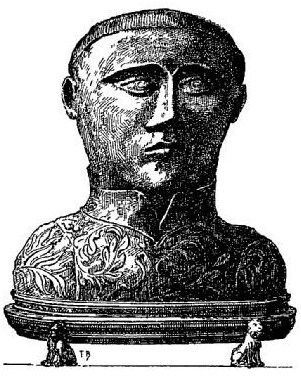
The body of S. Winwaloe is preserved at Montreuil-sur-Mer, whither it was translated through fear of the invasion of the Normans, after having first just found shelter at Ghent. The chasuble, alb and bell of S. Winwaloe, are preserved in the Jesuit Church of S. Charles, at Antwerp.
At the same time, the body of a S. Winwaloe is also at Blandinberg, near Ghent; and the story told of this saint is in many particulars like that of the S. Winwaloe at Montreuil, but it differs in others.
S. Winwaloe is represented in art vested as an abbot, with staff in one hand and bell in the other, standing by the sea, with the fish rising out of the water as if obeying the summons of his bell.