St. Wolfgang of Ratisbon

A shepherd who stayed with his people through hard times.

Read the essentials →
October 31 · Bishop

St. Wolfgang of Ratisbon

St. Wolfgang of Ratisbon

A shepherd who stayed with his people through hard times.

Traditional feast

October 31
1914 / pre-1969 calendar, per Baring-Gould (1897)

Current feast

October 31
Secondary source · Wikipedia

Represents

Bishop

Their story

Adapted in modern English from the Catholic Encyclopedia (1913) · original text below

Wolfgang was born about 934 into a family of Swabian counts and was schooled at the abbey of Reichenau. He later became a monk. At the request of St Ulrich and the Emperor Otto the Great, he was sent to preach to the Magyars, who had settled in Pannonia after their defeat at the Lechfeld.

In 972 he became Bishop of Ratisbon. He restored the abbey of St Emmeram's independence by giving it its own abbot again, and reformed the convents of the city. Once he withdrew as a hermit to a lonely place, now the Lake of St Wolfgang, until a hunter found him. He fell ill travelling on the Danube and died in the chapel of St Othmar at Pupping on 31 October 994.

Early life

The book says little or nothing about early life. This is how the account begins.

…the religious life. He received priest’s orders from S. Ulric of Augsburg, and at once went to Pilgrim, Bishop of Passau, and offered himself to do mission work in Pannonia. Nothing is related of this expedition, and probably it did not last long.

What they represent

How they teach us to live

Drawn from themes in the original account

Give to people in need. The account records care for the poor.

Share your faith, in words and by example. Preaching and conversion are central here.

Pray a little every day. Prayer runs all through this account.

Learn from the kind of life it was. A shepherd who stayed with his people through hard times.

From the Catholic Encyclopedia

1913 · 1338 words

Bishop of Ratisbon [Regensburg in Bavaria] (972-994), born about 934; died at the village of Pupping in upper Austria, 31 October, 994. The name Wolfgang is of early German origin. St. Wolfgang was one of the three brilliant stars of the tenth century, St. Ulrich, St. Conrad, and St. Wolfgang, which illuminated the early medieval period of Germany with the undying splendour of their acts and services. St. Wolfgang sprang from a family of Swabian counts of Pfullingen (Mon. Germ. His.: Script., X, 53). When seven years old he had an ecclesiastic as tutor at home; later he attended the celebrated monastic school on the Reichenau. Here he formed a strong friendship with Henry, brother of Bishop Poppo of Würzburg, whom he followed to Würzburg in order to attend at the cathedral school there the lectures of the noted Italian grammarian, Stephen of Novara. After Henry was made Archbishop of Trier in 956, he called his friend to Trier, where Wolfgang became a teacher in the cathedral school, and also laboured for the reform of the archdiocese, notwithstanding the enmity with which his efforts were met. Wolfgang's residence at Trier greatly influenced his monastic and ascetic tendencies, as here he came into connection with the great reformatory monastery of the tenth century, St. Maximin of Trier, where he made the acquaintance of Ramwold, the teacher of St. Adalbert of Prague. After the death (964) of Archbishop Henry of Trier, Wolfgang entered the Order of St. Benedict in the Abbey of Maria Einsiedeln, Switzerland, and was ordained priest by St. Ulrich in 968.

After their defeat in the battle of the Lechfeld (955), a victory gained with the aid of St. Ulrich, the heathen Magyars settled in ancient Pannonia [a Roman province roughly covering western Hungary and parts of Austria and Croatia]. As long as they were not converted to Christianity they remained a constant menace to the empire. At the request of St. Ulrich, who clearly saw the danger, and at the desire of the Emperor Otto the Great, St. Wolfgang, according to the abbey annals, was "sent to Magyars" as the most suitable man to evangelize them. He was followed by other missionaries sent by Bishop Piligrim of Nassau, under whose jurisdiction the new missionary region came. After the death of Bishop Michael of Ratisbon (23 September, 972) Bishop Piligrim obtained from the emperor the appointment of Wolfgang as Bishop of Ratisbon (Christmas, 972). Wolfgang's services in this new position were of the highest importance, not only for the diocese, but also for the cause of civilization. As Bishop of Ratisbon, Wolfgang became the tutor of Emperor St. Henry II, who learned from him the principles which governed his saintly and energetic life. Poppe, son of Margrave Luitpold, Archbishop of Trier (1016), and Tagino, Archbishop of Magdeburg (1004-1012), also had him as their teacher.

St. Wolfgang deserves credit for his disciplinary labours in his diocese. His main work in this respect was connected with the ancient and celebrated Abbey of St. Emmeram which he reformed by granting it once more abbots of its own, thus withdrawing it from the control of the bishops of Ratisbon, who for many years had been abbots in commendam, a condition of affairs that had been far from beneficial to the abbey and monastic life. In the Benedictine [monks following the Rule of St. Benedict] monk Ramwold, whom St. Wolfgang called from St. Maximin at Trier, St. Emmeram received a capable abbot (975). The saint also reformed the convents of Obermunster and Niedermunster at Ratisbon, chiefly by giving them as an example the convent of St. Paul, Mittelmunster, at Ratisbon, which he had founded in 983. He also co-operated in the reform of the ancient and celebrated Benedictine Abbey of Altach (Nieder-altach), which had been founded by the Agilolf dynasty, and which from that time took on new life. He showed genuine episcopal generosity in the liberal manner with which he met the views of the Emperor Otto II [German king and emperor, co-ruler with his father Otto I from 967 and sole ruler 973–983] regarding the intended reduction in size of his diocese for the benefit of the new Diocese of Prague (975), to which St. Adalbert was appointed first bishop. As prince of the empire he performed his duties towards the emperor and the empire with the utmost scrupulousness and, like St. Ulrich, was one of the mainstays of the Ottonian policies. He took part in the various imperial Diets, and, in the autumn of 978, accompanied the Emperor Otto II on his campaign to Paris, and took part in the great Diet of Verona in June, 983.

Read the rest of the article

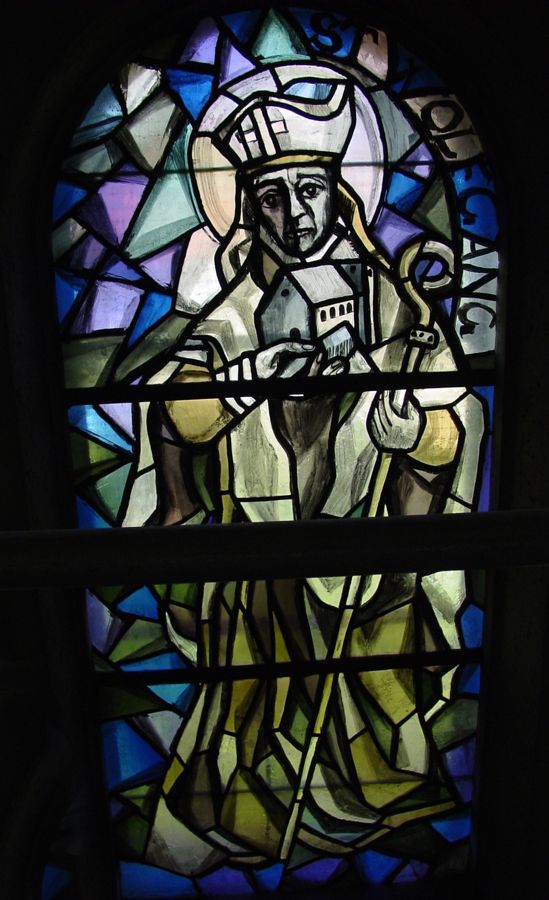
St. Wolfgang withdrew as a hermit to a solitary spot, now the Lake of St. Wolfgang, apparently on account of a political dispute, but probably in the course of a journey of inspection to the monastery of Mendsee which was under the direction of the bishops of Ratisbon. He was discovered by a hunter and brought back to Ratisbon. While travelling on the Danube to Pöchlarn in Lower Austria, he fell ill at the village of Pupping, which is between Efferding and the market town of Aschach near Linz, and at his request was carried into the chapel of St. Othmar at Pupping, where he died. His body was taken up the Danube by his friends Count Aribo of Andechs and Archbishop Hartwich of Salzburg to Ratisbon, and was solemnly buried in the crypt of St. Emmeram. Many miracles were performed at his grave; in 1052 he was canonized. Soon after his death many churches chose him as their patron saint, and various towns were named after him. In Christian art he has been especially honoured by the great medieval Tyrolese painter, Michael Pacher (1430-1498), who created an imperishable memorial of him, the high altar of St. Wolfgang. In the panel pictures which are now exhibited in the Old Pinakothek at Munich are depicted in an artistic manner the chief events in the saint's life. The oldest portrait of St. Wolfgang is a miniature, painted about the year 1100 in the celebrated Evangeliary of St. Emmeram, now in the library of the castle cathedral at Cracow. A fine modern picture by Schwind is in the Schak Gallery at Munich. This painting represents the legend of Wolfgang forcing the devil to help him to build a church. In other paintings he is generally depicted in episcopal dress, an axe in the right hand and the crozier in the left, or as a hermit in the wilderness being discovered by a hunter. The axe refers to an event in the life of the saint. After having selected a solitary spot in the wilderness, he prayed and then threw his axe into the thicket; the spot on which the axe fell he regarded as the place where God intended he should build his cell. This axe is still shown in the little market town of St. Wolfgang which sprang up on the spot of the old cell. At the request of the Abbey of St. Emmeram, the life of St. Wolfgang was written by Othlo, a Benedictine monk of St. Emmeram about 1050. This life is especially important for the early medieval history both of the Church and of civilization in Bavaria and Austria, and it forms the basis of all later accounts of the saint. The oldest and best manuscript of this "Life" is in the library of the Abbey of Maria Einsiedeln in Switzerland (MS. No. 322), and has been printed with critical notes in "Mon. Germ. His.: Script.", IV, 524-542. It has also been printed in, "Acta SS.":, II November, (Brussels, 1894), 529-537; "Acta SS. O. S. Ben.", V, 812-833; and in P.L., CXLVI, 395-422.

Der hl. Wolfgang, Bischof von Regensburg, hist. Festschrift z. jahr. Gedachtnisse seines Todes, ed., in connection with numerous historical scholars, by MEHLER (Ratisbon, 1894), among the chief collaborators on this work being BRAUNMULLER, RINGHOLZ (of Einsiedeln), and DANNERBAUER; KOLBE, Die Verdienste des Bischofs Wolfgang v. R. um das Bildungswesen Suddeutschlands. Beitrag z. Gesch. der Padogogik des X und XI Jahrhunderis (Breslau, 1894); WATTENBACH, Deutschlands Geschichtsquellen im Mittelalter, I (Berlin, 1904), 449-452; DETZEL, Christl. Iknographie, II (Freiburg, 1896), 683; POTTHAST, Bibl. medii aevi, II (Berlin, 1896), 1641.

Read more

The full original · 1098 words

Read Baring-Gould’s full account

Baring-Gould’s sources: Roman and German Martyrologies. Authority: — A Life by Othlo, written about A.D. 1050. There is also a metrical Life of S. Wolfgang, but of no great value in comparison with the other, which is a valuable contribution to the history of Austria and Bavaria in the 10th cent. The Life by Othlo is in Pertz. Mon. Ger. v. p.812, and Mabillon, Acta SS. O.S.B. saec. v. p. 788. Amulf of S. Emmeran also recast this same Life in the form of a dialogue.] Wolfgang, a native of Swabia, not of noble birth, was educated at Reichenau, in the Lake of Constance. There he contracted a warm friendship with Henry, son of noble parents in Swabia, afterwards Bishop of Trfeves. He accompanied Henry to Wurzburg, to finish his studies in the city of which Henry’s brother Poppo was bishop, as well as burgrave. There he remained till Henry was appointed to the bishopric of Trfeves, when he followed him thither and remained as his chaplain till his death in 964, when he retired to Einsiedeln in Switzerland, and devoted himself to 1 And yet the body was fifty-five years under water ! 6*. Wolfgang.

…the religious life. He received priest’s orders [ordination; “orders” means the sacrament by which deacons, priests and bishops are ordained] from S. Ulric of Augsburg [St. Ulrich, bishop of Augsburg 923–973], and at once went to Pilgrim, Bishop of Passau [Pilgrim (Piligrim), bishop of Passau 971–991, who promoted missions to the Hungarians], and offered himself to do mission work in Pannonia [a Roman province roughly covering western Hungary and parts of Austria and Croatia]. Nothing is related of this expedition, and probably it did not last long. He was recalled by Pilgrim in 972 to fill the vacant see of Ratisbon [a bishop’s “see” is his diocese, named from his seat (Latin sedes)], which Otho II [German king and emperor, co-ruler with his father Otto I from 967 and sole ruler 973–983]. conferred on him with staff and ring at Frankfort Thus invested with the temporalities [the lands and income attached to a bishopric], he went to Ratisbon to be instituted and enthroned. Shortly after he received episcopal consecration from the hands of Frederick, Archbishop of Salzburg [Frederick I, archbishop of Salzburg 958–991].

He set to work at once to remedy several abuses. The bishop of Ratisbon [Regensburg in Bavaria] was also abbot of the Benedictine [monks following the Rule of St. Benedict] monastery there, drawing its revenues, and leaving the monks not only without control, but in absolute indigence, so that they had recourse to shifts to get food as pitiable as they were disgraceful. Wolfgang summoned an old brother chaplain from Trfeves, on whom he could rely, constituted him abbot, and resigned into his hands the whole of the revenues of the abbey. He next reformed two communities of religious women who were not living with that sobriety and unworldliness that behoved them. A saint buried in one of these convents appeared to him with dripping shroud, and informed him that his linen vesture was soaked with tears caused by the scandalous living of the sisters. One of these communities seems not really to have been, strictly speaking, religious, but to have been a congregation of ladies living together under no fixed rule. Wolfgang took some relics [the bodily remains of a saint, or objects they used, kept with honor] and put them in a cavity of the altar-slab on the left side as he celebrated in their chapel one day, and prayed for guidance. If the relics lay there as he had placed them, then the ladies were to be left to live as seculars, but if they transferred themselves to the cavity on the right side, then it would be a token to him that he must bind them by rule and enclose them. During the saying of mass, the bones hopped over his fingers from one side of the altar to the other, and relying on this portent he cloistered the sisters. One year the vintage had failed, and some of the country priests took to using water in their chalices for mass. The bishop shed floods of tears when he heard of this, and threw open his episcopal cellars to the priests of his whole diocese. He was diligent also to see that the clergy lived in continence, and that the churches were provided with books, relics, vestments, and sacred vessels.

His charity and kindness to the poor knew no bounds. One pretty story of his goodness reminds one of Victor Hugo’s good bishop in “ Les Misdrables.” A poor man in such tatters that his nakedness could scarce be covered, crept one day into the bishop’s bedroom, and cut off a large piece of his bed-curtain. One of the servants saw the fellow making off with the spoil, gave chase, and caught him. He brought the thief before the bishop, who asked the man the reason of his having stolen the bedcurtain. The wretch showed his rags; he wanted to make a tunic to cover his nudity. “ The blame attaches not to you,” said Wolfgang, “ but to my servants, who ought to keep a better watch over my property. Go in peace. I give you the piece of damask, and no one will blame you for dressing in a tunic which has been given you by the bishop.”

Several miracles are recorded of him. One day he was preaching in the cathedral at Ratisbon, when a dark cloud came over the sky, and the air grew so thick, probably with blight, that the congregation were frightened. They paid no attention to the sermon, but began to cry out, some saying there must be a conflagration, others that a thunderstorm was coming on, and they rushed tumultuously out of the cathedral. Wolfgang knew better than to attribute the dark cloud to natural causes. None S. Wolfgang.

but the devil would have sought to interfere with his sermon, interrupting it before he came to the most impressive passages, and he accordingly lifted his voice in prayer that the devil and all his tricks might be brought to naught. Soon after the cloud passed off to leeward, and nothing and nobody was the worse.

On another occasion he was arguing with one of his clergy, when the man happening to differ from him on some point connected with the merits of a monastic life, S. Wolfgang. cursed his eyes.1 When the saint went to Divine Service in the cathedral not long after, he saw the man with his cowl drawn over his eyes. He sent to ask the reason, and was told that the priest was suffering from inflammation. He called him to his private apartment, and signed his eyes with his finger, but told the clerk to use lotions so that the miraculous cure wrought by his benediction might be attributed to the lotions and not to the benediction; and begged him to say nothing about it — his biographer says, about the miraculous cure; we may perhaps think, about the malediction on his eyes, which is perhaps not such as a bishop and a saint ought to have used. S. Wolfgang allowed Bohemia to be cut off from his diocese and constituted into another see, and Dietmar, abbot of Magdeburg, was appointed first bishop of Prague (973).

The holy bishop, after a life spent in good works, was on his way to Pechlava in Lower Austria, when he fell ill at was brought back to Ratisbon, and placed in the church of S. Emmeran. In the year 1032, Pope Leo IX. came to Germany to reconcile the Emperor Henry III. and the King of Hungary. He then canonized S. Wolfgang, and had his body taken up and enshrined. According to a popular v 1 “ S&nctus Famulus Domini... paullulum irascens, devotando suppliciter suit maledictum oculis ingescit.”

tradition, when S. Wolfgang entered Ratisbon on his enthronization, he asked the people if they would rather have his body or his miracles, when he was dead. They elected to have his body, as, without that, they thought they could not have miracles. They have his body, but no miracles are wrought by it, whereas in other churches dedicated to him, miracles are believed to be wrought by his intercession. Altar at Ratisbon.

Printed by Ballantyne, Hanson & Co. Edinburgh &• London I
Feast days

Feast: October 31

Nine days · Free

Pray the novena
with us.

One short email a day for nine days. The day's prayer, a line from St. Wolfgang of Ratisbon's story, and a nudge to keep going.

Also on October 31
St. Stachys

St. Stachys

October 31 · Bishop
A

Sts. Amplias

October 31 · Martyrs
N

Sts. Nemesius

October 31 · Martyr, Virgin
← All 1726 saints in the library
Sources & notes

Feast-day sources

Story sources

Sources

Credits

Image: Pfarrkirche Liesing - Wolfgang.jpg · No machine-readable author provided. JJFox~commonswiki assumed (based on copyright claims). · Public domain, via Wikimedia Commons

From Sabine Baring-Gould, The Lives of the Saints, new edition in 16 vols. (London: John C. Nimmo, 1897–98); text from the Internet Archive scan (OCR, lightly cleaned; errors possible). Public domain.

Image: No machine-readable author provided. JJFox~commonswiki assumed (based on copyright claims)., Wikimedia Commons (Public domain)

From “Catholic Encyclopedia (1913)/St. Wolfgang,” The Catholic Encyclopedia (New York: Robert Appleton Company, 1907–1914), via Wikisource. Public domain. Matched by name and feast date; text unedited except for our bracketed notes in grey.

From Sabine Baring-Gould, The Lives of the Saints, new edition in 16 vols. (London: John C. Nimmo, 1897–98); text from the Internet Archive scan (OCR, lightly cleaned; errors possible). Public domain in the United States. Reproduced unedited, except for short bracketed notes in grey that we added to explain names and terms (“S.” is the old abbreviation for Saint). Some history and judgments reflect 19th-century scholarship.