A shepherd who stayed with his people through hard times.
Read the essentials →A shepherd who stayed with his people through hard times.
Read the essentials →A shepherd who stayed with his people through hard times.
October 31
October 31
Bishop
…the religious life. He received priest’s orders from S. Ulric of Augsburg, and at once went to Pilgrim, Bishop of Passau, and offered himself to do mission work in Pannonia. Nothing is related of this expedition, and probably it did not last long.
Give to people in need. The account records care for the poor.
Share your faith, in words and by example. Preaching and conversion are central here.
Pray a little every day. Prayer runs all through this account.
Learn from the kind of life it was. A shepherd who stayed with his people through hard times.
…the religious life. He received priest’s orders [ordination; “orders” means the sacrament by which deacons, priests and bishops are ordained] from S. Ulric of Augsburg [St. Ulrich, bishop of Augsburg 923–973], and at once went to Pilgrim, Bishop of Passau [Pilgrim (Piligrim), bishop of Passau 971–991, who promoted missions to the Hungarians], and offered himself to do mission work in Pannonia [a Roman province roughly covering western Hungary and parts of Austria and Croatia]. Nothing is related of this expedition, and probably it did not last long. He was recalled by Pilgrim in 972 to fill the vacant see of Ratisbon [a bishop’s “see” is his diocese, named from his seat (Latin sedes)], which Otho II [German king and emperor, co-ruler with his father Otto I from 967 and sole ruler 973–983]. conferred on him with staff and ring at Frankfort Thus invested with the temporalities [the lands and income attached to a bishopric], he went to Ratisbon to be instituted and enthroned. Shortly after he received episcopal consecration from the hands of Frederick, Archbishop of Salzburg [Frederick I, archbishop of Salzburg 958–991].
He set to work at once to remedy several abuses. The bishop of Ratisbon [Regensburg in Bavaria] was also abbot of the Benedictine [monks following the Rule of St. Benedict] monastery there, drawing its revenues, and leaving the monks not only without control, but in absolute indigence, so that they had recourse to shifts to get food as pitiable as they were disgraceful. Wolfgang summoned an old brother chaplain from Trfeves, on whom he could rely, constituted him abbot, and resigned into his hands the whole of the revenues of the abbey. He next reformed two communities of religious women who were not living with that sobriety and unworldliness that behoved them. A saint buried in one of these convents appeared to him with dripping shroud, and informed him that his linen vesture was soaked with tears caused by the scandalous living of the sisters. One of these communities seems not really to have been, strictly speaking, religious, but to have been a congregation of ladies living together under no fixed rule. Wolfgang took some relics [the bodily remains of a saint, or objects they used, kept with honor] and put them in a cavity of the altar-slab on the left side as he celebrated in their chapel one day, and prayed for guidance. If the relics lay there as he had placed them, then the ladies were to be left to live as seculars, but if they transferred themselves to the cavity on the right side, then it would be a token to him that he must bind them by rule and enclose them. During the saying of mass, the bones hopped over his fingers from one side of the altar to the other, and relying on this portent he cloistered the sisters. One year the vintage had failed, and some of the country priests took to using water in their chalices for mass. The bishop shed floods of tears when he heard of this, and threw open his episcopal cellars to the priests of his whole diocese. He was diligent also to see that the clergy lived in continence, and that the churches were provided with books, relics, vestments, and sacred vessels.
His charity and kindness to the poor knew no bounds. One pretty story of his goodness reminds one of Victor Hugo’s good bishop in “ Les Misdrables.” A poor man in such tatters that his nakedness could scarce be covered, crept one day into the bishop’s bedroom, and cut off a large piece of his bed-curtain. One of the servants saw the fellow making off with the spoil, gave chase, and caught him. He brought the thief before the bishop, who asked the man the reason of his having stolen the bedcurtain. The wretch showed his rags; he wanted to make a tunic to cover his nudity. “ The blame attaches not to you,” said Wolfgang, “ but to my servants, who ought to keep a better watch over my property. Go in peace. I give you the piece of damask, and no one will blame you for dressing in a tunic which has been given you by the bishop.”
Several miracles are recorded of him. One day he was preaching in the cathedral at Ratisbon, when a dark cloud came over the sky, and the air grew so thick, probably with blight, that the congregation were frightened. They paid no attention to the sermon, but began to cry out, some saying there must be a conflagration, others that a thunderstorm was coming on, and they rushed tumultuously out of the cathedral. Wolfgang knew better than to attribute the dark cloud to natural causes. None S. Wolfgang.
but the devil would have sought to interfere with his sermon, interrupting it before he came to the most impressive passages, and he accordingly lifted his voice in prayer that the devil and all his tricks might be brought to naught. Soon after the cloud passed off to leeward, and nothing and nobody was the worse.
On another occasion he was arguing with one of his clergy, when the man happening to differ from him on some point connected with the merits of a monastic life, S. Wolfgang. cursed his eyes.1 When the saint went to Divine Service in the cathedral not long after, he saw the man with his cowl drawn over his eyes. He sent to ask the reason, and was told that the priest was suffering from inflammation. He called him to his private apartment, and signed his eyes with his finger, but told the clerk to use lotions so that the miraculous cure wrought by his benediction might be attributed to the lotions and not to the benediction; and begged him to say nothing about it — his biographer says, about the miraculous cure; we may perhaps think, about the malediction on his eyes, which is perhaps not such as a bishop and a saint ought to have used. S. Wolfgang allowed Bohemia to be cut off from his diocese and constituted into another see, and Dietmar, abbot of Magdeburg, was appointed first bishop of Prague (973).
The holy bishop, after a life spent in good works, was on his way to Pechlava in Lower Austria, when he fell ill at was brought back to Ratisbon, and placed in the church of S. Emmeran. In the year 1032, Pope Leo IX. came to Germany to reconcile the Emperor Henry III. and the King of Hungary. He then canonized S. Wolfgang, and had his body taken up and enshrined. According to a popular v 1 “ S&nctus Famulus Domini... paullulum irascens, devotando suppliciter suit maledictum oculis ingescit.”
tradition, when S. Wolfgang entered Ratisbon on his enthronization, he asked the people if they would rather have his body or his miracles, when he was dead. They elected to have his body, as, without that, they thought they could not have miracles. They have his body, but no miracles are wrought by it, whereas in other churches dedicated to him, miracles are believed to be wrought by his intercession. Altar at Ratisbon.
Printed by Ballantyne, Hanson & Co. Edinburgh &• London I
Feast: October 31
One short email a day for nine days. The day's prayer, a line from St. Wolfgang of Ratisbon's story, and a nudge to keep going.
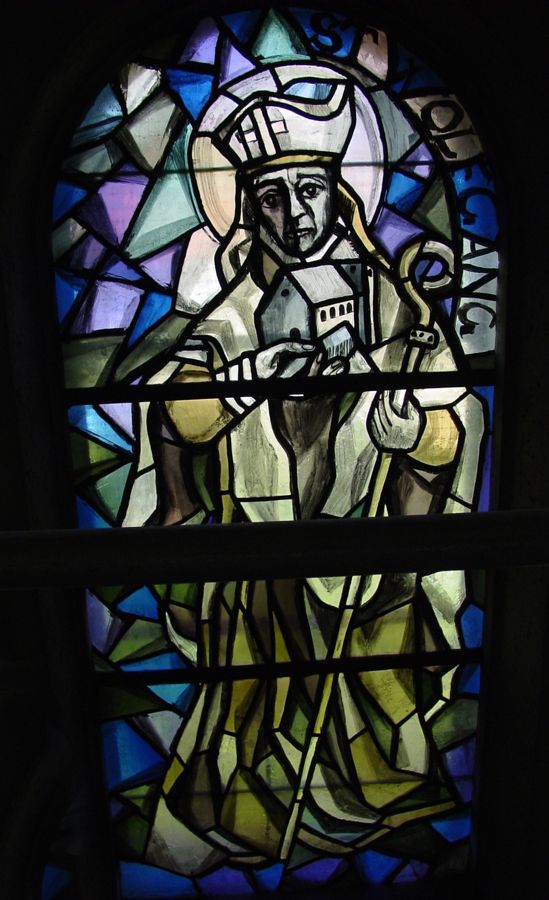
Image: Pfarrkirche Liesing - Wolfgang.jpg · No machine-readable author provided. JJFox~commonswiki assumed (based on copyright claims). · Public domain, via Wikimedia Commons
From Sabine Baring-Gould, The Lives of the Saints, new edition in 16 vols. (London: John C. Nimmo, 1897–98); text from the Internet Archive scan (OCR, lightly cleaned; errors possible). Public domain.
Image: No machine-readable author provided. JJFox~commonswiki assumed (based on copyright claims)., Wikimedia Commons (Public domain)
From Sabine Baring-Gould, The Lives of the Saints, new edition in 16 vols. (London: John C. Nimmo, 1897–98); text from the Internet Archive scan (OCR, lightly cleaned; errors possible). Public domain in the United States. Reproduced unedited, except for short bracketed notes in grey that we added to explain names and terms (“S.” is the old abbreviation for Saint). Some history and judgments reflect 19th-century scholarship.