St. Zita

A whole life given to God with an undivided heart.

Read the essentials →
April 27 · Virgin

St. Zita

St. Zita

A whole life given to God with an undivided heart.

Traditional feast

April 27
1914 / pre-1969 calendar, per Baring-Gould (1897)

Current feast

April 27
Secondary source · Wikipedia

Represents

Virgin

Their story

Adapted in modern English from the Catholic Encyclopedia (1913) · original text below

Zita was born early in the thirteenth century to a poor family at Monsagrati, a village near Lucca in Tuscany. Her cheerful nature and her mother's teaching made her gentle, modest and hard-working. At twelve she went into service with the Fatinelli family of Lucca.

She did her work as if serving God rather than man, and even made up for the faults of her fellow servants. Instead of love, this earned her years of ill-treatment from them, and through their accusations from her employers as well. None of it could take away her inner peace, her love for those who wronged her, or her respect for her masters. Her meekness finally won them over, and she was put in charge of the whole household. In that position she was kind to all the servants and never made them pay for the wrongs she had suffered. She was strict only to keep vice out, and she excused others' faults to their employers. She gave generously to those truly in need.

She died at Lucca on 27 April 1271. Many miracles followed, and she was so venerated that Dante and Fazio degli Uberti refer to Lucca simply as 'Santa Zita'. Her tomb was found in the church of San Frediano in 1580, and her cult was formally approved in 1696. She is the patroness of domestic servants.

Struggles & surrender

What they wrestled with, and how they gave it to God

  • Years of ill-treatment ·
    Zita's diligence won her not friendship but years of mistreatment from her fellow servants and, through their accusations, from her employers. The source says none of it took away her inner peace or her love for those who wronged her.

Early life

The book says little or nothing about early life. This is how the account begins.

On another occasion she started for a long pilgrimage to a church near the sea, five miles beyond Pisa, and Pisa is some ten miles from Lucca. She started with a companion, who, however, left her at Pisa, and when her devotions were ended Zita had to return alone to Lucca. In passing through Pisa, as evening fell, she was invited by a friend to sleep there; but Zita had her work to do the following morning for her master and mistress, and was resolved not to allow her pilgrimage to interfere with that; so she pushed on.

What they represent

How they teach us to live

Drawn from themes in the original account

Learn from the kind of life it was. A whole life given to God with an undivided heart.

Keep their day. Remember them on April 27 with a short prayer, and ask for their help.

From the Catholic Encyclopedia

1913 · 472 words

Model and heavenly patroness of domestic servants, born early in the thirteenth century of a poor family at Montsegradi, a little village near Lucca, in Tuscany; died at Lucca, 27 April, 1271. A naturally happy disposition and the teaching of a virtuous mother, aided by Divine grace, developed in the child's soul that sweetness and modesty of character and continual and conscientious application to work which constituted her especial virtues. At the age of twelve she entered the service of the Fatinelli family of Lucca. Her piety and the exactitude with which she discharged her domestic duties, in which she regarded herself as serving God rather than man, even supplying the deficiencies of her fellow servants, far from gaining for her their love and esteem and that of her employers rather brought upon her every manner of ill-treatment of both the former and, through their accusations, of the latter. The incessant ill-usage, however, was powerless to deprive her of her inward peace, her love of those who wronged her, and her respect for her employers. By this meek and humble self-restraint she at last succeeded in overcoming the malice of her fellow-servants and her employers, so much so that she was placed in charge of all the affairs of the house.

In her position of command over all the servants she treated all with kindness, not exacting from them any reckoning for the wrongs she had for so many years suffered from them. She was always circumspect, and only severe when there was a question of checking the introduction of vice among the servants. On the other hand, if any of them had been guilty of shortcomings, she took upon herself to excuse or defend them to their employers. Using the ample authority given her by her employers, she was generous in almsgiving, but careful to assist only those really in need. After her death numerous miracles were wrought at her intercession, so that she came to be venerated as a saint in the neighbourhood of Lucca, and the poets Fazio degli Uberti (Dittamonde, III, 6) and Dante (Inferno, XI, 38) both designate the city of Lucca simply as "Santa Zita". The office in her honour was approved by Leo X.

In 1580 her tomb was discovered in the Church of S. Frediano; thus was suggested the solemn approbation of her cult, which was granted by Innocent XII in 1696. The earliest biography of the saint is preserved in an anonymous manuscript belonging to the Fatinelli family which was published at Ferrara in 1688 by Monsignor Fatinelli, "Vita beatf Zitf virginis Lucensis ex vetustissimo codice manuscripto fideliter transumpta". For his fuller "Vita e miracoli di S. Zita vergine lucchese" (Lucca, 1752) Bartolomeo Fiorito has used this and other notices, especially those taken from the process drawn up to prove the immemorial cult.

Read more

The full original · 447 words

Read Baring-Gould’s full account

Baring-Gould’s sources: Roman Martyrology. Beatified by Innocent XII. in 1696, and canonized by Leo X. Authority: — A life written by a contemporary.] S. Zita was the child of poor parents at Bozzanello, a village on the slopes of Monte Sagrate, three leagues from Lucca. She was bom in 1218, and at the age of twelve was sent into domestic service to Pagano de Fatinelli, a nobleman of Lucca. She remained all her life in the same house, endearing herself to her master and mistress and afterwards to their son and his wife. Every morning she rose early to attend the first mass, and open her heart to her Lord and God. One Christmas Eve the cold was intense, and she was preparing to go to church, when her master, compassionating her thin gown, threw his furred mantle over her shoulders, and bade her wrap herself in that against frost and snow, but to be sure to bring it him back again. At the church door, since then called the 1 angel door, she saw a poor man crouching, numb with cold, who held up to her a ghastly white face, and extended his shaking hands for an alms. She instantly wrapped the warm mantle round him, bidding him wear it till she came out of church. When the service was over she could not find the beggar. He had made off with the cloak, and she returned home, alarmed and distressed. As may be expected, she met with a severe rebuke, which grieved her, however, less than having caused annoyance to a kind I April *7.] master, and violated, unintentionally, his confidence. But next morning a stranger came to the door, and without a word of explanation left the mantle in the hands of Zita, and she, amazed and grateful, could not but regard him as an angel Many pretty stories are told of this poor and pious servant maid, who walked in such close communion with the unseen world, that her story abounds in marvels, and we are not altogether sure where natural events end and marvels begin. One eve of S. Mary Magdalene’s Day she made a pilgrimage to a church under that invocation, two miles from Lucca; household affairs detained her till evening, and she was surprised by night However, she pressed on to the church; but when she reached it, the darkness was complete, the sky overcast with rain-clouds, and the doors of the little pilgrimage-shrine were closed. She was very tired, and sinking on her knees before the door, began to pray. But the long and toilsome mountain walk, at the end of a hard day’s work, had exhausted her, and she fell asleep. The rain poured down, and the wind moaned about the eaves of the solitary church; but still she slept on, with a little votive candle she had brought with her, standing by her side. Suddenly she awoke, the wan day was breaking in the East, and at her side twinkled the candle, lit by unknown hands, and angel wings had been spread over her, so that her garments were not soaked by the heavy rain.

On another occasion she started for a long pilgrimage to a church near the sea, five miles beyond Pisa, and Pisa is some ten miles from Lucca. She started with a companion, who, however, left her at Pisa, and when her devotions were ended Zita had to return alone to Lucca. In passing through Pisa, as evening fell, she was invited by a friend to sleep there; but Zita had her work to do the following morning for her master and mistress, and was resolved not to allow her pilgrimage to interfere with that; so she pushed on. On reaching the baths, some way further, an acquaintance who lived there also pressed her to stay, but she again refused. As she traversed the mountain of S. Giuliano, and night gathered in dark, an aged hermit who dwelt there advised her not to risk prosecuting her journey by night, and offered her shelter. But no, her strong sense of duty thrust her on. Further on she passed a castle, and the sentinels compassionating her, and knowing that the road was unsafe, on account of robbers, offered her hospitality. This was refused, and she pressed on, though her limbs tottered, and she was faint, having scarcely eaten anything all day. At length she sank down, dead-beat, on the side of a little spring, at the first cock-crow, and dipping her mouth into the water took a refreshing draught At that moment a woman stood beside her, and touching her asked if she were going further. Zita rose, and, rejoiced to meet with a companion, walked on at her side. And now her exhaustion seemed to go, and her vigour to be recruited, as she made the rest of her journey with her unknown companion. When they reached the covered bridge over the Ozzorio, the gate to it was locked, but it opened before them. It was the same with the gate of the city. Zita sought her home, and as she turned on the doorsteps to thank her companion, she had vanished; then she hoped, and hoping believed, that the Virgin Mother had been at her side. Zita died in her sixtieth year, beloved by all in the house where she had served so faithfully for forty-eight years, and it is said that when she died a bright star shone over Lucca. Some of her relics [the bodily remains of a saint, or objects they used, kept with honor] are preserved in her chapel on Monte Motrone, near Lucca; others at Genoa, in a church dedicated to her; others at Parma. A toe was given by the bishop of Lucca to Sir William Langstow, who built a chapel at Ely to her honour, in 1456. Other relics are in Portugal.:ed by GoO^lC
Feast days

Feast: April 27

Nine days · Free

Pray the novena
with us.

One short email a day for nine days. The day's prayer, a line from St. Zita's story, and a nudge to keep going.

Also on April 27
Sts. Vitalis and Valeria

Sts. Vitalis and Valeria

April 28 · Martyrs
T

Sts. Theodora and Didymus

April 28 · Martyrs
C

St. Cronan of Roscrea

April 28 · Feast
← All 1726 saints in the library
Sources & notes

Feast-day sources

Story sources

Sources

Credits

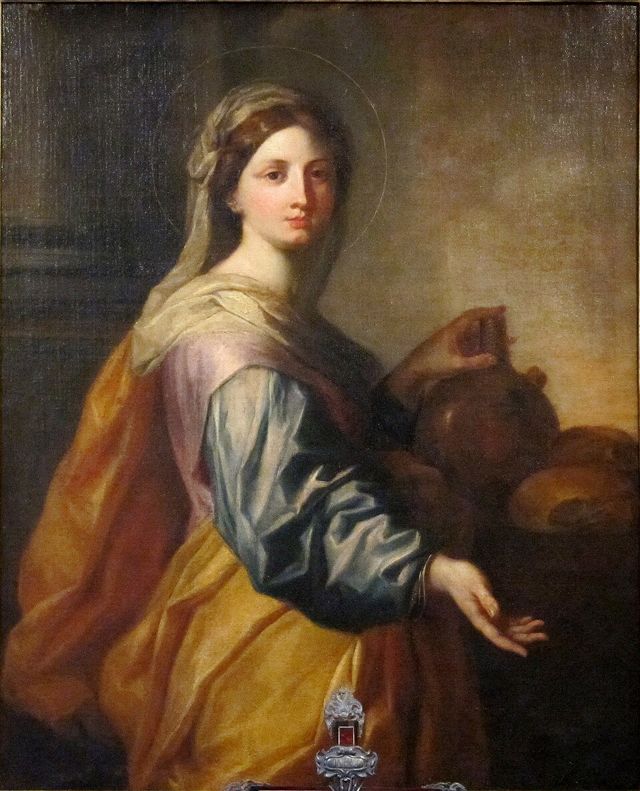
Image: Lille Hospice comt Vuez Ste Zite.JPG · Arnould de Vuez · CC BY-SA 3.0, via Wikimedia Commons

From Sabine Baring-Gould, The Lives of the Saints, new edition in 16 vols. (London: John C. Nimmo, 1897–98); text from the Internet Archive scan (OCR, lightly cleaned; errors possible). Public domain.

Image: Arnould de Vuez, Wikimedia Commons (CC BY-SA 3.0)

From “Catholic Encyclopedia (1913)/St. Zita,” The Catholic Encyclopedia (New York: Robert Appleton Company, 1907–1914), via Wikisource. Public domain. Matched by name and feast date; text unedited except for our bracketed notes in grey.

From Sabine Baring-Gould, The Lives of the Saints, new edition in 16 vols. (London: John C. Nimmo, 1897–98); text from the Internet Archive scan (OCR, lightly cleaned; errors possible). Public domain in the United States. Reproduced unedited, except for short bracketed notes in grey that we added to explain names and terms (“S.” is the old abbreviation for Saint). Some history and judgments reflect 19th-century scholarship.