Their story
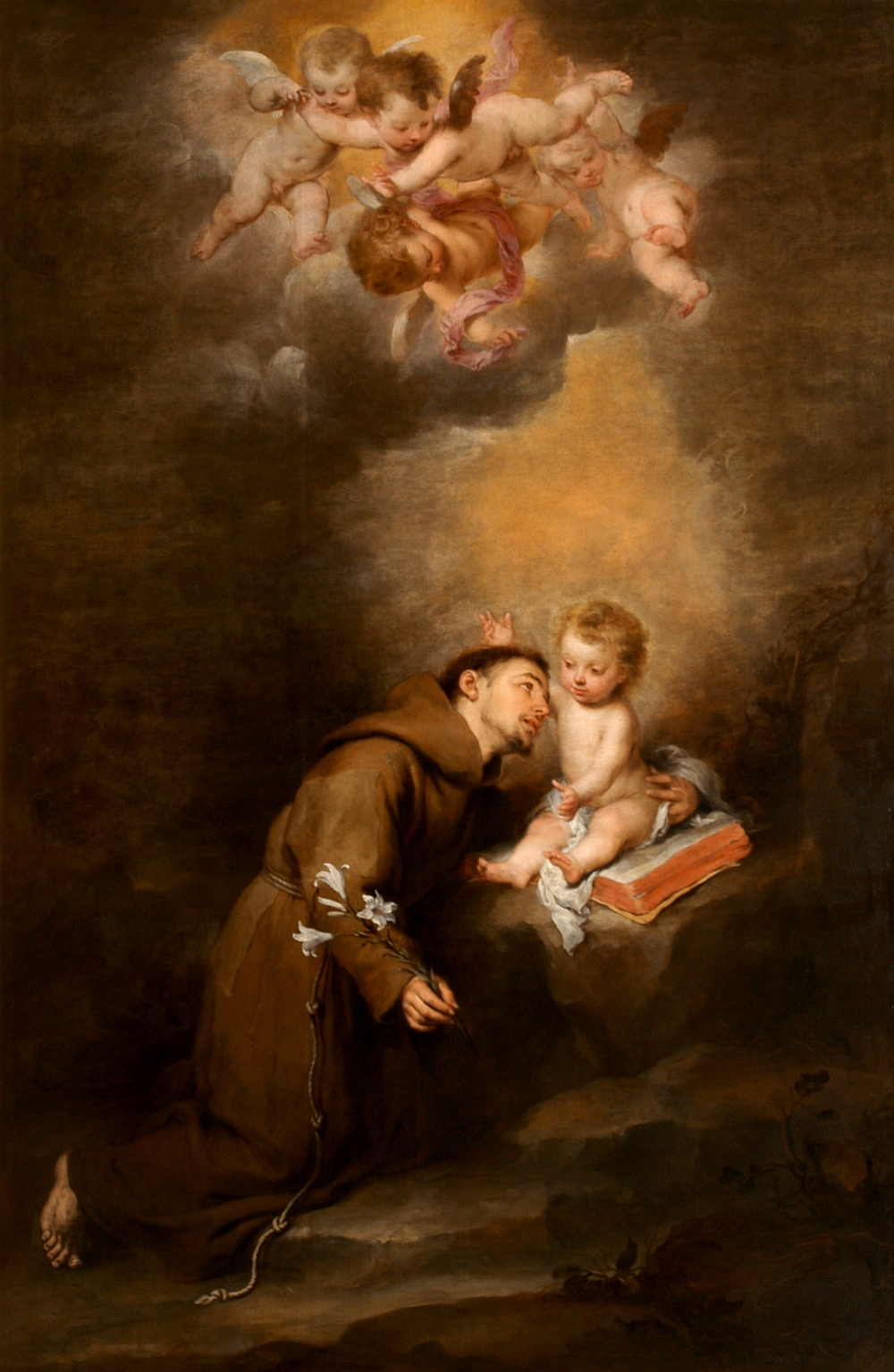
Anthony was born Fernando Martins around 1195 in Lisbon, Portugal, to a well-off family. He joined the Augustinian (religious who follow the Rule of St. Augustine) canons and studied seriously at Coimbra. In 1220 the bodies of five Franciscan (the order of friars founded by St. Francis of Assisi) friars martyred in Morocco were brought back through Coimbra. Moved by them, Fernando joined the new Franciscans, took the name Anthony, and set out for Morocco to preach and perhaps die there himself.
He fell ill almost immediately and had to sail home, but a storm drove his ship to Sicily. He ended up unnoticed in a small Italian hermitage, washing dishes. At an ordination in Forlì around 1222 no one had prepared a sermon, and he was told to say something. His learning and fire stunned everyone. Francis himself later wrote to him approving his teaching theology to the friars. He preached against heresy in Italy and southern France to huge crowds.
He died near Padua on June 13, 1231, aged about 36, and was canonized (officially declared a saint by the pope) less than a year later, one of the fastest canonizations in history. In 1946 he was named a Doctor of the Church (a title the pope gives to a saint whose teaching is of special value to the whole Church). People love Anthony because his own life went badly off plan—failed missionary, shipwreck, obscurity—and God used the detour.
The short version
Anthony (1195–1231) was born in Lisbon, Portugal, joined the Franciscans, and became one of the most powerful preachers of his day in Italy and France. He died near Padua on June 13, 1231. Pope Gregory IX canonized him in 1232, less than a year after his death, and Pope Pius XII named him a Doctor of the Church in 1946.
Three things you might not know
He was canonized less than a year after he died.
The responsory Si quaeris, written by Julian of Speyer about 1233, already says lost things are restored through him.
His devotions are kept on Tuesdays, traditionally nine or thirteen in a row.
The novena
Nine days · one intention
A novena is nine days of prayer for one intention, modeled on the nine days the apostles and Mary prayed between the Ascension and Pentecost (Acts 1–2). Pray this each day:
O blessed St. Antony! The grace of God has made thee a powerful advocate in all necessities, and the patron for the restoration of things lost or stolen: to thee I turn to-day with childlike love and heartfelt confidence. Oh, how many thousands hast thou miraculously aided in the recovery of lost goods! Thou wast the counselor of the erring, the comforter of the afflicted, the healer of the sick, the raiser of the dead, the deliverer of the captive, the refuge of the afflicted: to thee do I hasten, O Blessed St. Antony! Help me in my present affliction. I recommend what I have lost to thy care, in the secure hope that thou wilt restore it to me if it be to the greater glory of God and to the spiritual benefit of my soul, that I may praise and thank thee, in time and eternity, for thy glorious intercession in my behalf. Amen.