Their story
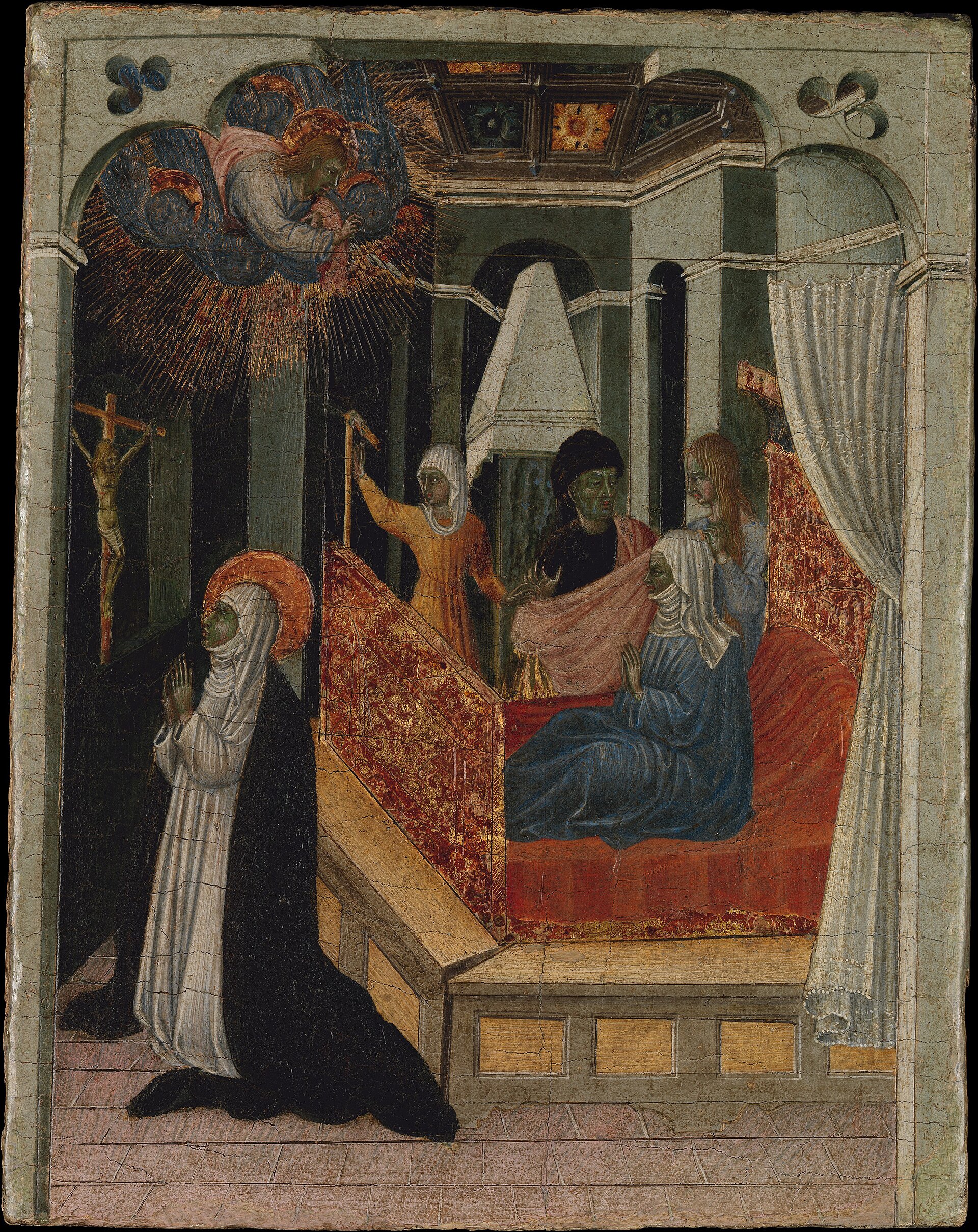
Caterina Benincasa was born in Siena on March 25, 1347, the twenty-third or twenty-fourth child of a wool dyer. At six she had a vision of Christ, and at seven she privately promised herself to God. When her parents pushed her to marry, she cut off her hair. Instead of a convent she joined the Mantellate, Dominican (the Order of Preachers founded by St. Dominic) laywomen who lived at home. For three years she lived almost in silence and solitude in her room.
Around 1368 she experienced what she called a mystical marriage with Christ, and she went out to nurse the sick in Siena's hospitals, including during plague. A circle of followers, clergy among them, gathered around her. She dictated letters—nearly 400 survive—to popes, kings, mercenaries and ordinary people. In 1376 she went to Avignon (in southern France, where the popes lived from 1309 to 1377) and urged Pope Gregory XI to return the papacy to Rome. He did in 1377.
She dictated her Dialogue, a conversation between the soul and God, and spent her last strength working for unity during the Great Western Schism (1378–1417, when two and then three men claimed to be pope). She died in Rome on April 29, 1380, at thirty-three. Paul VI named her a Doctor of the Church (a title the pope gives to a saint whose teaching is of special value to the whole Church) in 1970, with Teresa of Ávila the first women so named. People follow her because a laywoman with little formal schooling told the powerful the truth, lovingly and without fear.