A shepherd who stayed with his people through hard times.
Read the essentials →A shepherd who stayed with his people through hard times.
August 8
Not verified yet
Bishop
B. Altmann. resisted for a time, but on the third day famine compelled them to capitulate. When they came to the arrangement of the conditions of peace, there arose a violent quarrel, which was near leading to the massacre of the Christians by the Arabs. The Emir of Ramala, informed by some fugitives, came happily to the rescue, delivered them from the death with which they were threatened, and permitted them to continue their journey.
Learn from the kind of life it was. A shepherd who stayed with his people through hard times.
Keep their day. Remember them on August 8 with a short prayer, and ask for their help.
B. Altmann. resisted for a time, but on the third day famine compelled them to capitulate. When they came to the arrangement of the conditions of peace, there arose a violent quarrel, which was near leading to the massacre of the Christians by the Arabs. The Emir of Ramala, informed by some fugitives, came happily to the rescue, delivered them from the death with which they were threatened, and permitted them to continue their journey.
As the report of their combats and perils had preceded them, their arrival created a great sensation in Jerusalem. They were received in triumph by the Patriarch, and conducted, to the sound of timbrels, and by the light of torches, to the church of the Holy Sepulchre. During their abode at Jerusalem, the misery into which they had fallen excited the pity of the Christians. They could not visit the banks of the Jordan, nor the places most renowned in Judea, as they were infested by the Arabs. After having lost more than three thousand of their companions, they returned to Europe, to relate their tragical adventures and the danger of a pilgrimage to the Holy Land.
In 1065 died' Egilbert, Bishop of Passau, and Agnes the queen-mother and regent, with the advice of some of the electors and nobles, nominated Altmann to the vacant see. He was consecrated by Gebhardt, Archbishop of Salzburg. The great contest against the marriage of the clergy which occupied Hildebrand, and convulsed Germany and all Europe during his reign, was now beginning. Altmann threw himself enthusiastically into the party opposed to clerical marriage. He found nearly all the clergy of his diocese openly, unblushingly, living with their wives. It was the same throughout Germany.1 1 “ Pataviensis ecclesia, immo totum regnum Teutonicum, sacerdotum vita commaculabatur, qua pens omnes publicis conjugiis, ut populares, ubicunque, infames tenebantur." Vit L Bishop Altmann, on the reception of the letters of Gregory VII. forbidding clerical marriage, assembled the clergy and people on S. Stephen’s Day, 1074, in the cathedral at Passau, and read aloud the decree of the Pope.1 The result was a riot, with one consent ( unanimiter ) priests and people rose in indignation, and the bishop would have been torn in pieces by them, had he not been able by the aid of his servants to escape to a place of security. The clergy of Passau appealed to the emperor against their bishop, and Henry advanced at the head of his troops to expel Altmann from the diocese.
The only clerks who adhered to Altmann were the Augustinian [religious following the Rule of St. Augustine] canons of S. Nicolas, whom Altmann had introduced into Passau. As soon as the emperor was gone these zealous brethren provided themselves with holy water and brooms,2 and began to scour out all the places he had “ polluted ” with his presence. Thereupon the canons were taken by the magistrates, publicly beaten, and turned out of their establishment.
Altmann took refuge with Pope Gregory, and attended him for some years. The Council of Worms assembled in 1076, and deposed Pope Gregory; Hermann, Duke of Carinthia, was appointed bishop in the room of Altmann, and on his death in ro87, Thiemo, Dean of Wurzburg, was advanced to the bishopric, and governed the western portion of the diocese. Altmann, however, maintained himself in the eastern portion, fixing his residence in the fortress of Gottwich. “ Before the days of Altmann,” says his earliest biographer, “ almost all the churches in his diocese were of wood } and, for the matter of that, so were the priests — if I may so say — for they were devoted to their wives and worldly 1 “ Publice recitavit Apostolic® epistol® tenorem, gravi interminationis authoritate interdicens canonicis et presbyteris conjugia.” Ibid. 2 “ Fratres de S. Nicolao loca polluta, scopis et aqua benedicta emundaverunt.** Vit. i.
B. Altmann. goods.” But now Altmann succeeded in rearing churches of stone, and providing them with priests — not of wood — who had no wives, and were supposed to be indifferent to this world’s goods.
Altmann died on August 8th, 1091, and was buried at Gottwich, where his' tomb is still shown. Tho B.V M, receiving the announcement other approaching dissolution. After a bas-relief by Orcagna.
Feast: August 8
One short email a day for nine days. The day's prayer, a line from Bl. Altmann of Passau's story, and a nudge to keep going.
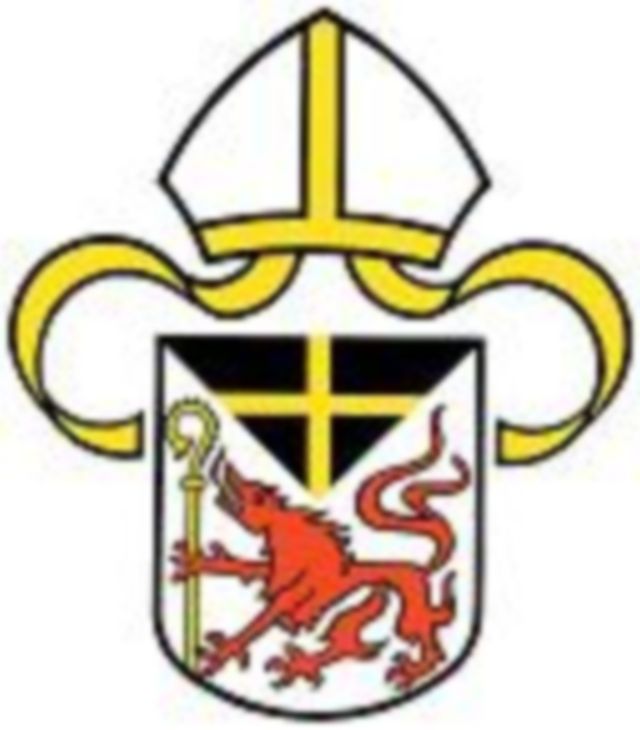
Image: BistumswappenPassau.JPG · Wolfgang Duschl · Public domain, via Wikimedia Commons
From Sabine Baring-Gould, The Lives of the Saints, new edition in 16 vols. (London: John C. Nimmo, 1897–98); text from the Internet Archive scan (OCR, lightly cleaned; errors possible). Public domain.
Image: Wolfgang Duschl, Wikimedia Commons (Public domain)
From Sabine Baring-Gould, The Lives of the Saints, new edition in 16 vols. (London: John C. Nimmo, 1897–98); text from the Internet Archive scan (OCR, lightly cleaned; errors possible). Public domain in the United States. Reproduced unedited, except for short bracketed notes in grey that we added to explain names and terms (“S.” is the old abbreviation for Saint). Some history and judgments reflect 19th-century scholarship.