Charlemagne (died 814), emperor of the Franks, was honored as 'Blessed' locally in some places, but he has never been canonized for the universal Church. Baring-Gould includes him for that local cult.
Read the essentials →Charlemagne (died 814), emperor of the Franks, was honored as 'Blessed' locally in some places, but he has never been canonized for the universal Church. Baring-Gould includes him for that local cult.
Read the essentials →Charlemagne (died 814), emperor of the Franks, was honored as 'Blessed' locally in some places, but he has never been canonized for the universal Church. Baring-Gould includes him for that local cult.
January 28
Not verified yet
Feast
Charlemagne, son of King Pepin, was born in 742, and was crowned king of France in 768.
Feed your mind with Scripture and good books. Learning and the Scriptures matter in this life.
Learn from the kind of life it was. Not really a saint story in the modern sense: read it as history.
The public life of the Emperor Charlemagne [king of the Franks, crowned emperor in 800] belongs to the domain of secular history, rather than to hagiology. We shall confine ourselves, in this notice, to those acts which have obtained for him a place in the Kalendar of the Church.
Charlemagne, son of King Pepin, was born in 742, and was crowned king of France in 768. In the early years of his reign he was guilty of grave moral faults, which he deeply deplored in his after life. He comes before us as a man penetrated with a strong sense of religious responsibility, and of faith in the divine mission of the Church. In the midst of his wars, the spread of the true faith, and the advancement of learning, were never absent from his mind. He was zealous in reforming the monasteries, and for the sake of uniformity, he introduced into them the rule of S. Benedict [father of Western monks (d. c. 547), author of the Rule]. For the discipline of the clergy, he procured the convention of many synods, in which were drawn up his famous Capitulars. He meditated assiduously on the Scriptures, assisted at the divine office, even that of midnight, if possible; had good books read to him at table, and took but one meal a day. He died at the age of seventy-two, at Aix-la-Chapelle, in 814, and was there buried. His tomb was opened in 1165. The body was found, not reclining in his coffin, as is the usual fashion of the dead, but seated on his throne as one alive, clothed in the imperial robes, bearing the sceptre in his hand, and on his knees a copy of the Gospels. On his fleshless brow was the crown, the imperial mantle covered his shoulders, the sword Joyeuse was by his side, and the pilgrim's pouch, which he had borne always while living, was still fastened to his girdle. His skull and throne and hunting horn are preserved in the sacristy at Aix.
Baptism of Vanquished Saxons by command of Charlemagne. From a Miniature of the 15th Century in the Burgundy Library at Brussels.
FOOTNOTES:
[128] "That Cyril had any share in this atrocity," says Canon Robertson, i. 401, "appears to be an unsupported calumny."
[129] Decline and Fall, Ed. Bohn, i. p. 348.
[130] See p. 406 .
[131] Chiefly from Bright's Church History.
S. Valerius , B. of Trèves, end of 1st. cent. S. Constantius , B.M. at Perugia, between a.d. 161-8. SS. Sabinian , M. , and Sabina, V. , at Troyes, in France, circ. a.d. 275. SS. Papias and Maurus , MM., at Rome, circ. a.d. 303. S. Gildas the Wise , Ab. in Brittany, 6th cent. S. Sulpicius Severus , B. of Bourges , a.d. 591. S. Baculus , B. of Sorrento, circ. a.d. 679. S. Peter Thomasius , Latin Patr. of Constantinople , a.d. 1366. S. Francis of Sales , B. of Geneva , a.d. 1622.
Feast: January 28
One short email a day for nine days. The day's prayer, a line from Bl. Charlemagne's story, and a nudge to keep going.
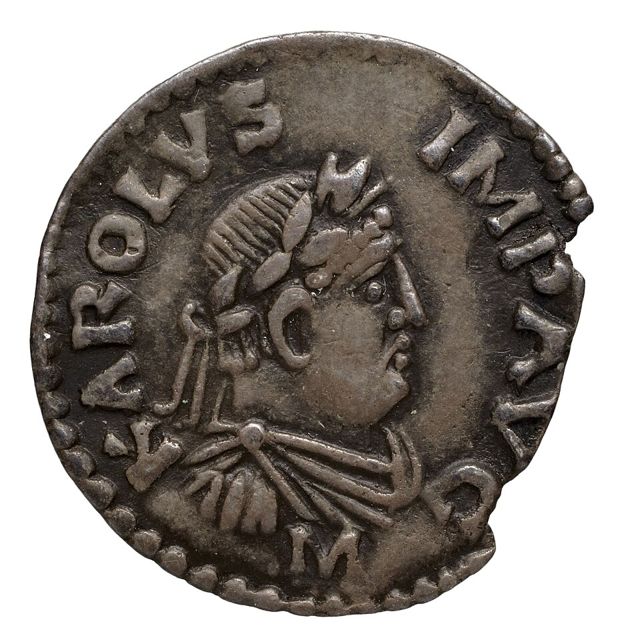
Image: Charlemagne denier Mayence 812 814.jpg · Charlemagne. Autorité émettrice de monnaie indéterminé. Atelier monétaire. Émetteur · Public domain, via Wikimedia Commons
From Sabine Baring-Gould, The Lives of the Saints, new and revised edition (Edinburgh: John Grant, 1914; first edition 1872). Public domain.
Image: Charlemagne. Autorité émettrice de monnaie indéterminé. Atelier monétaire. Émetteur, Wikimedia Commons (Public domain)
From Sabine Baring-Gould, The Lives of the Saints, new and revised edition (Edinburgh: John Grant, 1914; first edition 1872). Public domain in the United States. Reproduced unedited, except for short bracketed notes in grey that we added to explain names and terms (“S.” is the old abbreviation for Saint). Some history and judgments reflect 19th-century scholarship.