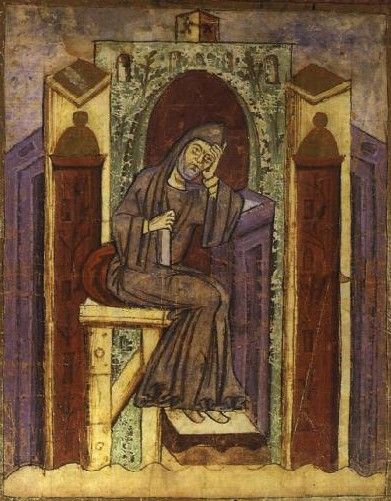
Baring-Gould’s sources: Beatified by Pope Julius II., at the instigation of the bishop of Constance, in 1514, but not venerated out of Thurgau and S. Gall. Authority: — His life by Eckhardt, dean of S. Gall, A.D. 1220. This is one of the most delightful of mediaeval memoirs, is full of information concerning the great music-schools of Metz and S. Gall, and contains many anecdotes which throw light on the manners of the times. The MS. that has been published has unfortunately passed through the hands of an ignorant copyist who has thought fit to interpolate sentences, making the most gross mistakes. Where Eckhardt had written the emperor Charles, meaning Charles the Fat, the stupid copyist has written Charlemagne. He has also added a chapter on the visit of Otho I. to the monastery, where he meets his nephew Notker Balbulus, who is still alive. As Otho came to the throne in 936, and Notker Balbulusdied in 912, the blunderis manifest. The copyist saw in one of the records of S. Gall that Otho visited the abbey at the time when Notker was there, but this was another Notker, called the Physician, who was the kinsman of Notker Balbulus. In another place he confounds them again, and also the Physician with Notker the Abbot, who was the nephew of Balbulus, And again, he confounds Notker the Abbot with Notker Labeo (d. 1022). Notker the Physician died 1033; Notker the Abbot in 973. It is necessary hereto caution the reader against falling into the error of which many have been guilty,of confusing with some of these, Notker, B. of Li^ge, d. 1007. Eckhardt in his prologue says of his undertaking, “ We have laboured to gather into one the acts, though scanty, which our forefathers have left us in writing of Notker called the Stammerer, a man then very famous for his learning, and blessed for his sanctity, and also of his companions, wherever we have found such accounts in schedules.”] Notker Balbulus, or the Stammerer, was the son of noble parents, of royal blood, who lived at Heiligawe (Elk), in the Thurgau. At an early age he entered the monastery of S. Gall, when he soon made himself remarkable by his piety and learning. When he was there, Mark, a certain Irish bishop, passed through Switzerland, with his nephew Maengal, on his way to Rome. On their return from their pilgrimage, the Irishmen again rested at S. Gall, where they were very hospitably received. Notker was struck with the genius and learning and musical accomplishments of Maengal, and thinking that it would be greatly to the advantage of S. Gall if the Irishman were to remain there, he besought God earnestly to retain him. His prayer was heard. Maengal took such a liking to the monastery that he sought and obtained permission from his uncle to remain there. The monks, thinking the Irish name Maengal somewhat uncouth, called him Marcellus, or the Little Mark, in contradistinction to Mark the greater, his uncle, the bishop. Maengal, then, tarried behind at S. Gall, and became the instructor of Notker and two favourite fellow pupils, Radpert and Tutillo. These three especially distinguished themselves for their musical skill, and thus extended the fame of the song-school of S. Gall. The history of this song-school as given in Eckhardt’s Life of Notker is too interesting to be passed over. He says that S. Gregory the Great compiled a collection of the antiphons of the church, and instituted a musical school at Rome, whence all Europe derived its ecclesiastical melodies. But these became corrupted, especially among the Germans and French, and Church music reached its utmost degradation in Switzerland. Eckhardt says with grim impatience, “ They received the sweet melodies incorrupt, but the levity of their minds, which made them intrude some of their own tunes into the Gregorian song, and their natural barbarity, made them lose them in their integrity. And indeed Alpine bodies with their own thundering voices are not adapted to sweet modulation of tone. The barbarous hugeness of those tippling throats, when endeavouring to utter a soft song full of inflections and dipthongs, makes a great roar, as though carts were tumbling down steps headlong; and so, instead of soothing the minds of those who listen, it agitates and exasperates them beyond endurance.” 1 And then, 1 This passage is, however, not original in Eckhardt; it is found verbatim in Johannes Diaconus. In Vit. b. Gregorii.
B. Notker Balbulus. adds Eckhard, these Alpine people, if they cannot master an art all at once, look down on it and despise it, and so, “being of indisciplined manners and untamed voice, (incompta voce), not only cannot understand and appreciate the sweetness of modulation, but obstruct others in acquiring this perception.”
Charlemagne [king of the Franks, crowned emperor in 800] having discovered that Church music was very corrupt, sent to Rome two of his clergy to bring the correct Gregorian music into his empire, and these clergy were then settled at Metz, which became the authority on ecclesiastical music in France. But after a while it was found that the Church music in France varied greatly from that at Metz, and an altercation arose, each party accusing the other of having corrupted the ancient song of the Church. It was, therefore, necessary to have fresh information on the subject from Rome, and the emperor sent to pope Adrian, requesting him to supply him with two priests who were thorough musicians. The pope readily complied, and sent two, Peter and Romanus, with authentic copies of the antiphonary of S. Gregory. But, on reaching the Lago Maggiore, Peter and Romanus caught cold, “ aere Romanis contrario quaterentur.” Peter soon got well, but Romanus was so prostrated with the fever that ensued, that he was obliged to remain at S. Gall [Irish companion of Columbanus, founder of the Swiss monastery that bears his name], which he managed to reach, carrying with him one of the antiphonaries — they had two — much to the annoyance of Peter, who wanted to keep them both himself. Peter went on to Charlemagne, who sent him to Metz; but Romanus remained at S. Gall, where he recovered of his cold. Peter, at Metz, composed “ jubilies and sequences,” which were called after the place where he composed them; but Romanus sang his “Romanly and sweetly,” and these melodies Notker in after time adapted to words. 1 The author of the life of Notker takes great 1 Ronaanum nos Sanctigallenses retin uimut, qui nos cantilenas Karolo jubente VOL. IV. 7 credit to his monastery for having a more Roman and correct form of music than the church of Metz. He says that at Rome the antiphonary of S. Gregory was kept for inspection by all, as an ultimate authority, and that in like manner, at S. Gall, the accurate copy of Romanus was preserved near the altar of the Apostles, that appeal might be made to it in case of dispute.
Notker Balbulus became, then, remarkable for his musical proficiency. He was also no less famous for his knowledge of divinity. On a certain occasion Charles the Fat visited S. Gall, and took great pleasure in discoursing with Notker. His chaplain, an exceedingly haughty and arrogant man, was jealous and angry, and he not only endeavoured to make Notker ridiculous by jesting on his infirmity, but also publicly to confound him. One day he went up to Notker as he sat composing melodies on his psaltery, and turning to those who followed him said, “ We will put a puzzling question to this most sapient and profound theologian.” Then to Notker, “ Master ! solve us a point in divinity, we pray. What is God Almighty doing now?”
“ God Almighty is doing now what he has done in past ages, and will do as long as the world lasts: He is setting down the proud and is exalting the humble.” Abbot Grimoald, who ruled the abbey when Notker was a young monk, was somewhat of a courtier and fond of associating with nobles. Now there was in the abbey-school a young man named Salomon, son of the count of Ramsweg; and this youth, being of high birth and great expectations, was treated in a very different manner from the other young scholars, and this highly displeased Notker, Rupert, Tutilo, edocuit, et Antlphonario suo exemplatum, in cantario, Bicut Romac cat, juxta apostolorum aram locavit note on the margin of Johannes Diaconus, lib. 4, by an anonymous scribe of the xxth cent., in the library of S. Gall, cod. no. $78. See fov further information on the Song School of S. Gall, "Die Sangerschule S. Gallens vom achten bis zwolften Jahrhundert," v. P. Anselm Schubiger, Einsiedeln, 18581 B. Notker Balbulus.
and Hartmann, all boys together and of honourable family. At length Salomon left school, his parents having died, and his fellow-scholars thought they were well rid of him. But Grimoald was made archchaplain of the emperor Louis the Pious, and coming across Salomon of Ramsweg, procured his ordination, and obtained for him, a canonry at Elwangen; afterwards through the favour of Hatto, archbishop of Mainz, Salomon became abbot of six monasteries and finally bishop of Constance. Salomon was fond of S. Gall, and used to reside near the abbey. Though no monk, he was wont to put on a surplice and daily attend the offices (lineus diatim introit). This was a breach of rule, and it highly displeased Notker and his friends. Salomon hearing of this, desisted from his practice, and no longer appeared during the day in a surplice. But he was wont at night to enter the abbey, and going through the cloisters, assist at Prime. Notker and his friends soon found out that there was a stranger in the abbey at night, and they were much offended. The party took counsel together, and resolved to keep watch for him. Rudiger was keeping guard when Salomon stole along the cloister into the church; then he got a candle and looked at his face, and found out who it was. Then he exclaimed “ By S. Gall !” for so, says Eckhard, did the Fathers swear. 1 “ We cannot suffer a stranger to be about the cloisters in our habit at this time of night 1” Salomon implored Rudiger to excuse him, and promised on the morrow to get permission from the abbot to come in and out of the monastery in the habit, and to wear his canon’s dress only before his knights, men-at-arms, and servants.
“May God grant,” answered the monk, “If once you put on the habit of S. Gall, that you do not put it off again till the time comes when all must lay it aside.” 1 Sic enim Patres jura bant.
Rudiger, however, consented to bring the request of Salomon before the abbot “There were then in our monastic republic wise and holy men, senators; Hartmann who composed the litany beginning, Sanctus hutnili prece y and set it to music; and Notker the Stammerer, who composed sequences; Ratpert, who invented the litany, Ardua spts mundi; and Tutilo, the author of Hodie cantandus.” “ These men were consulted by the abbot, and after much hesitation and opposition from the rest of the monks, Salomon was allowed to attend the offices, on condition that on entering the cloister he put off his canon's cassock and put on the Benedictine [monks following the Rule of St. Benedict] habit, and that at the conclusion of his visit he should lay aside the monastic habit and resume the canon's dress." To understand this alarm of the monks and opposition to the intrusion of Salomon, we must remember that the abbeys were often given to favourites of the emperor, who were not even monks, and that Salomon was dreaded especially by the brethren of S. Gall, who knew his rapacious avarice.
Salomon one day brought to the monastery a solid gold box adorned with jewels, “ shaped like a chapel,” containing relics [the bodily remains of a saint, or objects they used, kept with honor], which he had received from king Arnulf; and he offered it to the abbey, but the bluff Rudiger said, “ It is the monk, not the gold, that S. Gall wants.” It was not long before what the monks had feared fell out. Salomon was given the abbey of Reichenau, and then archbishop Hatto, desiring the wealthier abbey of S. Gall for his favourite, or, may be, Salomon asking for it, urged the abbot Bernard to resign, and then Salomon was forced on the monks as their superior.
A thought had long been working in the brain of Notker. He saw that the versicle of the Alleluia, sung between the Epistle and Gospel, was prolonged through an immense series of notes without words, to allow the B. N other Balbulus.
deacon time to reach the pulpit to chant the Gospel — and was constantly undergoing corruption, or becoming forgotten. About the year 851, the abbey of Jumifeges was burnt by the Normans, and one of the monks escaping from it, came to S. Gall, bringing with him an antiphonary, in which some prose words were set to this sequence of notes. Notker at once saw in this a solution to the difficulty, and set to work to compose sequences, some in prose, and some in rhyme. His first attempt was “Laudes Deo concinat,” and then “Coluber Adae male suasor.” These he showed to his master Yso, who approved warmly of them, but made some corrections “ so that each note should have its own syllable.” He afterwards composed others, and Maengal was so pleased with his melodies that he urged him to collect all his musical and poetical compositions into one book, but this he was too modest to do, till much later on in his life, when he compiled his Book of Sequences at the request of brother Othar, in 887, and dedicated it to bishop Luitward of Vercelli, archchaplain of the emperor Charles the Fat. It is related that one day Notker was in the dormitory listening to the sound of a mill-wheel which revolved slowly, as the summer was dry, and there was little water in the stream that set it in motion. An inspiration took him, and he composed the hymn and melody, “ Sancti Spiritus adsit nobis gratia.”
He sent this hymn, as soon as it was composed, to the emperor Charles, and received in return, by the same messenger, the hymn “Veni Creator,” which Charles had just composed.
On another occasion, as he was watching the erection of a bridge over the chasm of the Martinstobel, and saw the peril to which those were exposed who worked at it, he composed his famous sequence, “Media vita in morte sumus.” (In the midst of life we are in death, of whom ift 4< may we seek for succour but of Thee, O Lord, &C. 1 ) Notker was in correspondence with many famous men of his day; as Ottfried of Weissenburg, archbishop Ruodbert of Metz, and the monk Baltharius, who dedicated to him his life of S. Fridolin. Archbishop Ruodbert sought to obtain from the modest monk of S. Gall a hymn on S. Stephen, the protomartyr, to whom a church had been built at Metz. Notker sent him the required hymn, and appended to it these two verses: — “ Sick and stammering and full of evil, I Notker, unworthy, have sung the triumphs of Stephen with my polluted mouth, at the desire of the prelate. May Ruodbert, who has in a young body the prudent heart of a senior, may he see a long life, full of merits.”
Salomon was a resident in the abbey occasionally, in the year and a-half during which he held the abbacy before he was appointed to the bishopric of Constance. Sindolf the refectorer was a cross-grained brother, who disliked the three poets and musicians, Notker, Ratpert, and Tutilo: and he continually poured into the abbot Salomon’s ear stories of the discontent of these three men, and retailed disparaging speeches they had made, or he fancied they had made, about the abbot This was cause of great annoyance to “the three inseparables,” as the chronicler calls them. But one night an opportunity of teaching the refectorer a lesson presented itself which they were not slow to seize. By permission of the abbot the friends were able to go into the writing-room after lauds for study. Sindolf thought that they were certain to be talking scandal of the bishop, and so he stole outside a window of the scriptorium, and put his ear to a cracked pane of glass. Now Tutilo, a very lively man, saw him slinking to the 'The original melody of this world-famous sequence may be seen in the above mentioned “ Sangerschule S. Gallens,” No. 39, together with many more of Notkcr's melodies.
B. Notker Balbulus. window, so going up to his friends, he said to them in a whisper, “There he is, with his ear to the glass. Do you, Notker, because you are so timid, go back to the church; but do you, Ratpert, my friend, gently take down the whip from the chimney corner, run outside, and comfort my heart by giving it him with all your vigour. 1 As for me, I will suddenly fling the window open when you come near, and catch him by the hair of his head, and pull him towards me with all my might ” 8 “Then he, always most keen for the discipline, modestly went out,” says the historian, and hailed strokes on Sindolf (a dorso ingrandinat) from behind. Sindolf, who was held fast by the hair, writhed, and kicked, and yelled. Lights appeared, and the brethren came running from the dormitory to know what was the matter. Ratpert ran away, but Tutilo screamed out that he had caught the devil, and begged the brethren to bring up a light that he might see what his face was like. ‘Where are Notker and Ratpert?’ asked his brethren. ‘Oh l’ said Tutilo, ‘they smelt the devil and ran away to ask succour from heaven, and left me to do the best I could with this thing walking in darkness I believe an angel has been sent to chastise him in the rear/ ”
Sindolf was obliged to keep to himself for some days after this, and when the bishop heard the reason, he was greatly amused. But the refectorer’s temper was not mended by this castigation; and having found a beautiful copy of the Canonical Epistles in Greek, which Luitward, bishop of Vercelli, had sent to Notker, Sindolf spitefully In ecckslam, Ratperte autem, amice mi I rapto flagello quod pendet in pyrall, deforUaccurre. Tu autem, cor meum confortare et esto robustus; fiagelloque in Ilium tot is viribos increpita.
•Ego enim ilium, cum appropinquare te sensero, vitreo citissime readaperto, captum caplllis, et ad me pertractum ▼lokntcr tenebo. scored and cut it into strips with his knife, “ as may be seen to this day,” says the writer. Notker translated the whole Psalter into German, and his copy existed in the library of S. Gall, where Eckhard wrote his life. 1 In this life follows a sketch of the two friends of Notker. Ratpert was wont to walk between Notker and Tutilo, being the oldest He was master of the school from his youth up, a most punctual man at his class; rarely left the grounds of the abbey, and wore out two pairs of shoes in the year. “ Beware of making expeditions,” said Ratpert to Tutilo; “They are as dangerous as kisses.” Though most sedulous at school, he was negligent in attending the Canonical Offices and Mass. “ I hear very good Masses,” said he, “ when teaching my pupils how to say them.” He wrote a book of the “ Cases of the Monastery” from the time of S. Columbanus [Irish monk (d. 615) who founded monasteries in France and Italy] to that of bishop Salomon, and composed litanies, “which,” says Eckhard, “the Church sings throughout the whole world on Rogation days.”
Ratpert died on October 25th, a.d. 900. Tutilo was an active lithe fellow, very eloquent, with a sweet ringing voice, a good sculptor, painter, and goldsmith. He was, like his two friends, a good musician, and could play all manner of fiddles (fides) and pipes, and he was wont to teach the noblemen's sons who studied in the abbey school to play the fiddle. He was able to make a good joke, and tell a grave story. “ Curse the man !” exclaimed king Charles one day; “ he is too good a fellow to be a monk.” But with all his joyous lightness of heart, he was pure and simple in soul, and modest as a young maiden. He composed his hymn tunes on the rote or psaltery, and these are the hymns and tunes of which he was the author “ Hodie cantandus” “ Omnium virtutum gcmmis” and “ Viri tome, this translation is attributed to Notker Labco instead of Notker Balbulns. Galilai” which he sent to king Charles to be sung as an offertory.
King Charles composed a tune and sent it to Tutilo to have words set to it, and Tutilo wrote for it, “ Quoniam Dominus” He also composed the sequence, “ Gaudete et cantaic, M1 Charles the Fat was very fond of visiting S. Gall's, and the monks knew him so well that they were wont to call him “ Our Charles” when speaking of him. The emperor was especially attached to Notker, and often consulted him on spiritual matters. Once he sent a messenger to S. Gall to ask Notker to give him some advice on the conduct of his souL Notker was in the garden when the messenger came, weeding it, and watering the herbs. “Tell the emperor to do what I am doing now,” was all Notker's answer to the messenger. Charles, when he heard this said, “Yes, that is the sum of all. Away with the weeds of vices, and water the herbs of grace.” Notker was not the author of many works, but those we have by him are valuable, such as his sequences and his martyrology. He died in 912, at S. Gall, and was buried in the Abbey Church of SS. John Baptist and Peter. 1 Eckhart says, ** I mention this because the music is different in character from the others, as yon will know at once, if yon are a musician.** A picee of ivory carving by Tutilo, which he made for bishop Salomon, is shown at the present day in the town library of S. Gall.