Bl. Paul of the Cross

Witnessing to Christ by the way of life, not by death.

Read the essentials →
November 15 · Confessor

Bl. Paul of the Cross

Bl. Paul of the Cross

Witnessing to Christ by the way of life, not by death.

Traditional feast

November 15
1914 / pre-1969 calendar, per Baring-Gould (1897)

Current feast

October 19
Verified · General Roman Calendar

Represents

Confessor

Their story

Adapted in modern English from the Catholic Encyclopedia (1913) · original text below

Paul Francis Danei was born at Ovada near Genoa on 3 January 1694. From childhood the crucifix was his book. At fifteen he went home to Castellazzo, and from then on, the source says, his life was full of trials. He refused an honourable marriage and an inheritance.

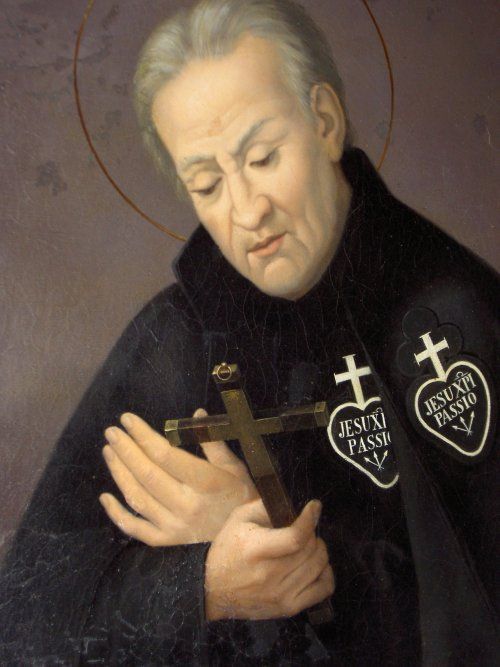
Dressed in a black tunic by his bishop, he wrote the Rule of a new order devoted to the Passion, the Passionists. At their first general chapter in 1747 he was elected superior general (the head of the whole order) against his wishes, and he held the office until death. He preached missions tirelessly and prayed for fifty years for the conversion of England.

He died in Rome on 18 October 1775 and rests in the Basilica of Sts. John and Paul.

Early life

The book says little or nothing about early life. This is how the account begins.

Thin entry · the 1897 book gives only 0 words. We have not filled the gap with invented detail.

What they represent

How they teach us to live

Drawn from themes in the original account

Learn from the kind of life it was. Witnessing to Christ by the way of life, not by death.

Keep their day. Remember them on November 15 with a short prayer, and ask for their help.

From the Catholic Encyclopedia

1913 · 707 words

Paul Francis Daneii, born at Ovada, Genoa, Italy, 3 January, 1694; died in Rome, 18 October, 1775.

His parents, Luke Danei and Anna Maria Massari, were exemplary Catholics. From his earliest years the crucifix was his book, and the Crucified his model. Paul received his early education from a priest who kept a school for boys, in Cremolino, Lombardy. He made great progress in study and virtue; spent much time in prayer, heard daily Mass, frequently received the Sacraments, faithfully attended to his school duties, and gave his spare time to reading good books and visiting the churches, where he spent much time before the Blessed Sacrament, to which he had an ardent devotion. At the age of fifteen he left school and returned to his home at Castellazzo, and from this time his life was full of trials. In early manhood he renounced the offer of an honourable marriage; also a good inheritance left him by an uncle who was a priest. He kept for himself only the priest's Breviary.

Inflamed with a desire for God's glory he formed the idea of instituting a religious order in honour of the Passion. Vested in a black tunic by the Bishop of Alessandria, his director, bearing the emblem of our Lord's Passion, barefooted, and bareheaded, he retired to a narrow cell where he drew up the Rules of the new congregation according to the plan made known to him in a vision, which he relates in the introduction to the original copy of the Rules. For the account of his ordination to the priesthood, of the foundation of the Congregation of the Passion, and the approbation of the Rules, see PASSIONISTS. After the approbation of the Rules and the institute the first general chapter was held at the Retreat of the Presentation on Mount Argentaro on 10 April, 1747. At this chapter, St. Paul, against his wishes, was unanimously elected first superior general, which office he held until the day of his death. In all virtues and in the observance of regular discipline, he became a model to his companions. "Although continually occupied with the cares of governing his religious society, and of founding everywhere new houses for it, yet he never left off preaching the word of God, burning as he did with a wondrous desire for the salvation of souls" (Brief of Pius IX for St. Paul's Beatification, 1 Oct., 1852). Sacred missions were instituted and numerous conversions were made. He was untiring in his Apostolic labours and never, even to his last hour, remitted anything of his austere manner of life, finally succumbing to a severe illness, worn out as much by his austerities as by old age.

Read the rest of the article

Among the distinguished associates of St. Paul in the formation and extension of the congregation were: John Baptist, his younger brother and constant companion from childhood, who shared all his labours and sufferings and equaled him in the practice of virtue; Father Mark Aurelius (Pastorelli), Father Thomas Struzzieri (subsequently Bishop of Amelia and afterwards of Todi), and Father Fulgentius of Jesus, all remarkable for learning, piety, and missionary zeal; Venerable Strambi, Bishop of Macerata and Tolentino, his biographer. Constant personal union with the Cross and Passion of our Lord was the prominent feature of St. Paul's sanctity. But devotion to the Passion did not stand alone, for he carried to a heroic degree all the other virtues of a Christian life. Numerous miracles, besides those special ones brought forward at his beatification and canonization, attested the favour he enjoyed with God. Miracles of grace abounded, as witnessed in the conversion of sinners seemingly hardened and hopeless. For fifty years he prayed for the conversion of England, and left the devotion as a legacy to his sons. The body of St. Paul lies in the Basilica of SS. John and Paul, Rome. He was beatified on 1 October, 1852, and canonized on 29 June, 1867. His feast occurs on 28 April. [Editor's note: It was later transferred to 19 October.] The fame of his sanctity, which had spread far and wide in Italy during his life, increased after his death and spread into all countries. Great devotion to him is practiced by the faithful wherever Passionists are established.
Read more

The full original · 0 words

Read Baring-Gould’s full account

Baring-Gould’s sources: Roman Martyrology. Beatified in 1853 by Pope Pius IX. Authorities: — A Life written in 1786 by P. Vincent Maria Strambi, Passionist, afterwards B. of Macerata and Tolentino. Another, by a Father of the same Order, published in 1821.] Paul Francis Daney, called afterwards Paul of the Cross, belonged to the noble family of Montferrat, in the diocese of Acqui. He was bom on January 3, 1694. From youth he dreamed of founding a new Order, and in an ecstasy thought that he had a special vision of the dress which his Order was to wear exhibited to him by the hands of the Almighty Himself He rushed off to John Mercurini Gastinara, bishop of Alessandria, whom he had chosen as his director, and informed him of the vision. The bishop in all gravity listened to the story, considered the cut of the dress according to the pattern displayed in heaven, approved it, had one made like it, and solemnly invested Paul in it. Paul at once drew out rules tor his new society, and went to Rome to have them approved, 1721. The approval he sought was not accorded, and he returned disappointed to his home. After a while he made another attempt (1727). He was on this occasion accompanied by his brother. Both received the order of priesthood in Rome, and permission was accorded them to retire to Monte Argentaro, near Orbitello, there to practise mortification. After a while they were joined by other persons desirous of leading a similar life, and a monastery was erected for them on Monte Argentaro in 1737. After much hesitation, Benedict XIV., by rescript in 1741, approved of the foundation, and published a brief of approbation in 1746. The congregation grew, and Paul VOL. xiii. 24 [Nov. xtt.

Feast days

Feast: October 19
Traditional: November 15

Nine days · Free

Pray the novena
with us.

One short email a day for nine days. The day's prayer, a line from Bl. Paul of the Cross's story, and a nudge to keep going.

Also on November 15
G

Sts. Gurias

November 15 · Martyrs
M

St. Maclovius or Malo

November 15 · Bishop
St. Leopold

St. Leopold

November 15 · Confessor
← All 1726 saints in the library
Sources & notes

Feast-day sources

Story sources

Sources

Credits

Image: Paul de la croix.jpg · Plet philippe · Public domain, via Wikimedia Commons

From Sabine Baring-Gould, The Lives of the Saints, new edition in 16 vols. (London: John C. Nimmo, 1897–98); text from the Internet Archive scan (OCR, lightly cleaned; errors possible). Public domain.

Image: Plet philippe, Wikimedia Commons (Public domain)

From “Catholic Encyclopedia (1913)/St. Paul of the Cross,” The Catholic Encyclopedia (New York: Robert Appleton Company, 1907–1914), via Wikisource. Public domain. Matched by name and feast date; text unedited except for our bracketed notes in grey.

From Sabine Baring-Gould, The Lives of the Saints, new edition in 16 vols. (London: John C. Nimmo, 1897–98); text from the Internet Archive scan (OCR, lightly cleaned; errors possible). Public domain in the United States. Reproduced unedited, except for short bracketed notes in grey that we added to explain names and terms (“S.” is the old abbreviation for Saint). Some history and judgments reflect 19th-century scholarship.