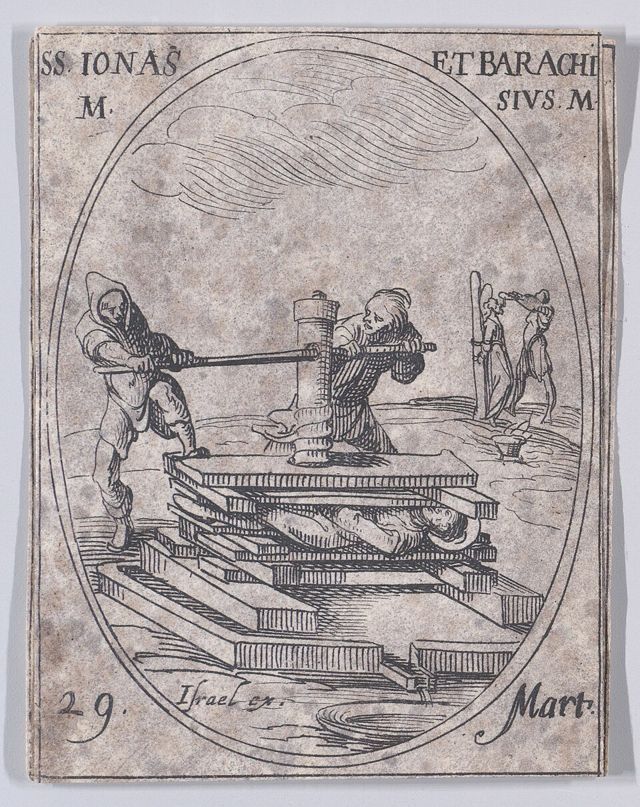
Baring-Gould’s sources: Usuardus, Ado, Notker, and Roman Martyrology. Authority:—Victor of Utica. De Persec. Vand. lib. i. (5th cent.)
Genseric, the Vandal king in North Africa, had in his early youth renounced the Orthodox communion, and had become an Arian [followers of Arius, who taught that the Son is a created being, not fully God]. He was exasperated to find that the Africans, who fled before him in the field, presumed to dispute his authority over their faith, and his ferocious mind was incapable of fear or of compassion. His Catholic subjects were oppressed by intolerant laws, and arbitrary punishments. The language of Genseric was furious and formidable; the knowledge of his intentions might justify the most unfavourable interpretations of his actions; and the Arians were reproached with the frequent executions which stained the palace and dominions of the tyrant.
Genseric had ordered, on the advice of the Arian bishops, that no Catholic should be allowed to hold office in his house. Now there was found one, named Armogastes, in the service of his son Theodoric. He was tortured with cords bound round his forehead and legs, compressing the flesh painfully. But he looked up to heaven, made the sign of the Cross, and the cords broke like a spider's web. Stouter cords of hemp were then used, but they proved equally inefficacious. He was next suspended by one foot, with his head downwards. His master, Theodoric, wished to cut off his head, but his hand was arrested by an Arian priest present, named Jucundus, who said, "If thou strikest off his head, the Romans will honour him as a martyr; therefore make him languish to death in other ways." By Romans, he meant the conquered inhabitants of the province. Theodoric then sent Armogastes into the province of Byzacene, to dig the earth. He afterwards recalled him to Carthage, and to disgrace him before all men, made him cow-keeper.
The confessor [in old usage, a saint who was not martyred, or who suffered for the faith without being killed] having had a revelation that his death was at hand, said to a Catholic, named Felix, "I pray thee, bury me under this oak tree, or thou shalt have to give account before God for not doing this." Felix replied, "God forbid that I should do so; I will bury thee, as thou deservest, in some church." Armogastes urged him, and Felix promised to fulfil his wish, so as not to vex him. The saint died a few days after, and Felix began his grave beneath the tree, but the roots incommoded him. He, therefore, got an axe, and cut through them, and found, to his surprise, an ancient marble sarcophagus beneath them; and in this he laid the body of Armogastes.
A certain Archinimus, of the city of Mascula, was also called on to confess Christ about the same time. The king himself endeavoured to persuade him to disbelieve in the eternal Godhead of Christ, and promised him great wealth and favour if he would comply with his wishes. But when he found that the man would not be persuaded, he gave orders that he should be executed, but he sent secret instructions that his life should be spared if he maintained his constancy to the last. The saint showed no disposition to yield, and he was spared.
Satur, procurator of Huneric, often spoke against Arian misbelief. For this he was denounced by an Arian deacon, named Varimad. Huneric threatened, unless he conformed to the established heresy, that he would deprive him of his house, his goods, his slaves, his children, even of his wife, and publicly wed her in his presence to a camel-driver. Satur remained inflexible, and was despoiled of all things. His wife implored delay, and going to her husband, with her garments rent, cast herself at his feet, and implored him not, by his obduracy, to expose her to such a public disgrace, and to such a sin as marriage to another whilst her husband lived. He replied, "You speak like one of the foolish women. (Job xi. 10.) If you loved me, you would not urge me to a second death. He that forsaketh not even his wife, the Lord said, when called upon so to do for His sake, cannot be His disciple." Then Satur was robbed of all, and reduced to beggary; he was even forbidden to go forth from his place. Thus was he despoiled of wealth and family, and liberty. "But," says Victor of Utica, "Of his baptismal robe they could not rob him." These three men are honoured, for their sufferings, as martyrs.