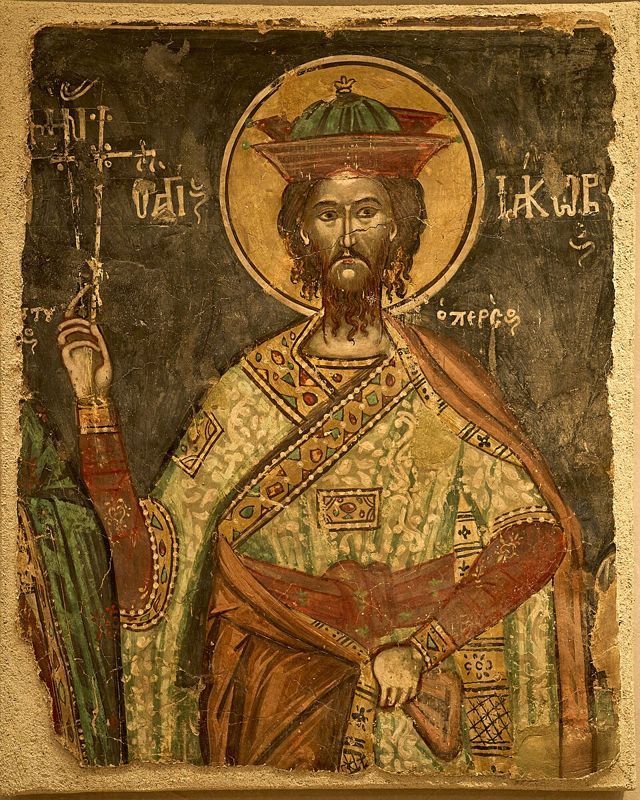
Baring-Gould’s sources: Modem Roman Martyrology. The Russian Kalendars and Menseas on Nov. 19. Authority: — The Narrative by S. John Damascene.] HE story of Barlaam and Josaphat is a Buddhist legend of the youth of Gotama Buddha, or Sidhartta, as he was called before he was arrayed with the Bodishat.
Sudhodana, king of Kapilawastu, became the father, by his wife, Maka Maya, of a prince, Sidhartta. The Brahmins prophesied at his birth that he would become an ascetic, if he were allowed to see decrepitude, sickness, a recluse, and a dead body. His father therefore built him a palace and surrounded it with guards who should keep off poor and sick people, and not suffer an ascetic to approach, and remove SS. Bctrlaani and JosapJiat.
every sign of death. The prince grew to the age of sixteen, enjoying life, and ignorant of the miseries to which man is heir, till one day when he was out riding he passed beyond the circuit of the guards, and lighted on an old man, decrepit, without teeth, and with grey hair. When he heard that this was the condition to which all men who live long must attain, his spirit failed within him. Four months after, Sidhartta saw a leper covered with sores, and learned that man is liable to disease. Four months after that again he came upon a dead body lying in a wood, devoured by worms. And then, full of horror, he resolved on renouncing the world. He fled from his palace, was invested in the habit of an ascetic by the Brahmin Ghatikara, and became Buddha.1 The story came to S. John Damascene probably not as told of Buddha himself, but of his disciple Asasat, whom he calls Josaphat The Brahmin hermit, his tutor, is called Barlaam, and made a Christian ascetic. S. John Damascene was no doubt thoroughly deceived himself in the matter. He lived amidst Mussulmans, and not Buddhists, and the Mohammedans probably mistook Indian Buddhists for Christians. The date of the death of Buddha is thought to be b.c. 543-2 Numerous relics [the bodily remains of a saint, or objects they used, kept with honor] of the great founder of Buddhism remain in India, the most famous being the tooth in Ceylon. We are not aware of any receiving veneration at Rome. It is not necessary here to enter into further particulars of the life of Buddha, as Baronius [Cardinal Baronius (d. 1607), church historian who edited the Roman Martyrology] was probably unaware that he was introducing him into the Roman Martyrology when he 2 It may perhaps amuse the reader to hear what MM. Guerin and Giry say about these saints. “ Si nous avions l’histoire des deux glorieux confesseurs d’une plume moins fidele et moins sure que celle de Saint Jean Damascene, nous aurions sujet de craindre qu’elle ne passat pour fabuleuse; mais l’autorite d’un si grand homme, qui la propose comme veritable et qui proteste l’avoir apprise de personnes dignes de croyance, ce qui fait que l'Eglise romaine l’a re$ue comme authentique, et a mis ces deux saints en son Martyrologe, ne nous permet pas d’en doubter.” VOL. XIV.
adopted his legend from S. John Damascene.1 The story of Barlaam and Josaphat found its way into the Golden Legend of Jacques de Voragine and into the Gesta Romanorum, and was translated into most European languages. There is even an Icelandic version of it.