Read Baring-Gould’s full account
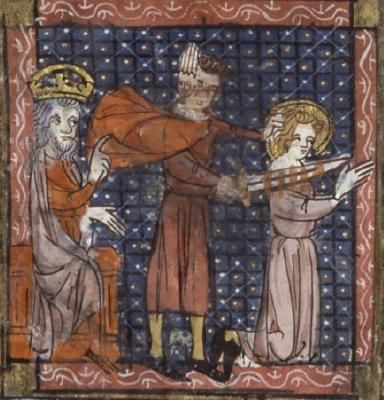
Baring-Gould’s sources: Roman and other Latin Martyrologies. Authorities: — The Acts, which are, however, fabulous, form a part of those of S. Calixtus, and pretend to have been written by the Notaries of the Roman Church; but they are forgeries. The account of S. Calepodius begins, “ In the days of Macrinus and Alexander, a great fire occurred which consumed the south of the Capitol. ” Now Macrinus was killed in 218 and was succeeded by Heliogabalus, who was murdered in 224, and then only was the boy Alexander invested with the purple. Moreover, the description given of Alexander, his desiring the consul to persecute the Christians, is quite opposed to history. It is true that some Christians suffered at the beginning of his reign, but that was through the severity of Ulpian the regent. In the Acts, however, it is Alexander himself who directs the persecution. Then again the consul at the time is Palmatius. There was no such consul at the time, and none of the name occur in the Fasti Consulares, so that the forgery is as clumsy as it is dishonest.] CCORDING to the very untrustworthy Acts, about the year 222 a fire broke out in Rome, and the Temple of Jupiter Capitolinus was so injured, that the golden hand of the idol was melted off.1 Alexander the Emperor consulted the augurs, who declared 1 History knows nothing of this fire.
…that the cause of this disaster was the presence of Christians in the city. Thereupon Alexander ordered the city to be purified of them, and that they should be punished with the utmost rigour. The consul Palmatius, at the head of a band of soldiers, penetrated into the catacombs, and captured a priest, Calepodius. Soon after, a virgin in one of the heathen temples, possessed by a demon, and regarded by the people of Rome as an oracle, cried out that the God of the Christians was the only true God. Thereupon the Consul Palmatius believed and went to pope Calixtus, and asked to be baptized. Calixtus made him lay aside his garments and descend into the font, and then he put to him the following liturgical questions: — “ Dost thou believe with all thy heart in God the Father Almighty, Maker of all things visible and invisible.” He answered, “ I believe.” “And in Jesus Christ His Son.” “ I believe.” “ And in the Holy Ghost, the Catholic Church, the remission of sins, the resurrection of the flesh?” And he answered, “Lord, I believe.”1 Then the pope poured water over him and baptized him in the name of the Trinity. After this Palmatius converted a friend, Simplicius, a senator, and healed Bl&nda, the sick wife of a certain Felix, both of whom, professing their faith in Jesus Christ, were baptized by Calixtus. All these were apprehended, and having withstood all promises, flattery, and the pangs of cruel torture, were finally taken out of the city and beheaded, and the body of Calepodius was cast into the Tiber, but having been caught in the nets of some fishermen, was brought to the pope, who buried it in a catacomb.
1 This form of the Baptismal Creed stamps the composition as later than the days of S. Gregory the Great (d. 604), for previously it was briefer, and then were introduced “ Maker of Heaven and Earth,” and the word “Catholic” as qualifying the Church. The form in the Sacramentary of Gelasius (d. 495) is without these. See Muratori “ Liturgia Romana.”