Baring-Gould’s sources: Nearly all Latin Martyrologies. Roman, Gallican, York, Salisbury, and Hereford. Anglican Reformed, S. Crispin alone. Authority: — The Acts, older than the 9th cent., in which Florus gives an epitome of them. They are so mixed up with fabulous matter that it is impossible to form an opinion on their historical value. They were probably written from popular tradition in 649, when the relics were translated by Anseric, B. of Soissons.] SS. Crispin and Crispinian, said to have been brothers, natives of Rome, exercised the trade of shoemakers at Soissons. Oct as-3 ^StS. Crispin and Crispinian.
In 284 Maximinus Herculeus proceeded against the Bagaudae, and having punished them for their revolt, came to Soissons. Among the Bagaudae there had been, no doubt, Christians, and the Caesar was inflamed with anger against those who followed the religion of Christ. Crispin and Crispinian were denounced to him, and he ordered Rictiovarus, prefect of the Gauls, to try and punish them. At Soissons is shown now the place where they are traditionally said to have been imprisoned. An abbey called Saint Crdpin en Chaie (in caved ) was built on the spot. Rictiovarus ordered them to execution by the sword, and their bodies to be cast into the common sewers. This is probably all that can be said with truth of the martyrdom; but the Acts are full of apocryphal matter, which, as it has supplied artists with subjects for their brushes, it is necessary here to detail. The judge, then, ordered the two brothers first to have spills of wood thrust between their nails and the quick. Then S. Crispin and S. Crispinian prayed, and instantly the spills started out of their fingers, and turning in the air, rushed at their tormentors and stabbed them, so that several fell dead on the spot and others died soon after of their wounds. Then Rictiovarus commanded a couple of mill-stones to be hung round the necks of the martyrs, and that they should be cast into the river Aisne. S. Crispin and his brother swam across without feeling the slightest inconvenience from the mill-stones. He then had boiling lead poured over them, but that refreshed rather than injured the indomitable shoemaker martyrs. Then pitch, oil, and fat were stewed together, and they were plunged in the bubbling caldron. This failed to injure them, therefore Rictiovarus, disgusted at his want of success, pitched himself headforemost into the fire under the caldron, and stifled his dissatisfaction in the flames. Seeing their chief persecutor thus disposed of, the martyrs vol. xii. 18 placidly devoted their necks to the sword, and their heads were struck off without difficulty by the executioner. One may be quite sure, when in the Acts of the Martyrs a series of tortures and miraculous cures leads up to a decapitation, that all but the decapitation is a pure invention of the writer.
The bodies of the martyrs are said to have been buried where afterwards stood the church of S. Cr£pin-le-Petit. It is customary at Soissons at Rogations for the procession to pass along the Rue de la Congregation, and halt before the house No. 14, which occupies the site of this old chapel, and there to chant an antiphon and collect of SS. Crispin and Crispinian.
The Roman Martyrology says on October 25th, "At Soissons in Gaul [roughly modern France and Belgium], the holy martyrs Crispin and Crispinian, Roman nobles, whose bodies were afterwards translated to Rome, and buried honourably in the church of S. Laurence ‘ in pane et pema.’ ” This translation took place in the 9th century. The bodies were also translated to Osnabriick, in Westphalia, by Charlemagne [king of the Franks, crowned emperor in 800], in the 8th century, where the pact of the Translation is annually observed on June 20th, with office approved by the Sacred Congregation of Rites. However, the church at Soissons exhibited during the Middle Ages, if not all the bones of the saints, at least a considerable number of them. All that has been preserved of the relics [the bodily remains of a saint, or objects they used, kept with honor] at Soissons since the Revolution are a portion of the skull, a thigh-bone, and some particles of bone. Other relics are at Falda.
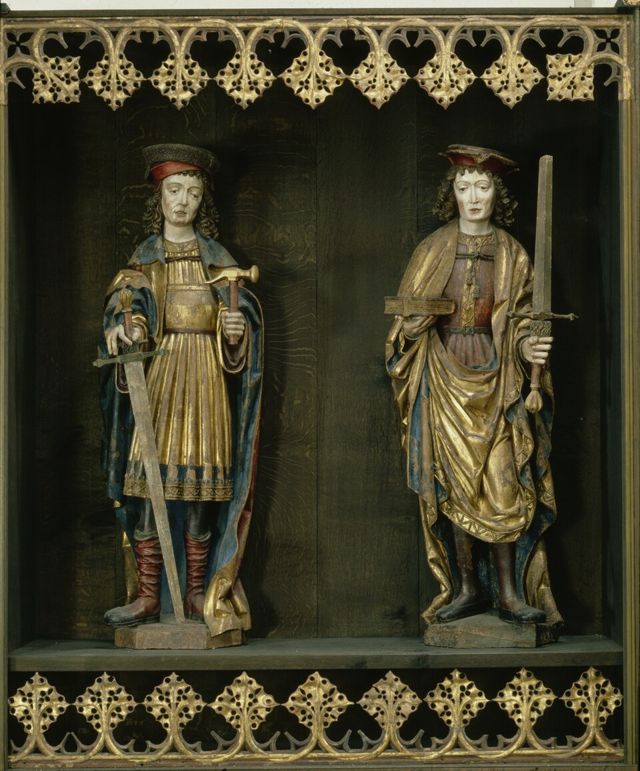
SS. Crispin and Crispinian are regarded as the patrons of shoemakers. In art they are represented with the symbols of their trade; sometimes with mill-stones hung round their necks.