Faithfulness to Christ when it cost everything.
October 9
Not verified yet
Bishop
Martyr
The first to mention S. Denys, or Dionysius of Paris, is S. Gregory of Tours, d. 594, three hundred years after his death. But this is not the most serious objection to the reception of the story. It has been argued that the worship of Dionysus (Bacchus), the god of the grape, was established at Paris, and that the great festival of Dionysus, singularly enough coincides with that of the saint of the same name, in October, the season of the vintage.
Share your faith, in words and by example. Preaching and conversion are central here.
Learn from the kind of life it was. Faithfulness to Christ when it cost everything.
The first to mention S. Denys, or Dionysius of Paris, is S. Gregory of Tours [bishop and historian of the Franks (d. 594)], d. 594, three hundred years after his death. But this is not the most serious objection to the reception of the story. It has been argued that the worship of Dionysus (Bacchus), the god of the grape, was established at Paris, and that the great festival of Dionysus, singularly enough coincides with that of the saint of the same name, in October, the season of the vintage.
Dionysus was sumamed Eleutheros, as the founder of the first mysteries, and two festivals were celebrated in his honour, one in the city, urbana, the other in the fields, rustica. During these feasts a day was dedicated to Demetrius, King of Macedon, who gave to Dionysus his daughter Aura-Placida (“the light breeze ”) as wife. Now curiously enough, on October 4th was venerated S. Aura, V., Abbess, at Paris; on October 5th S. Placidus, Mk. M., 1 on October 7th S. Bacchus, M., on October 8th S. Demetrius, M., on October 9th SS. Dionysius, Eleutherius, and Rusticus, and again a S. Demetrius. Till last century, the festival of the vintage, the legacy of the old pagan feast, was celebrated at Paris on the 8th and 9th of October, and it has been thought that as on this occasion wine made the merry-makers lose their heads, the fable of the martyrdom of S. Dionysius had reference to this phenomenon. But this argument is too plausible to satisfy. S. Placidus, though much fable has attached to his name, was a real personage, so was S. Aura, abbess at Paris in a. d. 631. Her existence 1 S. Placidia on Oct. u.
as a real person and not as an embodiment of pleasant breezes, can be very satisfactorily established. The S. Demetrius of October 9th was Bishop of Alexandria, and pronounced sentence of exile on Origen. It is quite possible that there may have been a Dionysius, bishop and apostle of the Parisians.
The Acts, it must be admitted, suspiciously recall the martyrdom of Zagreus-Dionysus. One of the first converts of Dionysius is said to have been a Parisian noble named Lisbius; the Montmorencys derive their pedigree from this personage, whence their battle cry and motto: “ Dieu aide au premier Chretien.” The mansion of Lisbius became the home of S. Denys; it was afterwards converted into a church and is now S. Barth&emy, before the Palais de Justice. Hilduin, Abbot of S. Denys, when he forged the acts of S. Dionysius, pretended that they were written by Visbius, son of Lisbius. The battle cry of the French kings, “ Montjoie Saint-Denys !” is said to have originated with Clovis, who shouted, “ Mon Jou Saint Denys !” — My Jove shall be S. Denys.
Before the Revolution the bodies of SS. Denys, Rusticus, and Eleutherius were preserved in three silver shrines in the Abbey of S. Denis. The bones were saved by a monk named Warenflot, and restored to the abbey church in 1819. The entire skull of S. Denys also at Longpont in the diocese of Soissons. Other relics [the bodily remains of a saint, or objects they used, kept with honor] at Ratisbon [Regensburg in Bavaria].
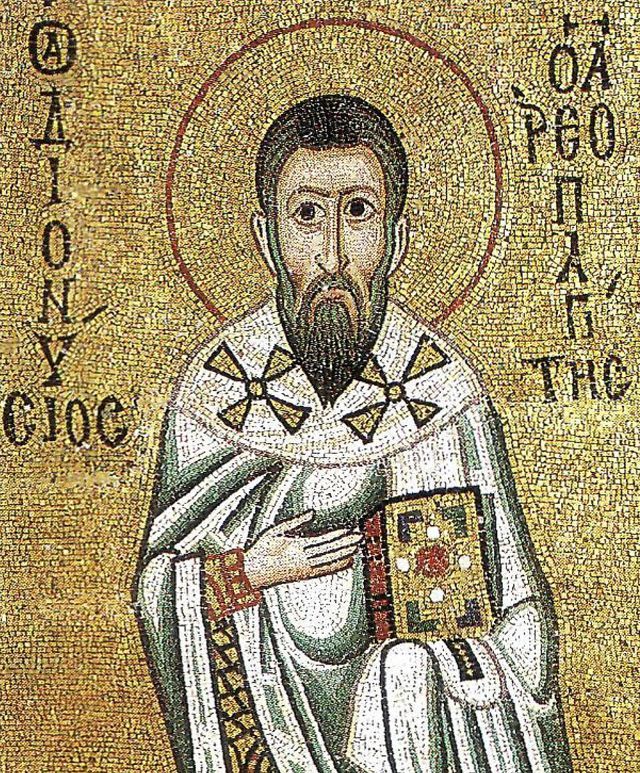
S. Denys is represented in art as a bishop, holding his head in his hands, sometimes also with a sword.
Feast: October 9
One short email a day for nine days. The day's prayer, a line from Sts. Dionysius's story, and a nudge to keep going.
From Sabine Baring-Gould, The Lives of the Saints, new edition in 16 vols. (London: John C. Nimmo, 1897–98); text from the Internet Archive scan (OCR, lightly cleaned; errors possible). Public domain.
From Sabine Baring-Gould, The Lives of the Saints, new edition in 16 vols. (London: John C. Nimmo, 1897–98); text from the Internet Archive scan (OCR, lightly cleaned; errors possible). Public domain in the United States. Reproduced unedited, except for short bracketed notes in grey that we added to explain names and terms (“S.” is the old abbreviation for Saint). Some history and judgments reflect 19th-century scholarship.