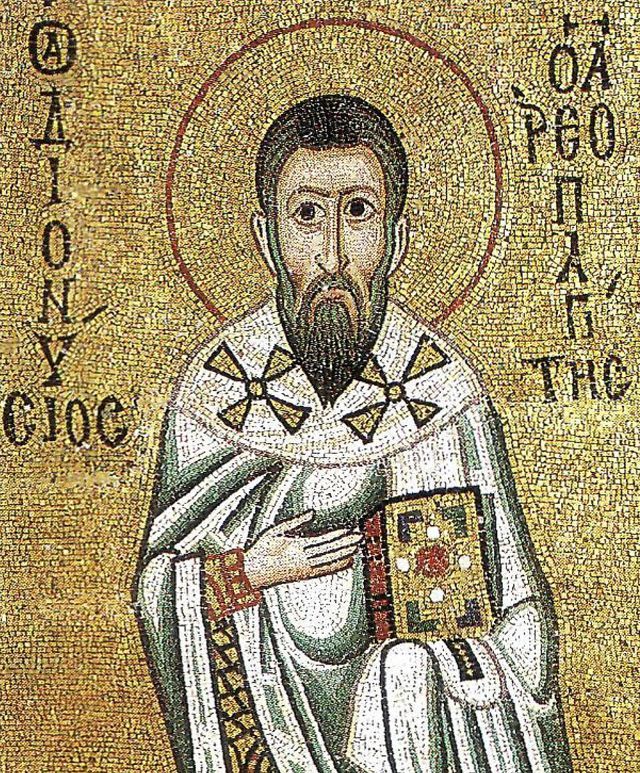
Baring-Gould’s sources: The “ Martyrologium Parvum,” drawn up in the 8th cent. “At Athens, under Adrian, the passion of S. Dionysius the Areopagite, as Aristides witnesses in his work, which he composed on the Christian Religion; ” this is on Oct. 3; and on Oct 9, “ At Paris, Dionysius the bishop and his companions slain by the sword by Fescennius.” The Martyrologies of Bede, Ado, Notker, Usuardus, and those of Virdun, Lyons, and Rheims, all belonging to the 7th, 8th, and 9th centuries, distinguish the two Dionysii. All these commemorate the Areopagite on Oct. 3. So also the Greek Menology of the Emperor Basil, which makes him suffer at Athens.] j|T would appear that at least three different persons have been confounded under the name of Dionysius: 1. Dionysius, the convert, friend, and companion of S. Paul, who “ clave unto him” at Athens; 2 2. Dionysius, the apostle and patron saint of France; and 3. The author of the so-called works of Dionysius. The identification of the first with the second was, 1 Never canonized, but inserted in the Anglican Martyrology of Wilson. FESTIVAL OF THE MATERNITY OF THE B.V. MARY. (Second Sunday in October.) From the Vienna Missal.
Oct. Parti. S. Dionysius. at least in the Western Church, the work of the 9th century. S. Gregory of Tours [bishop and historian of the Franks (d. 594)], a.d. 570, states expressly that the Dionysius who was the Apostle of France was sent in the time of Decius [Roman emperor 249–251, who ordered everyone to sacrifice to the gods] (circ. a.d. 253); and Sulpitius Severus (a.d. 410) places the first Gallic martyrdom as late as the reign of Antoninus [Antoninus Pius, Roman emperor 138–161] (a.d. 167-181), which could not have been correct had Dionysius, the friend of S. Paul, suffered under Domitian [Roman emperor 81–96] in apostolic times.
Michael the Stammerer, Emperor of the East, sent a copy of the Dionysian writings as a fitting present to Louis the Pious, son of Charlemagne [king of the Franks, crowned emperor in 800], King of France and Emperor of the West. These writings were attributed to Dionysius the Areopagite, the disciple of S. Paul. Their real date is the end of the 5th or the beginning of the 6th century. These writings arrived at Paris on the eve of the Feast of S. Denis of France, and were carried in state to the abbey erected over the remains of the patron of France. And, “ as though it had come down from heaven, such was the divine grace which followed, on that same night Christ our Lord deigned to work, to the glory of His name, through the prayers and merits of His most renowned martyr, nineteen most marvellous miracles, in the healing of persons well known and living in our neighbourhood, sick of various infirmities.” 1 Hilduin at once produced a forged life of S. Denis, which he pretended was written by the son of a Parisian chief, the first convert of Dionysius. He may have sought thereby to exalt the dignity of his abbey and enhance the popular estimation of S. Denis of France, but the act was a disgraceful and unpardonable one.
This life is, of course, utterly fabulous; it shall be spoken of under the head of S. Dionysius of Paris. But, before that, the identification of Dionysius of Paris with the disciple of S. Paul was an accomplished fact. In the reign of Dagobert 1 Letter of Hilduin, Abbot of S. Denis, to Charles the Simple. (a.d. 632-646), the abbey of S. Denis was founded, and this is probably the date of the simpler Acts which have been published by the Bollandists [Jesuit scholars who since the 1600s have critically studied the lives of the saints] and by Felibanus. The identification of S. Denis of Paris with S. Dionysius of Athens does not occur in the early Martyrologies, and does not seem to have been general before the time of Hilduin’s imposture. The Roman Martyrology identifies the two; and in the mass for October 9 the Collect and Gospel refer to the Gallican saint, and the Epistle to the Athenian. In the Legenda Aurea, the Bibliotheca Mundi of Vincent of Beauvais, and all the great mediaeval encyclopaedias, the two are identified without scruple with the author of the so-called works of S. Dionysius. Such was the triune saint to whom our great English martyr, S. Thomas of Canterbury, specially commended his soul when the sorrows of death encompassed him.
Eusebius [Eusebius of Caesarea (d. c. 339), the first historian of the Church], on the authority of Dionysius, Bishop of Corinth, says that the Areopagite became bishop of Athens. The writings attributed to him are certainly posterior. The earliest known quotation from them is as late as the 6th century. They are not quoted by any of the earlier fathers. S. Jerome [translator of the Bible into Latin (d. 420)] makes no mention of them in his catalogue of ecclesiastical writers. Many of the traditions and practices described belong to a period long posterior to the time of the apostles. And mention is made in them of an epistle of Ignatius, written shortly before his death, in the reign of Trajan [Roman emperor 98–117], and therefore two reigns after the death of the Dionysius who is said to have quoted it. These and other objections are ably considered by Mr. Westcott in a carefully-written article in the Contemporary Review, l and he fixes the date of the Dionysian writings at about a.d. 480-520. We see no reason why they should not have been written by a Dionysius of that time. The addresses and references to “ Our great Pre1 Vol. V tSfrr Oct. 9-j S. Dionysius.
ceptor” (Paul), to “Our most holy of holy sons ” (Timothy), “ To my fellow-priest, Timothy,” to “ Good Timothy,” to “ Polycarp, Bishop of Smyrna,” to “ Titus, Bishop of Crete,” to “John the Divine, apostle and evangelist, exiled in the Isle of Patmos,” &c., sit very loosely indeed upon the great body of the works which they adorn, and might easily enough have been inserted into one of the earlier copies of the text by some more devoted than scrupulous admirer, in order to gain greater authority for them. It may have been he, likewise, who selected from the New Testament “ the one name which combined Greek culture with Christian faith,” tJu ? Dionysius, to apply to these writers, much in the same way as the Apocryphal Gospels were, doubtless with the best and purest intentions, attributed not to those who actually, but to those who it was presumed potentially might, could, would, should, or ought to have written them. 1 But though the authenticity of the writings must be rejected, they received an assent almost at once, which was, practically, overwhelming. They were considered to be the works of the Areopagite by Leontius of Byzantium and S. Anastasius the Sinaite, both men of learning and authority in the 6th century; by S. Maximus, one of the greatest and most philosophic minds of the 7th century; by Sophronius of Jerusalem (circ. 638); by S. Andrew of Crete (c. 635); by Michael Syncellus (c. 830); by S. John Damascene (d. 760); by Simeon Metaphrastes (c. 901); by Suidas (c. 1081); by Euthymius Zigabenus (c. 1 1 16); and, in fact, by all the great writers of the Greek Church of those ages. They were likewise quoted as authoritative in several Greek Councils. 2 And finally, in the Latin Church they were likewise rewritings of Philo on them is very observable, as Philo De Fugativ. cc. 18, 19; De ceived as genuine as early as the time of S. Gregory, who himself quotes the Areopagite in one of his sermons. 1 In the Acts of the Lateran [St. John Lateran, the pope’s cathedral in Rome] Synod (a.d. 660) S. Martin [St. Martin of Tours (d. 397), soldier turned bishop] quotes, as a conclusive authority, “ Dionysius egregius.” The titles of the extant Dionysian writings are; 1. On the Celestial Hierarchy; 2. On the Ecclesiastical Hierarchy; 3. On the Divine Names; 4. On Mystical Theology; 5. Ten Epistles. The four first of these, taken together, form a complete philosophical or theological system, beginning (1) with God (or pure Being), descending step by step through His manifestations, from the highest spirits of heaven to (2) the lowest things on earth, to the end (3) that the soul may know God so far as He may be known, and (4) be united with him as the only source of all Good and Blessedness. The author alludes to six other works, now lost: 1. On Theological Outlines; 2. On Symbolical Theology; 3. On the Soul; 4. On the Just Judgment of God; 5. On the Objects of Intellect and Sense; 6. On Divine Hymns. But as none of these have ever been heard of apart from such mention of them, and as they are seldom referred to except in those places where the writer is least inclined to add more, it has been thought that these works were in contemplation by the author, but were never written. Of the value and importance of the writings of the pseudoDionysius it is scarcely possible to speak too highly. I S. DENYS, J supported by two angels, and carrying his head— a Christian lady, 8. Catulla, is holding his winding sheet or shroud— Above: the shroud is being wrapped around the head. After a Miniature in a MS. of the XIV. Century. Oct. 9.