Baring-Gould’s sources: Greek Menaea and Menology. Roman Martyrology. Authority. The Greek Acts, late and not trustworthy.]. The Acts say that Maximian, in his seventh year, issued an edict against the Christians, and that Eulampius and Eulampia suffered at Nicomedia, in Bithynia. The seventh year of Maximian is 293, when there was no persecution. Moreover, Maximian did not bear rule in the East. His palace was at Milan, that of Diocletian at Nicomedia. But Maximinus did persecute in the East in 306, when Caesar. Maximinus assumed the title of Emperor in 307, and when persecution relaxed he renewed it The persecution was stopped by edict of Galerius in 31 1. Maximinus died in 313. Probably, though Acts, Menaea, and Menology assert that Maximian was the persecutor, we must read Maximin for Maximian. Maximin was made Caesar in 305, and the seventh year may be 312. But not much VOL. XI. IS reliance can be placed on the figures or names in the late Acts.
The edict given in them begins, “ Maximianus, Emperor, to the inhabitants of the metropolis of Nicomedia,” &c. And considering that Maximian [Diocletian’s co-emperor in the West, 286–305] had nothing to do with Nicomedia, and that the seventh year of Maximin as Emperor would be 314, a year after his death, we may judge of the worthlessness of such statements in the Acts. When the persecution broke out in Nicomedia, Eulampius, a young Christian, together with many other Christians, fled the city and hid themselves in caves. After a while they had consumed all their provisions, and therefore were obliged to send one of their number into the town to buy bread. They selected Eulampius, who, being a boy, might escape observation. Eulampius had unfortunately chosen the day for entering the city when all the inhabitants were attending in the temple to offer sacrifice according to the commands of the Emperor. The boy saw the edict nailed up at the gates, and stood still to read it. The soldiers guarding the gates spoke to him, and he turned and ran away. The watch pursued him, outstripped and arrested him, and asked him his name and why he had attempted flight. As he did not answer, they suspected that he was a Christian, bound him, and put him in ward.
Next day he was brought before the prefect, and the guards told their tale. But the governor, pitying his simplicity and youth, said, “ Ye have acted wrongly and rashly. This is an ignorant country boy, and ye have bound him without cause. Knock off his chains, and place him by me.” The boy was at once freed and brought to the governor, who addressed him kindly, saying, “Boy, what is your name ? Are you a slave or free ?”
“I am the Lord’s servant,” answered he, “ and my name is Eulampius. I am of honourable birth.” oct to.] 6\S\ Eulampius and Eulampia. 227 “ Well, boy,” said the prefect, “ if you belong to an honourable family, behave honourably, and go and sacrifice and return to me.”
“ To whom shall I sacrifice?” “ To Dios, or to Apollo, or to the great goddess Demeter.” “ He who trusts in them falls into perdition,” answered Eulampius. “ They are but idols, the work of men’s hands.” Then the governor was angry, and ordered Eulampius to be stripped and beaten. After he had received many strokes, the kind-hearted governor said, “ That will do; spare him, and let him get up.”
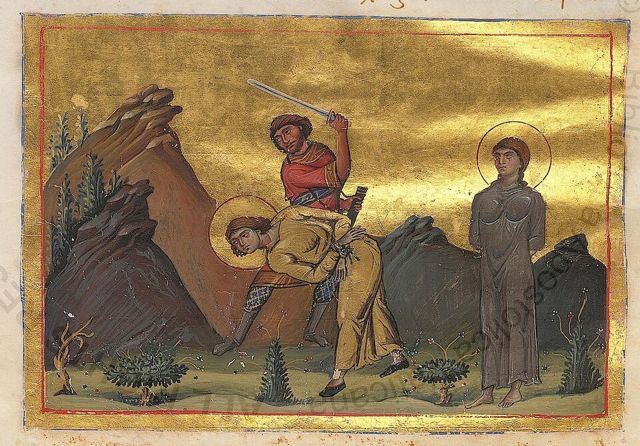
Eulampius rose, and defied him and his gods, in language excited and violent, and which seems to have been quite as much an exhibition of temper in a boy smarting after a whipping as of Christian zeal in a martyr for the faith. He succeeded in sufficiently incensing the governor to order his suspension on the little horse. Suddenly, from among the bystanders broke a young girl, who, rushing up to Eulampius, threw her arms round his neck, sobbing. This was Eulampia, his sister. She was at once arrested, and conducted to prison along with her brother, and on the morrow both were executed with the sword.
The untrustworthy Acts have intruded a whole series of tortures which do not hurt the martyrs. They are plunged in boiling lead, and come forth refreshed, but cold steel in these cases is infallible; and we may be quite sure when we read of a martyr suffering by the sword after a string of unsuccessful attempts at execution by fire, water, poison, wild beasts, &c., that these tortures were not tried, but are the invention of the author of the Acts in their present form. [Oct- ia