Sts. Gervasius and Protasius

Gervasius and Protasius are martyrs of Milan, probably of the second century, and patrons of the city.

Read the essentials →
June 19 · Martyrs

Sts. Gervasius and…

Sts. Gervasius and Protasius

Gervasius and Protasius are martyrs of Milan, probably of the second century, and patrons of the city.

Traditional feast

June 19
1914 / pre-1969 calendar, per Baring-Gould (1897)

Current feast

June 19 (also listed: October 14)
Secondary source · Wikipedia

Represents

Martyrs

Their story

Adapted in modern English from the Catholic Encyclopedia (1913) · original text below

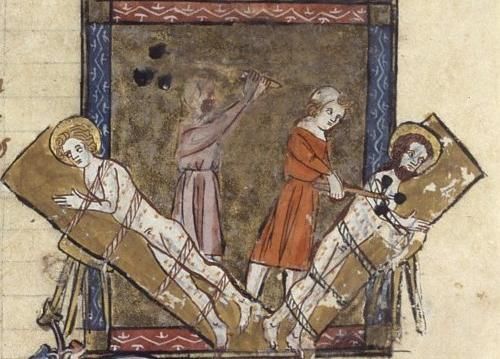
Gervasius and Protasius are martyrs of Milan, probably of the second century, and patrons of the city. Their Acts (the written account of a martyr's trial and death) are of uncertain date. Tradition, as recorded there, says they were twin sons of martyrs: their father Vitalis died for the faith at Ravenna and their mother Valeria at Milan. The brothers are said to have been scourged and then beheaded.

By the time of St Ambrose their grave and even their names had been forgotten. In 386 Ambrose built a magnificent basilica at Milan, and the people asked him to consecrate it with relics, as was done at Rome. He promised to do so if relics could be found. In a dream he was shown where to look. He had the ground dug up in the cemetery church of Sts Nabor and Felix outside the city, and there found the remains of Gervasius and Protasius. They were carried into his new basilica, now Sant'Ambrogio, and many miracles were reported. This happened during Ambrose's great struggle with the Arian (followers of Arius's teaching that the Son is a created being, not fully God) Empress Justina.

Ambrose described the discovery in a letter to his sister Marcellina. St Augustine, not yet baptized, saw these events and wrote about them in his Confessions. When Ambrose died in 397 he was buried beside the two martyrs, as he had wished, and their relics were found together again in 1864. Their cult spread quickly through Italy and Gaul, and their names were put into the Litany of the Saints very early.

Early life

Selected sentences from the original account, unaltered.

Gervasius and Protasius entered into possession of the wealth of their parents, and disposed of it in charity.

What they represent

How they teach us to live

Drawn from themes in the original account

Keep their day. Remember them on June 19 with a short prayer, and ask for their help.

From the Catholic Encyclopedia

1913 · 714 words

Martyrs of Milan, probably in the second century, patrons of the city of Milan and of haymakers; invoked for the discovery of thieves. Feast, in the Latin Church, 19 June, the day of the translation [the solemn moving of a saint’s relics to a new shrine] of the relics [the bodily remains of a saint, or objects they used, kept with honor]; in the Greek Church, 14 Oct., the supposed day of their death. Emblems: scourge, club, sword.

The Acts (Acta SS., June, IV, 680 and 29) were perhaps compiled from a letter (Ep. liii) to the bishops of Italy, falsely ascribed to St. Ambrose. They are written in a very simple style, but it has been found impossible to establish their age. According to these, Gervasius and Protasius were twins, children of martyrs. Their father Vitalis, a man of consular dignity, suffered martyrdom at Ravenna under Nero (?). The mother Valeria died for her faith at Milan. The sons are said to have been scourged and then beheaded, during the reign of Nero, under the presidency of Anubinus or Astasius, and while Cajus was Bishop of Milan. Some authors place the martyrdom under Diocletian [Roman emperor 284–305, who began the ‘Great Persecution’ of Christians in 303], while others object to this time, because they fail to understand how, in that case, the place of burial, and even the names, could be forgotten by the time of St. Ambrose, as is stated. De Rossi places their death before Diocletian. It probably occurred during the reign of Antoninus [Antoninus Pius, Roman emperor 138–161] (161-168).

St. Ambrose, in 386, had built a magnificent basilica at Milan. Asked by the people to consecrate it in the same solemn manner as was done in Rome, he promised to do so if he could obtain the necessary relics. In a dream he was shown the place in which such could be found. He ordered excavations to be made in the cemetery church of Sts. Nabor and Felix, outside the city, and there found the relics of Sts. Gervasius and Protasius. He had them removed to the church of St. Fausta, and on the next day into the basilica, which later received the name San Ambrogio Maggiore. Many miracles are related to have occurred, and all greatly rejoiced at the signal favour from heaven, given at the time of the great struggle between St. Ambrose and the Arian [followers of Arius, who taught that the Son is a created being, not fully God] Empress Justina. Of the vision, the subsequent discovery of the relics and the accompanying miracles, St. Ambrose wrote to his sister Marcellina. St. Augustine, not yet baptized, witnessed the facts, and relates them in his "Confessions", IX, vii; in "De civ. Dei", XXII, viii; and in "Serm. 286 in natal. Ss. Mm. Gerv. et Prot.", they are also attested by St. Paulinus of Nola, in his life of St. Ambrose. The latter died 397 and, as he had wished, his body was, on Easter Sunday, deposited in his basilica by the side of these martyrs. In 835, Angilbert II, a successor in the See of Milan, placed the relics of the three saints in a porphyry sarcophagus, and here they were again found, January, 1864 (Civiltà Cattolica, 1864, IX, 608, and XII, 345).

Read the rest of the article

A tradition claims that after the destruction of Milan by Frederick Barbarossa, his chancellor Rainald von Dassel had taken the relics from Milan, and deposited them at Altbreisach in Germany, whence some came to Soissons; the claim is rejected by Milan (Biraghi, "I tre sepoleri", etc. Milan, 1864). Immediately after the finding of the relics by St. Ambrose, the cult of Sts. Gervasius and Protasius was spread in Italy, and churches were built in their honour at Pavia, Nola, etc. In Gaul [roughly modern France and Belgium] we find churches dedicated to them, about 400, at Mans, Rouen, and Soissons. At the Louvre there is now a famous picture of the saints by Lesueur (d. 1655), which was formerly in their church at Paris. According to the "Liber Pontificalis", Innocent I (402-417) dedicated a church to them at Rome. Later, the name of St. Vitalis, their father, was added to the title. Very early their names were inserted in the Litany of the Saints. The whole history of these saints has received a great deal of adverse criticism. Some deny their existence, and make them a Christianized version of the Dioscuri of the Romans. Thus Harris, "The Dioscuri in Christian Legend", but see "Analecta Boll." (1904), XXIII, 427.

STOKES in Dict. Christ. Biog., s.v.; KRIEG in Kirchenlex., s.v.; BUTLER, Lives of the Saints (19 June).
Read more

The full original · 383 words

Read Baring-Gould’s full account

Baring-Gould’s sources: Roman Martyrology. Authority: — An account which is falsely attributed to S. Ambrose. The account is very simple in style, and it is impossible to conjecture its date. It contains no account ot the discovery of the relics by S. Ambrose in 386, so that it is probable that these Acts are earlier, and that the introduction was added later. It has been supposed that because we are told in them that the place where the bodies of the saints were laid had been forgotten, the existence of these saints must have been forgotton also, but this is by no means self-evident. It was because SS. Or vase and Protasius were regarded as the protomartyrs of Milan that.such rejoicing was manifested at the discovery of their bodies.] [t™05ja|ITALIS, the father of the twins Gervasius and Protasius, was a man of consular rank, MyJm at Milan, who had served in the army wrV^Ml with distinction. He came to Ravenna with the judge Paulinus, whom he assisted in his functions. One day, a Christian physician named Ursicinus, was brought before tribunal, and was sentenced to lose his head. The place of execution was called Ad Palmas, because it was situated at the foot of a clump of old 1 See S. Bruno, Feb. 14.

Gervasius & Protasius. palms. When Ursicinus arrived at the spot, his courage failed, and he would have fallen from the faith, had not Vitalis, regardless of his own safety in his zeal to save his brother, exclaimed, “Ursicinus! say, having reached the palm, will you lose the crown ?” Ursicinus, filled with shame, threw himself on his knees, and bade the executioner strike. For having encouraged the martyr, Vitalis was accused to Paulinus, who ordered a hole to be dug, and Vitalis to be laid in it, and stones to be heaped over him; and thus he gained his reward. His wife, Valeria, was on her way to Milan, when she was met by a party of Bacchantes celebrating the mysteries of Sylvanus. They noisily insisted on her joining in their ceremonies, and when she indignantly refused, the intoxicated pagans fell upon her, and beat her so severely, that she died three days after. Gervasius and Protasius entered into possession of the wealth of their parents, and disposed of it in charity. At the end of ten years, the Roman ‘general, Astasius, was on his way through Milan, to oppose the Marcomanni, when the augurs whom he consulted at Milan informed him that the gods would refuse him success unless he purged the city of certain Christians who derided their worship. Astasius at once gave orders for the arrest of the Christians, and Gervasius and Protasius were brought before him. Gervasius was beaten with leaded whips till he was dead, and then the general endeavoured to persuade his brother to sacrifice. But Protasius declared his readiness to die like his brother, and his head was struck off. In the lapse of time, the place where the martyrs were buried was forgotten, but it was revealed to S. Ambrose [bishop of Milan (d. 397)] in a dream, and he wrote an account of the vision and the subsequent discovery of the bones in a Lives oj the Saints.

letter to his sister, still extant. S. Augustine also mentions the circumstances in his “ De Civitate Dei.” The bones of these two saints were carried away from Milan by the Emperor Frederick Barbarossa, and distributed amongst several churches in Germany. Some of the relics [the bodily remains of a saint, or objects they used, kept with honor] are at Soissons; some at Alt Breisach in Breisgau, but these relics have been pronounced spurious.

Feast days

Feast: June 19

Nine days · Free

Pray the novena
with us.

One short email a day for nine days. The day's prayer, a line from Sts. Gervasius and…'s story, and a nudge to keep going.

Also on June 19
I

St. Innocent of Le Mans

June 19 · Bishop
O

Bl. Odo of Cambrai

June 19 · Bishop
St. Juliana Falconieri

St. Juliana Falconieri

June 19 · Virgin
← All 1726 saints in the library
Sources & notes

Feast-day sources

Story sources

Sources

Credits

Image: Gervaseandprotase.jpg · Français 185 , Fol. 233v. Vies de saints, France, Paris, XIVe siècle, Richard de Montbaston et collaborateurs · Public domain, via Wikimedia Commons

From Sabine Baring-Gould, The Lives of the Saints, new edition in 16 vols. (London: John C. Nimmo, 1897–98); text from the Internet Archive scan (OCR, lightly cleaned; errors possible). Public domain.

Image: Français 185 , Fol. 233v. Vies de saints, France, Paris, XIVe siècle, Richard de Montbaston et collaborateurs, Wikimedia Commons (Public domain)

From “Catholic Encyclopedia (1913)/Sts. Gervasius and Protasius,” The Catholic Encyclopedia (New York: Robert Appleton Company, 1907–1914), via Wikisource. Public domain. Matched by name and feast date; text unedited except for our bracketed notes in grey.

From Sabine Baring-Gould, The Lives of the Saints, new edition in 16 vols. (London: John C. Nimmo, 1897–98); text from the Internet Archive scan (OCR, lightly cleaned; errors possible). Public domain in the United States. Reproduced unedited, except for short bracketed notes in grey that we added to explain names and terms (“S.” is the old abbreviation for Saint). Some history and judgments reflect 19th-century scholarship.