St. Juliana Falconieri

A whole life given to God with an undivided heart.

Read the essentials →
June 19 · Virgin

St. Juliana Falconieri

St. Juliana Falconieri

A whole life given to God with an undivided heart.

Traditional feast

June 19
1914 / pre-1969 calendar, per Baring-Gould (1897)

Current feast

June 19
Secondary source · Wikipedia

Represents

Virgin

Their story

Adapted in modern English from Baring-Gould (1897–98) · original text below

Juliana's father had built the noble church of the Annunziata in Florence at his own expense. It was claimed that the first words she ever spoke were the names of Jesus and Mary, though the source calls this an exaggeration of the fact that she learned those names early. She was so devout as a child that her uncle, Blessed Alexis, told her mother she had brought an angel into the world.

At fifteen she gave up her inheritance, refused to marry, and took religious vows before St Philip Benizi, and she founded the Mantellates. Her mother joined them and became her daughter's disciple in religious life. Philip thought so highly of Juliana that at his death he entrusted the management of his Servite Order to her.

She spent her days in prayer and often fell into ecstasies. She ate only four times a week, and on Saturdays only bread and water. This severe diet ruined her digestion, and she suffered from her stomach for the rest of her life. In her long last illness she could not keep food down and so could not receive Communion. Grieved, she asked the priest to lay the Host on her breast. According to her biographer, who wrote more than two hundred years later, the Host vanished and its imprint was found on her flesh after her death. The story spread through Florence and she was venerated as a saint.

Struggles & surrender

What they wrestled with, and how they gave it to God

  • Fasting that broke her health ·
    Juliana ate only four times a week, and on Saturdays only bread and water. This severe diet ruined her digestion, and she suffered from her stomach for the rest of her life. In her last illness she could not keep food down and grieved that she could not receive Holy Communion.

Early life

Selected sentences from the original account, unaltered.

Her father had erected, at his sole cost, in the town ol Florence, the noble church of the Annunziata. It is pretended that the first words Juliana uttered, even before she learned to call her father and mother, were the sacred names of Jesus and Mary, but this is no doubt an exaggeration of the fact that she learned these names at an early age. She showed such precocious signs of piety that her uncle, the Blessed Alexis, told her mother that she had brought into the world an angel rather than a little woman.

What they represent

How they teach us to live

Drawn from themes in the original account

Feed your mind with Scripture and good books. Learning and the Scriptures matter in this life.

Learn from the kind of life it was. A whole life given to God with an undivided heart.

From the Catholic Encyclopedia

1913 · 435 words

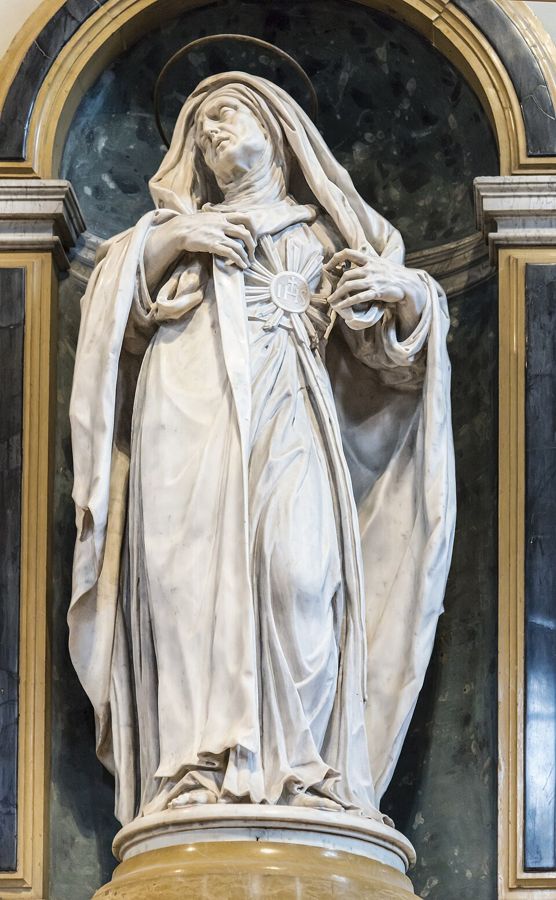
Born in 1270; died 12 June, 1341. Juliana belonged to the noble Florentine family of Falconieri. Her uncle, St. Alexis Falconieri, was one of the seven founders of the Servite Order (q.v.). Through his influence she also consecrated herself from her earliest youth to the religious life and the practices of Christian perfection. After her father's death she received about A.D. 1385 from St. Philip Benitius, then General of the Servites, the habit of the Third Order, of which she became the foundress. Until her mother's death she remained in her parents' house, where she followed the rule given her by St. Philip Benitius, practicing perfect chastity, strict mortification, severe penance, zealous prayer, and works of Christian charity. After her mother's death she and several companions moved into a house of their own in 1305, which thus became the first convent of the Sisters of the Third Order of Servites, Juliana remaining the superior until the end of her life. Their dress consisted of a black gown, secured by a leathern girdle, and a white veil. As the gown had short sleeves to facilitate work, people called the sisters of the new order "Mantellate". They devoted themselves especially to the care of the sick and other works of mercy, and the superioress, through her heroic deeds of charity, set a noble example to all. For thirty-five years Juliana directed the community of Servite Tertiaries. An extraordinary occurrence, mentioned in the oratio of her feast day, took place at her death. Being unable to receive Holy Communion because of constant vomiting, she requested the priest to spread a corporal upon her breast and lay the Host on it. Shortly afterwards the Host disappeared and Juliana expired, and the image of a cross, such as had been on the Host, was found on her breast. Immediately after her death she was honoured as a saint. The Order of Servite Tertiaries was sanctioned by Martin V in 1420. Benedict XIII granted the Servites permission to celebrate the Feast of St. Juliana. Clement XII canonized her in 1737, and extended the celebration of her feast on 19 June to the entire Church. St. Juliana is usually represented in the habit of her order with a Host upon her breast.

Acta SS., III, June, 917-25; BERNARDUS, Vita della beata Giuliana Faconieri (Florence, 1681); LORENZINI, Vita di S. Giuliana Falconieri (Rome, 1738); Legenda di S. Giuliana Falconieri, con note di Agost. Morini (Florence, 1864); BATTINI, Compendio della vita di S. Giuliana Falconieri (Bologna, 1866); SOULIER, Life of St. Juliana Falconieri (London, 1898); LÉPICIER, Ste. Julienne Falconieri fondatrice des Mantelées (Brussels, 1907).

Read more

The full original · 455 words

Read Baring-Gould’s full account

Baring-Gould’s sources: Roman Martyrology. Beatified by Benedict XIII. in 1799, canonized by Clement XII. Authority: — An Italian life by Fr, Archangelo Giani Florentine a Servite, dedicated to Anne of Austria, in 1618.] Juliana was the child of the old age of Chiarissimo and Reguardata Falconieri, who had lost all hopes of having issue.

Her father had erected, at his sole cost, in the town ol Florence, the noble church of the Annunziata. It is pretended that the first words Juliana uttered, even before she learned to call her father and mother, were the sacred names of Jesus and Mary, but this is no doubt an exaggeration of the fact that she learned these names at an early age.

She showed such precocious signs of piety that her uncle, the Blessed Alexis, told her mother that she had brought into the world an angel rather than a little woman. It is not uncommon for uncles and other kindly-disposed persons to make flattering remarks about babies to their parents, but it is not always that these remarks prove prophetic. Juliana early showed that she had by nature, or had acquired, a most unfeminine indifference to men. There is nothing more charming in a child than the open ingenuous look, full of guilelessness, and telling its own tale of an innocent, transparent soul. But Juliana never looked a man full in the. face; and she had, or affected, such a horror of sin, that the mere mention of a crime caused her to faint away. On reaching the age of fifteen she gave up her patrimonial estate, refused to marry, and took the vows of religion before S. Philip Beniti, and founded the order of the Mantellates. Her mother joined the society, and became a disciple in the religious life under her daughter. S. Philip Beniti entertained so high an opinion of Juliana that, at his death, he entrusted to her the management of his Order of Servites.

Juliana Falconieri spent her days in prayer, and was often rapt in ecstacies. She took food only four times a week, and on Saturdays ate only bread, and drank water. This severe system of diet naturally disordered her digestive organs, and she suffered severely from her stomach through the rest of her life. In her long last sickness her stomach rejected food, and she was consequently unable to receive the Holy Communion. Grieved at this deprivation, she requested the prie&t to apply the Host to her breast. It is pretended that the host disappeared, and that after her death the impression of it was found on her flesh.1 The rumours of this marvel attracted the attention of all Florence, and she received popular veneration as a saint. Pope Benedict XII. allowed the Order of the Servites to draw up and use an office for her day, and she was inscribed among the saints by Clement XU.

1 It must be remembered that the only authority for this marvel is the biographer who wrote more than two hundred years later. June bo.] S. Novatus.

Feast days

Feast: June 19

Nine days · Free

Pray the novena
with us.

One short email a day for nine days. The day's prayer, a line from St. Juliana Falconieri's story, and a nudge to keep going.

Also on June 19
Sts. Gervasius and Protasius

Sts. Gervasius and…

June 19 · Martyrs
I

St. Innocent of Le Mans

June 19 · Bishop
O

Bl. Odo of Cambrai

June 19 · Bishop
← All 1726 saints in the library
Sources & notes

Feast-day sources

Story sources

Sources

Credits

Image: Santa Maria dei Servi (Padua) - Altare dell'Addolorata - Santa Giuliana Falconieri.jpg · Didier Descouens · CC BY-SA 4.0, via Wikimedia Commons

From Sabine Baring-Gould, The Lives of the Saints, new edition in 16 vols. (London: John C. Nimmo, 1897–98); text from the Internet Archive scan (OCR, lightly cleaned; errors possible). Public domain.

Image: Didier Descouens, Wikimedia Commons (CC BY-SA 4.0)

From “Catholic Encyclopedia (1913)/St. Juliana Falconieri,” The Catholic Encyclopedia (New York: Robert Appleton Company, 1907–1914), via Wikisource. Public domain. Matched by name and feast date; text unedited except for our bracketed notes in grey.

From Sabine Baring-Gould, The Lives of the Saints, new edition in 16 vols. (London: John C. Nimmo, 1897–98); text from the Internet Archive scan (OCR, lightly cleaned; errors possible). Public domain in the United States. Reproduced unedited, except for short bracketed notes in grey that we added to explain names and terms (“S.” is the old abbreviation for Saint). Some history and judgments reflect 19th-century scholarship.