M

The relics of these martyrs are thought to have been found at Saragossa in 1389.

Read the essentials →
April 16 · —

Sts. Martyrs of Saragossa

Sts. Martyrs of Saragossa

The relics of these martyrs are thought to have been found at Saragossa in 1389.

Traditional feast

April 16
1914 / pre-1969 calendar, per Baring-Gould (1897)

Current feast

Not verified yet

Represents

Feast

Their story

Adapted in modern English from Baring-Gould (1897–98) · original text below · little is known

(The surviving account on this page begins partway through the story.)

The relics of these martyrs are thought to have been found at Saragossa in 1389. Another martyr of Saragossa, Lambert, is also remembered; the Bollandist Papebroeck criticised the Breviary (the book of the Church's daily prayer) lessons about him as built from guesses, folk tales and misread pictures.

The story is that Lambert, a farm labourer, refused his master's order to worship the gods while ploughing, and was struck dead with the ploughshare. Baring-Gould thinks his Germanic name means he died much later, under a Moorish master. Papebroeck added that the Breviary compilers of 1573 had not shown much care. Lambert is shown holding his head.

Early life

The book says little or nothing about early life. This is how the account begins.

Thin entry · the 1897 book gives only 249 words. We have not filled the gap with invented detail.

…where her wounds mortified and she died. The relics of these martyrs are supposed to have been found at Saragossa in 1389.

What they represent

How they teach us to live

Drawn from themes in the original account

Stay faithful when it costs you. This account is about holding firm under pressure.

Practise small acts of self-denial. The account dwells on fasting and penance; a skipped snack or a phone-free hour is a start.

Read more

The full original · 249 words

Read Baring-Gould’s full account

Baring-Gould’s sources: Ado, Notker, Roman Martyrology; Spanish and P o r tu g ese Marty rologies. Authorities A hymn of Prudentius, and the Acts.] [ B 8 PWRUDENT 1 US, the Christian poet of Saragossa, describing the passion of these glorious martyrs, still fresh in the memory of the citizens of his native town. S. Optatus, and seventeen other stalwart soldiers of Jesus Christ, received the crown of martyrdom on the same day, in the persecution of Diocletian,, under the cruel governor Dacian. Two others, Caius and Crementius, died of their torments after a second examination. The blessed Encratia was another victim of the same magistrate. She was most barbarously tortured by his orders; her sides were lacerated with iron hooks, and one of her breasts was then cut 0$ and then part of her liver was tom out She was then sent back to prison, Apru i6.] vS\9. Martyrs of Saragossa.

…where her wounds mortified and she died. The relics [the bodily remains of a saint, or objects they used, kept with honor] of these martyrs are supposed to have been found at Saragossa in 1389.

Another Saragossian martyr commemorated this day is S. Lambert Of him Tamayus Salazar says, in his Spanish Martyrology, “ Lest there should be too much joy through so many festivals on one day, the Church with circumspection has separated them, and transferred the feast of S. Lambert to June 19th.” And Papebroeck, the Bollandist, adds, “Prudently and circumspectly indeed, but we very much doubt whether the compilers of the Breviary published in 1573 used the same prudence and circumspection, when, confusing times and events, they compiled the lessons for this saint, to be recited in the divine offices, partly from their own conjectures, partly from the uncertain tales of the vulgar, and partly from pictures and sculptures ill understood.”

S. Lambert is said to have been the husbandman of a well-to-do farmer, near Saragossa, at the time of the same persecution. His master having got into an altercation with him, whilst he was ploughing, insisted on his at once adoring the gods, and when the labourer refused, saying he was a Christian, his master struck him with the ploughshare and killed him. There seems, however, every reason to believe that Lambert suffered much later, under a Moorish master, for his name, of Teutonic origin, is evidence against the antiquity attributed to his martyrdom. He is represented in art with his head in his hands. I vol. nr.
Feast days

Feast: April 16

Nine days · Free

Pray the novena
with us.

One short email a day for nine days. The day's prayer, a line from Sts. Martyrs of Saragossa's story, and a nudge to keep going.

Also on April 16
Sts. Maro, Eutyches and Victorinus

Sts. Maro

April 16 · Martyrs
O

Sts. Olympias and Maximus

April 16 · Martyrs
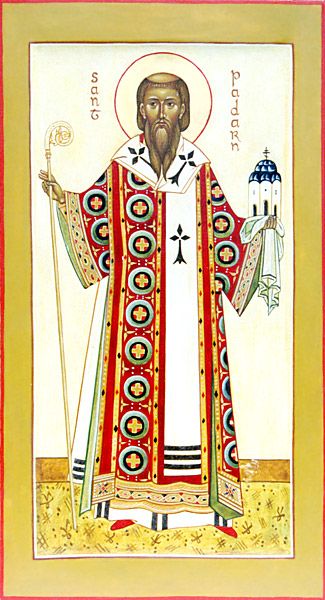
St. Padarn of Vannes

St. Padarn of Vannes

April 16 · Bishop
← All 1726 saints in the library
Sources & notes

Feast-day sources

Story sources

Sources

Credits

From Sabine Baring-Gould, The Lives of the Saints, new edition in 16 vols. (London: John C. Nimmo, 1897–98); text from the Internet Archive scan (OCR, lightly cleaned; errors possible). Public domain.

From Sabine Baring-Gould, The Lives of the Saints, new edition in 16 vols. (London: John C. Nimmo, 1897–98); text from the Internet Archive scan (OCR, lightly cleaned; errors possible). Public domain in the United States. Reproduced unedited, except for short bracketed notes in grey that we added to explain names and terms (“S.” is the old abbreviation for Saint). Some history and judgments reflect 19th-century scholarship.