Their story
Adapted in modern English from Baring-Gould (1897–98) · original text below · little is known
(The surviving account on this page begins partway through the story.)
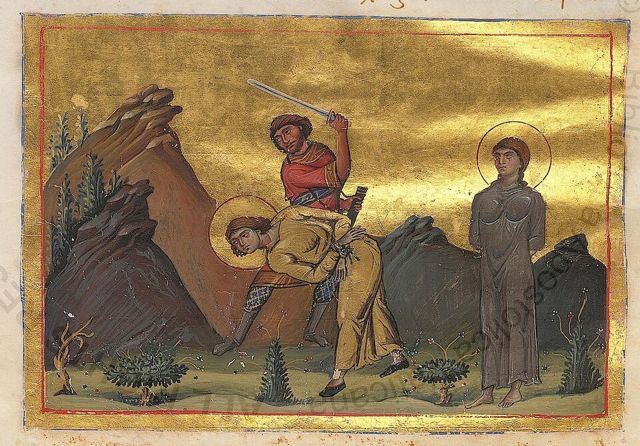
Nicasius made Rouen the centre of his mission. The procurator Fescennius Sisinnius had him and his companions executed at Ecos, near the river Epte.
The legend says the headless bodies rose at night and carried their heads to an islet, Gasny, where a woman named Pientia buried them; her father then beheaded her. Baring-Gould thinks there was no bishop Nicasius of Rouen, and that memory of Nicasius of Rheims was transferred there. Some lists of the bishops of Rouen still name him eleventh bishop. Relics are kept at Meulan, Evreux and Ecos. St. Denys is said to have come from Paris to consecrate his church at Rouen.
Early life
The book says little or nothing about early life. This is how the account begins.
Nicasius pushed on to Rouen, and made that the headOct. quarters of his mission. He built a church there, and S. Denys came from Paris to consecrate it. The procurator Fescennius Sisinnius had Nicasius and his companions arrested and executed at Ecos, between La Roche-Guyon and Les Andelys, near the river Epte.
How they teach us to live
Drawn from themes in the original account
Share your faith, in words and by example. Preaching and conversion are central here.
Keep their day. Remember them on October 10 with a short prayer, and ask for their help.