M
St. Mnason
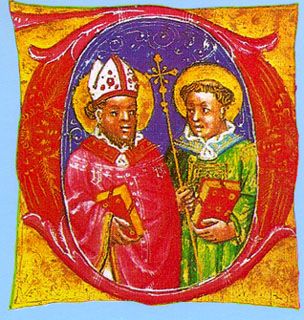
St. Hermagoras
A whole community that stayed faithful to Christ when it cost everything.
Read the essentials →A whole community that stayed faithful to Christ when it cost everything.
July 12
Not verified yet
Bishop
Martyrs
Now there was in Lucca, at the time, a certain Paulinus, a native of Antioch, who had been ordained bishop by S. Peter, and sent to Lucca.
Stay faithful when it costs you. This account is about holding firm under pressure.
Learn from the kind of life it was. A whole community that stayed faithful to Christ when it cost everything.
Nero the emperor ordered a temple to Diana, to be erected at Lucca, at the bridge of the river Serchio, to contain a statue of the goddess, made of pure gold and set with pearls, of gigantic size, and all the people of Lucca were summoned to fall down and worship it Now the temple had a brazen vault, set on ninety pillars of marble, and it was pierced with holes. And Nero ordered water to be poured over the vault, and the water streamed down through the holes like rain. And he made a sun of lamps, and it was drawn through the vault, and rose and set And he also made a moon of precious stones, to rise when the sun set But the string that supported the moon broke, and it tumbled down and cracked. And he drove a chariot over the brazen vault, and the people heard the rumbling of the wheels, and thought it strikingly resembled thunder. But the Lord sent a wind, and it blew the chariot and horses off the roof, and tumbled them into the river. Now there was in Lucca, at the time, a certain Paulinus, a native of Antioch, who had been ordained bishop by S. Peter, and sent to Lucca. And he had with him a priest named Severus, and a deacon named Luke. Now Paulinus built in Lucca many churches, and placed over them priests. And Nero sent officers, and they took Paulinus, Severus, and Luke, and a faithful soldier named Theobald, as they were praising God in a church Paulinus Veronica, had built and dedicated to “ the Holy Trinity, the lifegiving Cross, the immaculate Virgin Mary, and S. Stephen the proto-martyr.” They were brought before Anulinus, the governor, tortured and slain.
Feast: July 12
One short email a day for nine days. The day's prayer, a line from Sts. Paulinus and…'s story, and a nudge to keep going.
From Sabine Baring-Gould, The Lives of the Saints, new edition in 16 vols. (London: John C. Nimmo, 1897–98); text from the Internet Archive scan (OCR, lightly cleaned; errors possible). Public domain.
From Sabine Baring-Gould, The Lives of the Saints, new edition in 16 vols. (London: John C. Nimmo, 1897–98); text from the Internet Archive scan (OCR, lightly cleaned; errors possible). Public domain in the United States. Reproduced unedited, except for short bracketed notes in grey that we added to explain names and terms (“S.” is the old abbreviation for Saint). Some history and judgments reflect 19th-century scholarship.