Baring-Gould’s sources: By the Greeks on December 14th. By the Latins on March 8th. Arian and Theotychus, who are included in the Roman Martyrology, are not mentioned in any ancient Martyrologies except that of Usuardus. Authority:—The Acts, which as they now exist, are very corrupt. The original Acts have apparently been made a foundation to which a later Greek writer has added a superstructure of fable. The conversion and the martyrdom of the governor Arian has all the appearance of being an addition by a later hand, to complete the story, for the fabulous Greek Acts generally wind up with the conversion or destruction of the judge. This seems to have been regarded as the proper conclusion of every martyrdom.
Arianus [followers of Arius, who taught that the Son is a created being, not fully God] the judge, who had condemned S. Asclas (Jan. 23rd) to a cruel death, at Antinoë in Upper Egypt, did not leave the place till many other Christians had suffered by his orders. Now there was at Antinoë a deacon named Apollonius, who feared torture, being by nature of a highly sensitive and timorous constitution, and when the governor had given orders that every inhabitant should appear before him and sacrifice, he went to Philemon, a stage piper and dancer, and offered him money if he would go and sacrifice in his name, and bring him a ticket to the effect that Apollonius had sacrificed. Christians who thus acted were called libellatics; and on the return of tranquillity were put to penance, but were not regarded in the same light as apostates. Philemon asked Apollonius for one of his hooded cloaks, which would conceal his face, and then went before the judge.
Then Arian said, "Well, fellow, what art thou? A Christian perhaps, muffled thus, as if thou fearedst to be seen."
Philemon, filled with the grace of God, answered gravely, "Yes, my lord, I am a Christian."
"Thou knowest the choice that is set before thee, torture or sacrifice," said the magistrate.
"I will not sacrifice," answered the piper, "I saw how, by the power of God, Asclas held thee stationary in the midst of the river."
Then Arian, leaning back in his seat, said to his officers, "Send for Philemon the piper; perchance his sweet melodies will drive away the fancies of this fool, and allure him to the worship of our gods." But Philemon was not to be found; then his brother Theonas was brought in, and Arian asked him where was the piper Philemon. Theonas, looking intently at the prisoner, said, "That is he." Then the hood was plucked off the face of Philemon, and the cloak drawn from his shoulders, and it was the merry piper shod with his gay buskins, and with the tuneful reeds in his hands. Arian laughed heartily, and exclaimed that this was a rare joke. "We make no account of all this, man!" said he, "for to this thou wast born, and to this bred, that thou shouldst shake our sides with laughter. Now sacrifice, and end the farce."
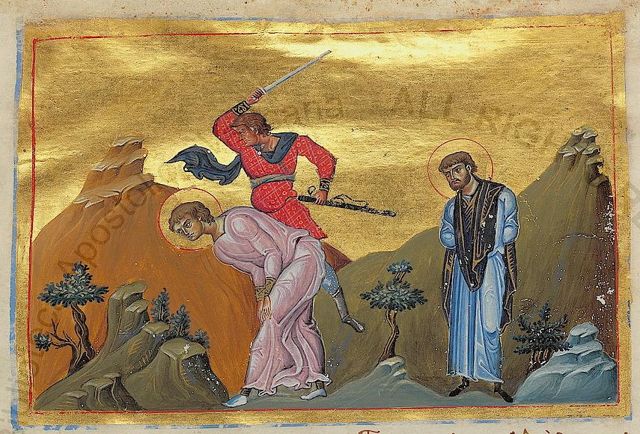
But Philemon steadfastly refused, and Arian saw that no jest was meant, but that this was sober earnest. So putting on an angry look, he said, "It is foolery for thee to pass thyself off as a Christian, piper! for thou art not baptized." Then the poor man was filled with tribulation, and in his doubt and grief he cried to the Lord Jesus Christ to accept and baptize him. And as he prayed, there came down a soft sparkling spring shower, and the piper, stretching his hands to heaven, cried joyously, "He has heard me, and has baptized me in the cloud!" And he took his pipes and broke them up, and cast them away. Now the officer had taken the deacon Apollonius, and they brought him before Arian, who reproached him for his cowardice; the deacon in shame admitted that he had done wrong. "But now," said he, in a firm voice, "know that I will not sacrifice." Then the judge ordered him and Philemon to be executed with the sword.
So far the Acts seem to be trustworthy, but what follows is fabulous; some of these incidents shall however be given. Philemon before his execution, bade the officers bring a brass pot, and put a baby in it, cover it, and take aim at it with their arrows. The pot was soon transfixed; but when it was opened, the child within was found unhurt. Then Philemon said, "Like that vessel is a Christian's body, riddled with wounds, but the soul within, like that infant, is unharmed." And when the governor ordered a flight of arrows to be discharged at him, he raised his hand, and the arrows remained stationary in the air, but one returning put out the eye of Arian. Then Philemon said, "When I am dead, go to my grave, and make clay of the dust there, and anoint thine eye, and it will be restored whole."
This Arian does and is healed, and in consequence converted. Then Dioclesian, hearing of his conversion, sends four officers to judge him, and these in turn are converted, and finally Arian and the four officers are sewn up in sacks and flung into the sea. All this may safely be rejected as fabulous.