F

A shepherd who stayed with his people through hard times.

Read the essentials →
March 8 · Bishop

St. Felix

St. Felix

A shepherd who stayed with his people through hard times.

Traditional feast

March 8
1914 / pre-1969 calendar, per Baring-Gould (1897)

Current feast

Not verified yet

Represents

Bishop

Their story

Adapted in modern English from Alban Butler's Lives of the Saints · Baring-Gould original below · little is known

Felix, bishop of the East Angles, worked with King Sigebert, who set up a school for youth with masters supplied by Felix; for this, Butler says, some have called Sigebert the founder of Cambridge.

Felix fixed his see at Dummoc, now Dunwich in Suffolk, and governed it seventeen years. He was buried at Dunwich and his relics were later moved to the abbey of Ramsey. Butler gives 646; Baring-Gould, the text on this page, gives 654. The sources differ.

Early life

Selected sentences from the original account, unaltered.

S. Felix was a native of Burgundy, where he made the acquaintance of Sigebert, prince of the East Angles, who had been banished by Redwald. Some time after this, upon the death of his half-brother, king Espenwald, the son of Redwald, who had been killed at the instigation of the cruel Penda, king of Mercia, Sigebert was called to England to succeed to the kingdom, and he made it his care to introduce Christianity among the East Angles, who occupied Norfolk, Suffolk, and Cambridgeshire.

What they represent

How they teach us to live

Drawn from themes in the original account

Share your faith, in words and by example. Preaching and conversion are central here.

Learn from the kind of life it was. A shepherd who stayed with his people through hard times.

Read more

The full original · 261 words

Read Baring-Gould’s full account

Baring-Gould’s sources: Roman and Gallican Martyrologies. Salisbury Breviary, and more modern Anglican Martyrologies. Also Molanus and Greven, in their addition to Usuardus. Authorities:—Bede and Malmesbury.

S. Felix was a native of Burgundy, where he made the acquaintance of Sigebert, prince of the East Angles, who had been banished by Redwald. This prince was instructed in the Christian faith, and was baptized by Felix, at that time a priest. Some time after this, upon the death of his half-brother, king Espenwald, the son of Redwald, who had been killed at the instigation of the cruel Penda, king of Mercia [the Anglo-Saxon kingdom of the English Midlands], Sigebert was called to England to succeed to the kingdom, and he made it his care to introduce Christianity among the East Angles, who occupied Norfolk, Suffolk, and Cambridgeshire. For this purpose he invited S. Felix to his court, and he, without demur, quitted country, friends, and home, to preach the faith to an uncivilized pagan people. But first he visited Honorius, archbishop of Canterbury, and from him he received his mission to the East Angles, and, as some say, his episcopal consecration. King Sigebert appointed Dunwich, on the Suffolk coast, as the head-quarters of his mission. Felix went about, preaching, founding churches and schools, and, through his exertions, the Christian faith took deep root in the land. Some attribute to him the foundation of the first school at Cambridge.

S. Felix lived till after the year 650, and having discharged the duty of a most zealous pastor of souls for the space of seventeen years, he departed to the Lord, and was buried in his church of Dunwich, from which place his body was afterwards translated to Soham, near Ely, and thence to the abbey of Ramsey.
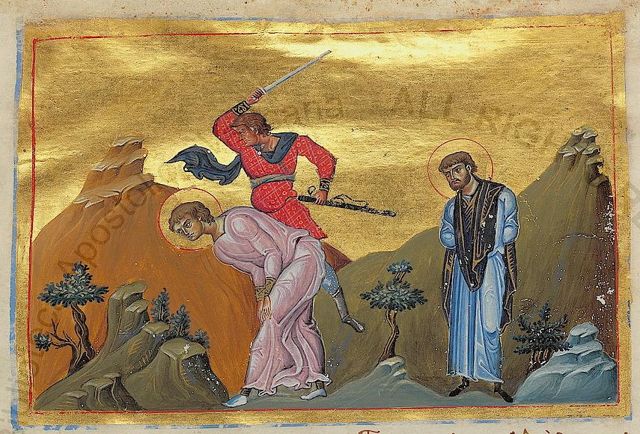
Feast days

Feast: March 8

Nine days · Free

Pray the novena
with us.

One short email a day for nine days. The day's prayer, a line from St. Felix's story, and a nudge to keep going.

Also on March 8
Sts. Philemon and Apollonius

Sts. Philemon and…

March 8 · Martyrs
S

St. Senan of Iniscatthy

March 8 · Abbot, Bishop
D

St. Duthac of Ross

March 8 · Bishop
← All 1726 saints in the library
Sources & notes

Feast-day sources

Story sources

Sources

Credits

From Sabine Baring-Gould, The Lives of the Saints, new edition in 16 vols. (London: John C. Nimmo, 1897), digitized text from Project Gutenberg. Public domain.

From Sabine Baring-Gould, The Lives of the Saints, new edition in 16 vols. (London: John C. Nimmo, 1897), digitized text from Project Gutenberg. Public domain in the United States. Reproduced unedited, except for short bracketed notes in grey that we added to explain names and terms (“S.” is the old abbreviation for Saint). Some history and judgments reflect 19th-century scholarship.