P

In the persecution of Decius, Pionius, a priest of Smyrna, was arrested with Sabina, Macedonia, Asclepiades and the priest Linus while keeping the feast of St. Polycarp on 23 February.

Read the essentials →
February 1 · Priest, Martyrs

Sts. Pionius and…

Sts. Pionius and Companions

In the persecution of Decius, Pionius, a priest of Smyrna, was arrested with Sabina, Macedonia, Asclepiades and the priest Linus while keeping the feast of St. Polycarp on 23 February.

Traditional feast

February 1
1914 / pre-1969 calendar, per Baring-Gould (1897)

Current feast

Not verified yet

Represents

Priest
Martyrs

Their story

Adapted in modern English from Baring-Gould (1897) · original text below

In the persecution of Decius, Pionius, a priest of Smyrna, was arrested with Sabina, Macedonia, Asclepiades and the priest Linus while keeping the feast of St. Polycarp on 23 February. After fasting on the eve, he had been warned of his coming death in a vision. On Saturday morning, having taken blessed bread (the Eulogies) and water, they were seized by Polemon, chief priest of the temple in Smyrna. They refused to sacrifice and were led into the forum, where Pionius addressed the crowd. The church of Smyrna was then ashamed because its bishop, Eudæmon, had given up the faith, and many fearful Christians had followed him.

The notary's record of the questioning survives. Pionius said he worshipped the Almighty God who made heaven and earth, known through His Word, Christ; he would not sacrifice even to the emperor, since he could not sacrifice to any man. Asked his church, he said, "I belong to the Catholic Church. There is none other with Christ." Sabina answered nearly the same. Asclepiades said he worshipped Jesus Christ, not another God but the same God the others spoke of.

They were taken to prison amid jeers. The next day the priest tried to force them into the temple, and Pionius tore off the sacrificial garland put on his head. Polemon handed them to the proconsul Quintilian when he arrived. Pionius was racked, torn with iron hooks, nailed to a post and burned alive, alongside Metrodorus, a Marcionite priest (a member of a separate Christian sect).

Early life

The book says little or nothing about early life. This is how the account begins.

In the persecution of Decius, S. Pionius, a priest of Smyrna, was apprehended; together with Sabina, Macedonia, Asclepiades, and Linus a priest, whilst they were celebrating the festival of S. Polycarp, on February 23. Pionius having fasted on the vigil, was forewarned of his coming passion in a vision. On the morning, which was the Sabbath, or Saturday, they took holy bread (the Eulogies) and water, and were then surprised and taken by Polemon, the chief priest of the idol temple in Smyrna, and his satellites.

What they represent

How they teach us to live

Drawn from themes in the original account

Keep their day. Remember them on February 1 with a short prayer, and ask for their help.

Read more

The full original · 492 words

Read Baring-Gould’s full account

Baring-Gould’s sources: Roman and many ancient Martyrologies on this day. The Greeks on March 11th; the Martyrology attributed to S. Jerome, on March 12th. Authorities:—The genuine Acts of these martyrs, and the brief account in Eusebius, lib. iv. c. 15.

In the persecution of Decius [Roman emperor 249–251, who ordered everyone to sacrifice to the gods], S. Pionius, a priest of Smyrna, was apprehended; together with Sabina, Macedonia, Asclepiades, and Linus a priest, whilst they were celebrating the festival of S. Polycarp, on February 23. Pionius having fasted on the vigil, was forewarned of his coming passion in a vision. On the morning, which was the Sabbath, or Saturday, they took holy bread (the Eulogies) and water, and were then surprised and taken by Polemon, the chief priest of the idol temple in Smyrna, and his satellites. Polemon in vain urged them to conform to the imperial edicts, and sacrifice to the gods; but they set their faces as flint against his solicitations, and were led into the forum, where Pionius took the opportunity of haranguing the crowds who hurried up to be present at their trial.

The Smyrnian Church was then suffering the shame of having seen its bishop, Eudæmon, apostatize, and his example had been followed by many timorous Christians.

The interrogatory was conducted by Polemon, and is dryly recorded by the notary who wrote the acts:—The Idol priest said, "Pionius! sacrifice." But he answered, "I am a Christian." "Whom," said Polemon, "dost thou worship?" "The Almighty God," answered Pionius, "who made heaven and earth, and all things in heaven and earth, and us men; who giveth to all men liberally, as they need; whom we know through His Word, Christ." Polemon said, "Sacrifice then, only to the Emperor." Pionius said, "I cannot sacrifice to any man. I am a Christian."

Then—the notary writing all down—Polemon asked, "What is thy name?" He answered, "Pionius." Polemon said, "Thou art a Christian?" He answered, "Certainly I am." "To what Church dost thou belong?" asked Polemon. "I belong to the Catholic Church," answered Pionius. "There is none other with Christ."

Then he went to Sabina, and put to her the same questions, which she answered almost in the same words. Next he turned to Asclepiades, and asked, "What is thy name?" "Asclepiades." "Art thou a Christian?" "I am." Then said Polemon, "Whom dost thou worship?" Asclepiades answered, "I worship Jesus Christ." "What!" asked Polemon, "Is that another God?" "No," answered Asclepiades, "He is the same God of whom the others spake."

After this the martyrs were taken to prison, followed by a crowd jeering and insulting them. On the morrow they were led forth again to trial, and the idol priest endeavoured to force them to enter the temple, and by violence to compel them to sacrifice. Pionius tore from his head the sacrificial garlands that the priest had placed upon him. Polemon, unable to bend the holy martyrs to submission, delivered them over to Quintilian, the pro-consul, on his arrival at Smyrna, and he sentenced Pionius to be hung on a rack, and his body to be torn with hooks of iron, and afterwards to be nailed to a post, and burnt alive. Metrodorus, a Marcionite priest, underwent the same punishment with him.
Feast days

Feast: February 1

Nine days · Free

Pray the novena
with us.

One short email a day for nine days. The day's prayer, a line from Sts. Pionius and…'s story, and a nudge to keep going.

Also on February 1
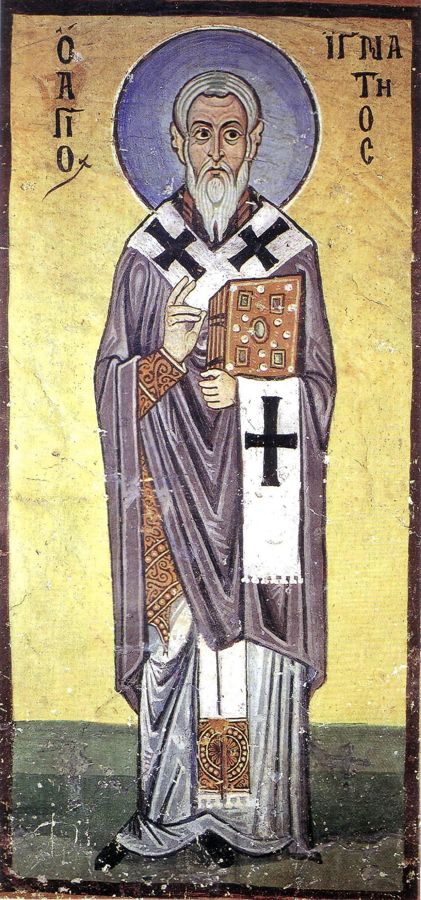
St. Ignatius

St. Ignatius

February 1 · Bishop, Martyr
E

St. Ephraem the Syrian

February 1 · Deacon, Confessor
S

St. Severus of Ravenna

February 1 · Bishop, Confessor
← All 1726 saints in the library
Sources & notes

Feast-day sources

Story sources

Sources

Credits

From Sabine Baring-Gould, The Lives of the Saints, new edition in 16 vols. (London: John C. Nimmo, 1897), digitized text from Project Gutenberg. Public domain.

From Sabine Baring-Gould, The Lives of the Saints, new edition in 16 vols. (London: John C. Nimmo, 1897), digitized text from Project Gutenberg. Public domain in the United States. Reproduced unedited, except for short bracketed notes in grey that we added to explain names and terms (“S.” is the old abbreviation for Saint). Some history and judgments reflect 19th-century scholarship.