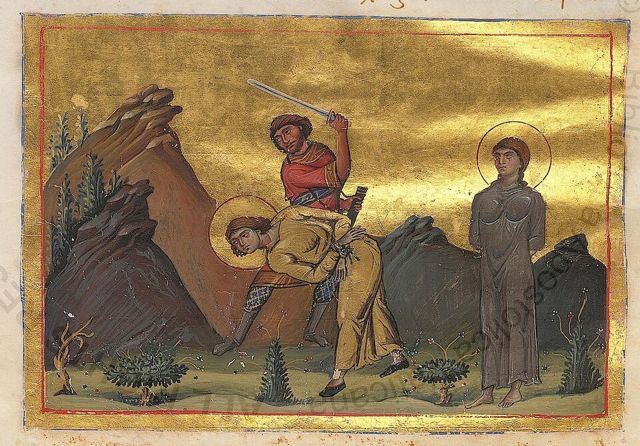
A whole community that stayed faithful to Christ when it cost everything.
Read the essentials →A whole community that stayed faithful to Christ when it cost everything.
Read the essentials →A whole community that stayed faithful to Christ when it cost everything.
October 10
October 11 (also listed: October 12)
Martyrs
If you would know that which my parents gave me, it is Tarachus; when I bore arms I went by the name of Victor.” “ Right; for this is the Son of the living God; He is the hope of the Christians, and the author of salvation to such as suffer for His sake.” “I am no idle talker; I am sixty -five years old; thus have I been brought up, and I cannot forsake the truth.”
Stay faithful when it costs you. This account is about holding firm under pressure.
Pray a little every day. Prayer runs all through this account.
Learn from the kind of life it was. A whole community that stayed faithful to Christ when it cost everything.
Maximus. “Speak not of thy impiety, but tell me thy name.” G°°gle_ Oct. xx.] SS. Tarachus and Others. Tarachus. “lama Christian.”
Maximus. “ Strike him upon the mouth, and bid him not answer one thing for another.” Tarachus, after receiving a buffet on his jaws, said: “ I tell you my true name. If you would know that which my parents gave me, it is Tarachus; when I bore arms I went by the name of Victor.”
Maximus. “ What is thy profession, and of what country art thou ?” Tarachus. “ I am of a Roman family, and was bom at Claudiopolis, in Isauria. I am by profession a soldier, but quitted the service upon the account of my religion.” Maximus. " Thy impiety rendered thee unworthy to bear arms; but how didst thou procure thy discharge ? ” Tarachus. " I asked it of my captain, Publio, and he gave it me.”
Maximus. “In consideration of thy grey hairs I will procure thee the favour and friendship of the emperors, if thou wilt obey their orders. Draw near, therefore, and sacrifice to the gods, as the emperors themselves do all the world over.”
Tarachus. “ They are deceived by the devil in so doing.” Maximus. “ Break his jaws for saying the emperors are deceived.”
Tarachus. “ I repeat it, as men, they are deluded.” Maximus. “Sacrifice to our gods, and renounce thy folly.” Tarachus. " I cannot renounce the law of God.” Maximus. “ Is there any law, wretch, but that which we obey?”
Tarachus. “ There is, and you transgress it by adoring stocks and stones, the works of men’s hands.” Maximus. “ Strike him on the face, saying, ‘ Abandon thy folly.*”
[Oct. xx. Tarachus. “ What you call folly is the salvation of my soul, and I will never leave it.” Maximus. “ But I will make thee leave it, and force thee to be wise.”
Tarachus. “ Do with my body what you please, it is entirely in your power.” Then Maximus said: “ Strip him and beat him with rods.” Tarachus, when beaten, said: “ You have now made me truly wise. I am strengthened by your blows, and my confidence in God and in Jesus Christ is increased.” Maximus. “ Wretch, how canst thy deny a plurality of gods, when, according to thy own confession, thou servest two gods? Didst thou not give the name of God to a certain person named Christ ? ”
Tarachus. “ Right; for this is the Son of the living God; He is the hope of the Christians, and the author of salvation to such as suffer for His sake.”
Maximus. “ Forbear this idle talk; draw near, and sacrifice.” Tarachus. “I am no idle talker; I am sixty -five years old; thus have I been brought up, and I cannot forsake the truth.”
Demetrius the centurion said: “ Poor man, I pity thee; be advised by me, sacrifice, and save thyself.” Tarachus. “ Away, thou minister of Satan, and keep thy advice for thy own use.”
Maximus. “Let him be loaded with large chains, and carried back to prison. Bring forth the next in years.” Demetrius the centurion said: “ He is here, my lord.” Maximus, “ What is thy name ? ”
Probus. “ My chief and most honourable name is Christian; but the name I go by in the world is Probus.” Maximus, “Of what country art thou, and of what family?”
Oct. ii.] SS. Tarachus and Others. Probus. “ My father was of Thrace. I am a plebeian, bom at Sida in Pamphilia, and profess Christianity.” Maximus. “ That will do thee no service. Be advised by me, sacrifice to the gods, that thou mayest be honoured by the emperors, and enjoy my friendship.” Probus. “ I want nothing of that kind. Formerly I was possessed of a considerable estate; but I relinquished it to serve the living God through Jesus Christ.” Maximus. u Take off his garments, gird him, lay him at his full length, and lash him with ox-hide thongs.” Demetrius the centurion said to him, whilst they were beating him: “ Spare thyself, my friend; see how thy blood runs in streams on the ground.”
Probus. “ Do what you will with my body; your torments are sweet to me.” Maximus. “ Is this obstinate folly incurable ? What canst thou hope for ? ”
Probus. “ I am wiser than you are, because I do not worship devils.” Maximus. “ Turn him, and strike him on the belly.” Probus. “ Lord, assist thy servant.”
Maximus. “ Ask him, at every stripe, where is his succour ?” Probus. “He succours me, and will succour me; for I pay so little regard to your torments that I do not obey you.”
Maximus. “ Look, wretch, upon thy mangled body: the ground is covered with thy blood.” Probus. ** The more my body suffers for Jesus Christ, the more is my soul refreshed.”
Maximus. “ Put fetters on his hands and feet, with his legs distended in the stocks to the fourth hole, and let nobody approach to dress his wounds. Bring the third to the bar.”
Demetrius the centurion said: “ Here he stands, my lord/’ Maximus. " What is thy name ? ” Andronicus. “ My true name is Christian, and the name by which I am commonly known among men is Andronicus.”
Maximus. “ What is your family ? ” Andronicus. “ My father is one of the first rank in Ephesus.” Maximus. “ Adore the gods, and obey the emperors, who are our fathers and masters.”
Andronicus. “ The devil is your father, whilst you do his works.” Maximus. “ Youth makes you insolent; I have torments ready.”
Andronicus. “ I am prepared for whatever may happen.” Maximus. “Strip him naked, gird him, and stretch him on the rack.” Demetrius the centurion said to the martyr: “ Obey, my friend, before thy body is tom and mangled.” Andronicus. “It is better for me to have my body tormented than to lose my soul.”
Maximus. “ Sacrifice, before I put thee to the most cruel death.” Andronicus. “ I have never sacrificed to demons from my infancy, and I will not now begin.”
Athanasius, the comicularius, or clerk to the army, said to him: “I am old enough to be thy father, and therefore take the liberty to advise thee to obey the governor.” Andronicus. “ You give me admirable advice, indeed, — to sacrifice to devils ! ”
Maximus. “Wretch, art thou insensible to torments? Thou dost not yet know what it is to suffer fire and razors. When thou hast felt them, thou wilt, perhaps, give over thy folly.”
Oct. xx.] SS. Tarachus and Others. Andronicus. “ This folly is expedient for us who hope in Jesus Christ. Earthly wisdom leads to eternal death.** Maximus. “ Wrench his limbs with the utmost violence.** Andronicus. “ I have done no evil; yet you torment me like a murderer. I contend for that worship which is due to the true God.** Maximus. “ If thou hadst but the least sense of piety, thou wouldst adore the gods whom the emperors so religiously worship.”
Androtiicus. “ It is not piety, but impiety, to abandon the true God, and to adore brass and marble.** Maximus. “ Execrable villain! are then the emperors guilty of impieties ? Hoist him again, and gore his sides.** Andronicus. “ I am in your hands; do with my body what you please.** Maximus. “ Lay salt upon his wounds, and rub his sides with broken tiles.** Andronicus. “ Your torments have refreshed my body.** Maximus. “ I will cause thee to die gradually.** Andronicus. “Your menaces do not terrify me; my courage is above all that your malice can invent.** Maximus. “ Put a heavy chain about his neck, and another upon his legs, and keep him in close prison.** Thus ended the first examination; the second was held at Mopsuestia.
Flavius Clemens Numerianus Maximus, governor of Cilicia, sitting on his tribunal, said to Demetrius the centurion: “ Bring forth the impious wretches who follow the religion of the Christians.** Demetrius said: “ Here they are, my lord.** Maximus said to Tarachus: “Old age is respected in many, on account of the good sense and prudence that generally attend it: wherefore, if you have made a proper use of the time allowed you for reflection, I presume your own [Oct ii.
discretion has wrought in you a change of sentiments: as a proof of which, it is required that you sacrifice to the gods, which cannot fail to recommend you to the esteem of your superiors.”
Tarachus. “ I am a Christian, and I wish you and the emperors would leave your blindness, and embrace the truth which leads to life.”
Maximus. “ Break his jaws with a stone, and bid him leave off his folly” Tarachus. “This folly is true wisdom.” Maximus. “Now they have loosened all thy teeth, wretch, take pity on thyself, come to the altar, and sacrifice to the gods, to prevent severer treatment.”
Tarachus. “Though you cut my body into a thousand pieces, you will not be able to shake my resolution, because it is Christ who gives me strength to stand my ground.” Maximus. “Wretch, accursed by the godsl I will find means to drive out thy folly. Bring in a pan of burning coals, and hold his hands in the fire till they are consumed.”
Tarachus. “I fear not your temporal fire, which soon passes; but I dread eternal flames.” Maximus. “ See, thy hands are well baked; they are consumed by the fire. Is it not time for thee to grow wise ? Sacrifice.”
Tarachus. “If you have any other torments in store for me, employ them; I hope I shall be able to withstand all your attacks.”
Maximus. “ Hang him by the feet, with his head over a great smoke.” Tarachus. “After having proved an overmatch for your fire, I am not afraid of your smoke.”
Maximus. “ Bring vinegar and salt, and force them up his nostrils.” Oct XX.] SS. Tarachus and Others. Tarachus. “Your vinegar is sweet to me, and your salt insipid.”
Maximus. “ Put mustard into the vinegar, and thrust it up his nose.” Tarachus. “ Your ministers impose upon you; they have given me honey instead of mustard.”
Maximus. “ Enough for the present. I will make it my business to invent fresh tortures to bring thee to thy senses; I will not be baffled.”
Tarachus. “ You will find me prepared for the attack.” Maximus. “ Away with him to the dungeon. Bring in another.” Demetrius the centurion said: “ My lord, here is Probus.” Maximus. “ Well, Probus, hast thou considered the matter, and art thou disposed to sacrifice to the gods, after the example of the emperors ? ”
Probus. “ I appear here again with fresh vigour. The torments I have endured have hardened my body, and my soul is proof against all you can inflict. I have a living God in heaven: Him I serve and adore, and no other.” Maximus. “ What, villain ? are not ours living gods ? ” Probus. “Can stones and wood, the workmanship of a statuary, be living gods ? You know not what you do when you sacrifice to them.”
Maximus. “ What insolence ! At least sacrifice to the great god Jupiter. I will excuse you as to the rest” Probus. “ Do not you blush to call him god who was guilty of adulteries, incests, and other abominable crimes? ” Maximus. “ Beat his mouth with a stone, and bid him not blaspheme.”
Probus. “Why this evil treatment? I have spoken no worse of Jupiter than they do who serve him. I utter no lie: I speak the truth, as you yourself well know.” Maximus. “ Heat bars of iron, and apply them to his feet” [Oct. xx.
Probus. “This fire is without heat; at least I feel none.” Maximus. “Hoist him on the rack, and let him be scourged with thongs of raw leather till his shoulders are flayed.”
Probus. “ All this does me no harm; invent something new, and you will see the power of God who is in me and strengthens me.”
Maximus. “ Shave his head, and lay burning coals upon it.” Probus. “ You have burnt my head and my feet. You see, notwithstanding, that I still continue God's servant, and disregard your torments. He will save me: your gods can only destroy.”
Maximus. “ Dost thou not see all those that worship them standing about my tribunal honoured by the gods and the emperors ? They look upon thee and thy companions with contempt.”
Probus. “ Believe me, unless they repent and serve the living God, they will all perish, because, against the voice of their own conscience, they adore idols.” Maximus. “ Beat his face, that he may learn to say ‘ the Gods/ and not * God.' ”
Probus. “ You unjustly destroy my mouth and disfigure my face, because I speak the truth.” Maximus. “ I will also cause thy blasphemous tongue to be plucked out to make thee comply.”
Probus. “Besides the tongue which serves me for utterance, I have an immortal tongue, which is out of reach.” Maximus. “ Take him to prison. Let the third come in.” Demetrius the centurion said: “ He is here.” Maximus. “ Your companions, Andronicus, were at first obstinate: but gained nothing thereby but torments and disgrace, and have been at last compelled to obey. They shall Oct. xi.] 6VS 1. Tarachus and Others.
receive considerable recompenses. Therefore, to escape the like torments, sacrifice to the gods, and thou shalt be honoured accordingly. But if thou refusest, I swear by the immortal gods and by the invincible emperors, that thou shalt not escape out of my hands with thy life.” Andronicus. “ Why do you endeavour to deceive me with lies ? They have not renounced the true God. And even had they done so, you should never find me guilty of such impiety. God, whom I adore, has clothed me with the arms of faith; and Jesus Christ, my Saviour, is my strength: so that I neither fear your power nor that of your masters and of your gods. Come, now, cause all your instruments to be displayed before my eyes, and employed on my body.” Maximus. “ Bind him to the stakes, and scourge him with raw thongs.”
Andronicus. “There is nothing new or extraordinary in this torment.” The clerk, Athanasius, said: “ Thy whole body is but one wound from head to foot, and dost thou count this nothing? ” Andronicus. “ They who love the living God make small account of this.”
Maximus. “ Rub his back with salt.” Andronicus. “ Give orders, I pray you, that they do not spare me, that being well seasoned I may be in no danger of putrefaction, and may be the better able to withstand your torments.”
Maximus. “ Turn him, and beat him upon the belly to open afresh his wounds.” Andronicus. “You saw when I was brought last before your tribunal, how I was perfectly cured of the wounds I re ceived by the first day’s tortures. He that cured me then can cure me a second time.”
Maximus, addressing himself to the guards of the prison: “ Villains and traitors !” said he, “ did I not strictly forbid you to suffer any one to see them or dress their wounds? Yet see here I ”
Pegasus, the jailer, said: “ I swear by your greatness that no one has applied anything whatever to his wounds, or had admittance to him; and he has been kept in chains in the most retired part of the prison on purpose. If you catch me in a lie I'll forfeit my head.”
Maximus. “ How comes it then that there is nothing to be seen of his wounds ? ” The Jailer. “ I swear by your high birth that I know not how they have been healed.”
Andronicus. “Senseless man, the physician that has healed me is no less powerful than He is tender and charitable. You know Him not. He cures not by the application of medicines, but by His word alone. Though He dwells in heaven, He is present everywhere, but you know Him not.” Maximus. “Thy idle prating will do thee no service; sacrifice, or thou art a lost man.”
Andronicus. “ I do not change. I am not a child to be wheedled or frightened.” Maximus. “ Do not flatter thyself that thou shalt get the better of me.”
Atidronicus. “ Nor shall you ever make us yield to your threats.” Maximus. “ My authority shall not be baffled by thee.” Andronicus. “ Nor shall it ever be said that the cause of Jesus Christ is vanquished by your authority.” Maximus. “ Let me have several kinds of tortures in readiness against my next sitting. Put this man in prison loaded with chains, and let no one be admitted to visit them in the dungeon.”
The third examination was held at Anazarbus. In it Tarachus answered first with his usual constancy, saying to all threats that a speedy death would finish his victory and Oct. xx.] SS. Tarachus and Others.
complete his happiness; and that long torments would procure him the greater recompense. When Maximus had caused him to be bound and stretched on the rack, he said: “ I could allege the rescript of Diocletian [Roman emperor 284–305, who began the ‘Great Persecution’ of Christians in 303], which forbids judges to put military men on the rack. But I waive my privilege, lest you should suspect me of cowardice.”
Maximus said: “Thou flatterest thyself with the hopes of having thy body embalmed by Christian women, and wrapped up in perfumes after thou art dead; but I will take care to dispose of thy remains.”
Tarachus replied: “ Do what you please with my body, not only whilst it is living, but also after my death.” Maximus ordered his lips, cheeks, and whole face to be slashed and cut.
Tarachus said: “You have disfigured my face; but have added new beauty to my soul. I fear not any of your inventions, for I am clothed with the divine armour.” The tyrant ordered spits to be heated, and applied red hot to his arm-pits; then his ears to be cut off. At which the martyr said: “ My heart will not be less attentive to the word of God.”
Maximus said: “ Tear the skin off his head; then cover it with burning coals.” Tarachus replied: “ Though you order my whole body to be flayed you will not be able to separate me from my God”
Maximus. “Apply the red-hot spits once more to his arm-pits and sides.” Tarachus. “ O God of heaven, look down upon me and be my judge ! ”
The governor then sent him back to prison, to be reserved for the public shows the day following, and called for the next.
[Oct. xi. Probus having been brought forth, Maximus again exhorted him to sacrifice; but, after many words, ordered him to be bound and hung up by the feet, then red-hot spits to be applied to his sides and back.
Probus said: “ My body is in your power. May the Lord of heaven and earth vouchsafe to consider my patience, and the humility of my heart.”
Maximus. “ The God whom thou implorest has delivered thee into my hands.” Probus. “ He loves men.” Maximus. “Open his mouth and pour in some of the wine which has been offered upon the altars, and thrust some of the sanctified meat into his mouth.” Probus. “ See, O Lord, the violence they offer me, and judge my cause ! ”
Maximus. “ Now thou seest that after suffering a thousand torments rather than sacrifice, thou hast nevertheless partaken of a sacrifice.”
Probus. “You have done no great feat in making me taste these abominable offerings against my will.” Maximus. “No matter, it is now done. Promise now to do it voluntarily, and thou shalt be released.” Probus. “ God forbid that I should yield; but know that if you should force into me all the abominable offerings of your whole altars, I should not be defiled; for God sees the violence which I suffer.”
Maximus. “ Heat the spits again, and burn the calves of his legs with them.” Then he said to Probus, “ There is not a sound part in thy whole body, and still thou persistest in thy folly. Wretch, what canst thou hope for?” Probus. “ I have abandoned my body to you that my soul may remain sound.”
Maximus. “ Make some sharp nails red-hot, and pierce his hands with them.” Oct. ii.] SS. Tarachus and Others. Probus. “ 0 my Saviour, I return Thee hearty thanks that Thou hast been pleased to make me share in Thy sufferings ! ”
Maximus. “ The torments make thee foolish.” Probus. “ Would to God your soul were not blind, and in darkness.” Maximus. “ Now that thou hast lost the use of all thy members, thou complainest of my not having deprived thee of sight. Prick him in the eyes, but by little and little, till you have bored out the organs of sight.” Probus. “ Behold I am now blind. Thou hast destroyed the eyes of my body; but canst not take away those of my soul.”
Maximus. “ Thou continuest still to argue, but thou art condemned to eternal darkness.” Probus. “ Did you know the darkness in which your soul is plunged, you would see yourself much more miserable than I am.”
Maximus. “ Thou hast no more use of thy body than a dead man, yet thou talkest still.” Probus. “ So long as any vital heat continues to animate the remains which you have left me of this body, I will never cease to speak of God, to praise and thank Him.” Maximus. “ What ! dost thou hope to survive these torments? Canst thou flatter thyself that I shall allow thee one moment's respite ?”
Probus. “ I expect nothing from you but a cruel death and I ask of God only the grace to persevere to the end in the confession of His holy name.”
Maximus. “ I will leave thee to languish, as such an impious wretch deserves. Take him hence. Let the prisoners be closely guarded that none of their friends find access to them. I design them for the shows. Let Andronicus be brought in. He is the most resolute of the three.” [Oct. xx.
The answers and behaviour of the martyrs were often very disrespectful towards their judges. They were, no doubt, exasperated by the pain they endured, and the Acts of the Martyrs contain too often a wearisome string of mutual vituperation; but it is quite possible that the abusive expressions put into the mouths of the martyrs were sometimes added by the writers of the Acts.
S. Paul, however, it will be remembered, called his judge a whited wall \ and threatened him with the anger of God; and S. Augustine says of the martyrs, “ They were patient in torments, faithful in their confession, constant lovers of truth in all their words. But they cast certain arrows of God against the impious, and provoked them to anger; but they wounded many to salvation.” In the answers of S. Andronicus we find many harsh expressions, insulting to the ministers of justice, which we must regard as bursting from his lips in the agony of pain, when incapable of weighing well his words. The governor pressed Andronicus again to comply with the edict, adding, that his two companions had at length sacrificed to the gods, and to the emperors themselves. The martyr replied: “ This is truly the part of an adorer of the god of lies: and by this imposture I know that such men as you are like the gods whom you serve. May God judge you, O worker of iniquity !”
Maximus ordered rolls of paper to be made, and set on fire Upon the belly of the martyr; then bodkins to be heated, and laid red hot betwixt his fingers. Finding him still unshaken, he said to him, “ Do not expect to die at once. I will keep thee alive till the time of the shows, that thou mayest behold thy limbs devoured one after another by cruel beasts.”
Andronicus answered: “You are more inhuman than the tigers, and more insatiable for blood than the most barbarous murderers.”
Oct u.] •SVS’. Tarachns and Others. Maximus. “ Open his mouth, and put some of the sanctified meat into it, and pour some of the wine into it which hath been offered to the gods.”
Andronicus. “Behold, O Lord, the violence which is offered to me.” Maximus. “ What wilt thou do now ? Thou hast tasted of the offerings taken from the altar. Thou art now initiated into the mysteries of the gods.”
Andronicus. “ Know, tyrant, that the soul is not defiled when it suffers involuntarily what it condemns. God, who sees the secrets of hearts, knows that mine has not consented to this abomination.”
Maximus. “ How long will this frenzy delude thy imagination ? It will not deliver thee out of my hands.” Andronicus. “ God will deliver me when He pleases.” Maximus. “ This is a fresh extravagance: I will cause that tongue of thine to be cut out, to put an end to thy prating.”
Andronicus. “ I ask it as a favour that those lips and tongue with which I have partaken of meats and wine offered to idols, may be cut off.”
Maximus. “Pluck out his teeth, and cut out his blasphemous tongue to the very root; bum them, and then scatter the ashes in the air, that none of his impious companions, or of the wenches, may be able to gather them up, to keep as something precious or holy. 1 Let him be carried to his dungeon, to serve for food to the wild beasts in the amphitheatre.”
The trial of the three martyrs having been concluded, Maximus sent for Terentianus, the chiliarch, and first magistrate of the community in Cilicia, who had the care of the 1 “ Dentes ejus et linguam blasphemam tollite, et comburite, et ubique spargite ut nemo de consortibus ejus tmpiis aut de mulierculis, aliqua colligat ut servet quas predosum aliquid aut sanctum aes timet.” [Oct. xx.
public games and spectacles, and gave him orders to exhibit a public show next day. In the morning, a prodigious multitude of people flocked to the amphitheatre, which was a mile distant from the town of Anazarbus. The governor came thither about noon. Many gladiators and others were slain in the combats of gladiators and by the beasts, and their bodies were devoured or lay on the ground. " We,” say the authors of his Acts, “ came, but stood on an adjoining mountain behind, looking over the walls of the amphitheatre, waiting the issue in great fear and alarm. The governor at length sent some of the guards to bring the Christians whom he had sentenced to the beasts. The martyrs were in so piteous a condition by their torments that, far from being able to walk, they could not so much as stir their mangled bodies. But they were carried on the backs of porters, and thrown down in the pit of the amphitheatre, below the seat of the governor. We advanced as near as we could on an eminence behind, and concealed ourselves by piling stones before us as high as our breasts, that we might not be known or observed. The sight of our brethren in so dismal a condition made us shed abundance of tears: even many of the infidel spectators could not contain theirs. For no sooner were the martyrs laid down, than an almost universal deep silence followed at the sight of such dismal objects, and the people began openly to murmur against the governor for his barbarous cruelty. Many even left the shows, and returned to the city, which provoked the governor, and he ordered more soldiers to guard all the avenues to stop any from departing, and to take notice of all who attempted it, that they might be afterwards called to their trial by him. At the same time he commanded a great number of beasts to be let loose out of their dens into the arena. These fierce creatures rushed out, but all stopped near the doors of their lodges, and would not advance to hurt the martyrs. Maximus, Oct. xi.] 55. Tarachus and Others.
in a fury, called for the keepers, and caused one hundred strokes with cudgels to be given them, making them responsible for the tameness of their lions and tigers, because they were less cruel than himself. He threatened even to crucify them unless they let out the most ravenous of their beasts. They turned out a great bear which that very day had killed three men. He walked up slowly towards the martyrs, and began to lick the wounds of Andronicus. That martyr leaned his head on the bear, and endeavoured to provoke him, but in vain. Maximus possessed himself no longer, but ordered the beast to be immediately killed. The bear received the strokes, and fell quietly before the feet of Andronicus. Terentianus, seeing the rage of the governor, and trembling for himself, immediately ordered a most furious lioness to be let out. At the sight of her all the spectators turned pale, and her terrible roarings made the bravest men tremble on their safe seats. Yet, when she came up to the saints, who lay stretched on the sand, she laid herself down at the feet of S. Tarachus, and licked them, quite forgetting her natural ferocity. Maximus, foaming with rage, commanded her to be pricked with goads. She then arose and raged about in a furious manner, roaring terribly, and affrighting all the spectators; who, seeing that she had broken down part of the door of her lodge, which the governor had ordered to be shut, cried out earnestly that she might be again driven into her lodge. The governor therefore called for the confectors or gladiators to dispatch the martyrs with their swords, which they did. Maximus commanded the bodies to be mingled with those of the gladiators who had been slain, and also to be guarded that night by six soldiers, lest the Christians should carry them off. The night was very dark, and a violent storm of thunder and rain dispersed the guards.
“And when we were seeking the bodies,” continue the three eye-witnesses, “ we raised our hands to heaven, praying God to show us the relics [the bodily remains of a saint, or objects they used, kept with honor] of the saints. Then, suddenly, the merciful God sent a brilliant star from heaven, which rested on each of the bodies of the saints; and the bright star went before us, showing the way. And when we had gone some distance, we were tired, and we put down the bodies and rested. But the star did not leave us. And when we meditated where to lay the bodies, we prayed God to perfect by us the good work that was begun. Then, filled with strength, we went on, carrying the bodies to a certain part of the mountain, when the star vanished. We found an open rock, and there we laid the corpses, and concealed them carefully, fearing inquisition by Maximus.”
These three Christians, in conclusion, express their desire to retire to the cave, with resolve to spend there the remainder of their days.
Feast: October 11
Traditional: October 10
One short email a day for nine days. The day's prayer, a line from Sts. Tarachus's story, and a nudge to keep going.
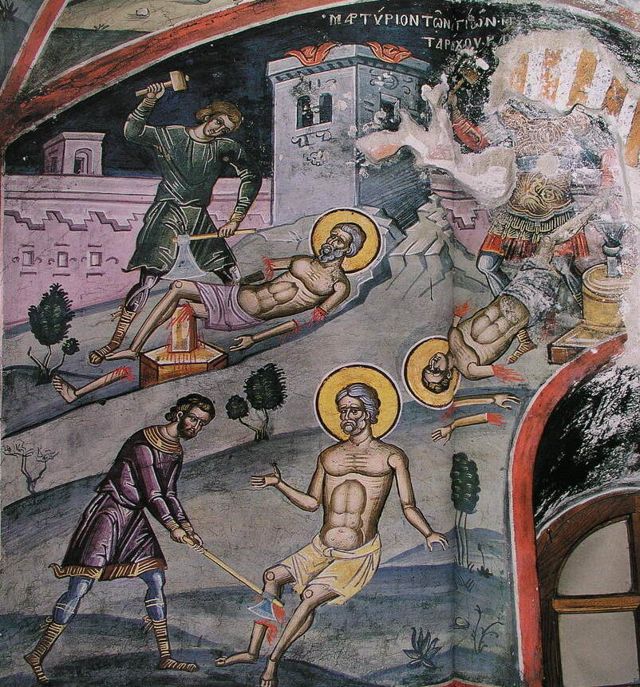
Image: Martyrion Agion Tarachou Andronikou Probou Dionysiou.jpg · Tzortzis Phouka · Public domain, via Wikimedia Commons
From Sabine Baring-Gould, The Lives of the Saints, new edition in 16 vols. (London: John C. Nimmo, 1897–98); text from the Internet Archive scan (OCR, lightly cleaned; errors possible). Public domain.
Image: Tzortzis Phouka, Wikimedia Commons (Public domain)
From Sabine Baring-Gould, The Lives of the Saints, new edition in 16 vols. (London: John C. Nimmo, 1897–98); text from the Internet Archive scan (OCR, lightly cleaned; errors possible). Public domain in the United States. Reproduced unedited, except for short bracketed notes in grey that we added to explain names and terms (“S.” is the old abbreviation for Saint). Some history and judgments reflect 19th-century scholarship.