Faithfulness to Christ when it cost everything.
Read the essentials →Faithfulness to Christ when it cost everything.
August 11
August 11
Martyr
Confessor
Thin entry · the 1897 book gives only 174 words. We have not filled the gap with invented detail.
VOL. IX. “ Sir,” said the vice-prefect, “ I have seen Tranquillinus relieved from gout in his hands and feet, which before were swelled and painful; and when I asked him what medicine he had used to cure him, he exhorted me to baptism.” After three days’ preparation, Chromatius and his son Tiburtius were baptized.
Stay faithful when it costs you. This account is about holding firm under pressure.
Share your faith, in words and by example. Preaching and conversion are central here.
Practise small acts of self-denial. The account dwells on fasting and penance; a skipped snack or a phone-free hour is a start.
Learn from the kind of life it was. Faithfulness to Christ when it cost everything.
VOL. IX. “ Sir,” said the vice-prefect, “ I have seen Tranquillinus relieved from gout in his hands and feet, which before were swelled and painful; and when I asked him what medicine he had used to cure him, he exhorted me to baptism.” After three days’ preparation, Chromatius and his son Tiburtius were baptized. The vice-prefect then went to his villa, and broke all his idols. Under the new regimen imposed by his faith, the twinges of gout ceased to make themselves felt. His baptism had been preceded by severe fasting.
Torquatus, an apostate, betrayed Tiburtius. The prefect Fabian sentenced him to death, and he was executed on the Via Lavicana, at the third milestone from Rome. Chromatius lived quietly in his villa in Campania in the practice of Christian virtues till his death.1 The body of S. Tiburtius is shown in the basilica of S. Peter at Rome. Another body at Autun, given in 862 by Pope Nicolas I.; perhaps this may be the body of another martyr of tire same name.
Feast: August 11
One short email a day for nine days. The day's prayer, a line from Sts. Tiburtius and…'s story, and a nudge to keep going.
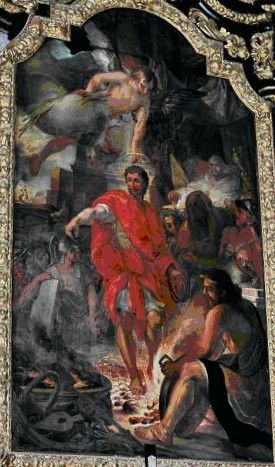
Image: Tiburtius.jpg · Cosmas Damian Asam · Public domain, via Wikimedia Commons
From Sabine Baring-Gould, The Lives of the Saints, new edition in 16 vols. (London: John C. Nimmo, 1897–98); text from the Internet Archive scan (OCR, lightly cleaned; errors possible). Public domain.
Image: Cosmas Damian Asam, Wikimedia Commons (Public domain)
From Sabine Baring-Gould, The Lives of the Saints, new edition in 16 vols. (London: John C. Nimmo, 1897–98); text from the Internet Archive scan (OCR, lightly cleaned; errors possible). Public domain in the United States. Reproduced unedited, except for short bracketed notes in grey that we added to explain names and terms (“S.” is the old abbreviation for Saint). Some history and judgments reflect 19th-century scholarship.