Sts. Vitus, Modestus and Crescentia

A whole community that stayed faithful to Christ when it cost everything.

Read the essentials →
June 15 · Martyrs

Sts. Vitus

Sts. Vitus, Modestus and Crescentia

A whole community that stayed faithful to Christ when it cost everything.

Traditional feast

June 15
1914 / pre-1969 calendar, per Baring-Gould (1897)

Current feast

June 15
Secondary source · Wikipedia

Represents

Martyrs

Their story

Adapted in modern English from the Catholic Encyclopedia (1913) · original text below

Vitus, Modestus and Crescentia are historical martyrs. They were publicly honoured by the fifth century, when the Martyrology of St Jerome lists them in Sicily on 15 June. Nothing historical is known about when or how they died.

A legend that appeared in the sixth and seventh centuries fills the gap, and the source says it has no historical value. In it Vitus is a boy of seven (or twelve), the son of a pagan senator. His father tries everything, even torture, to make him give up the faith, but he stands firm, and he flees by boat with his tutor Modestus. He is brought to Rome to drive a demon out of the Emperor Diocletian's (Roman emperor 284–305, who launched the last and fiercest persecution of Christians in 303) son, and does so. Even so, because he will not renounce Christ, he is tortured along with Modestus and his nurse Crescentia. An angel carries the martyrs back to Lucania, where they die of their torments. Three days later Vitus appears to a noble lady named Florentia, who finds their bodies and buries them where they lie.

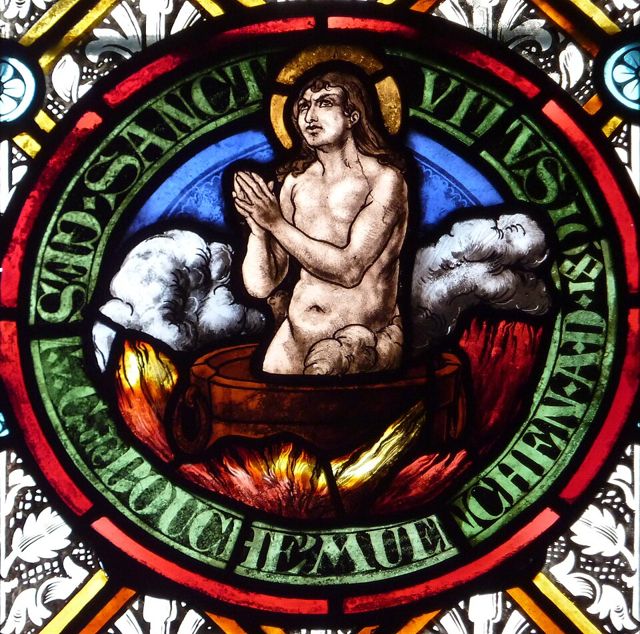
Their cult spread quickly through southern Italy and Sicily and reached Rome early. In 836 relics of Vitus were brought to the abbey of Corvey in Germany, and from there devotion to him spread across northern and eastern Germany. He is invoked above all against epilepsy, called 'St Vitus's dance', and is one of the Fourteen Holy Helpers. He is shown beside a cauldron of boiling oil, from which, according to the legend, he escaped unharmed.

Early life

The book says little or nothing about early life. This is how the account begins.

Thin entry · the 1897 book gives only 0 words. We have not filled the gap with invented detail.

What they represent

How they teach us to live

Drawn from themes in the original account

Learn from the kind of life it was. A whole community that stayed faithful to Christ when it cost everything.

Keep their day. Remember them on June 15 with a short prayer, and ask for their help.

From the Catholic Encyclopedia

1913 · 753 words

According to the legend, martyrs under Diocletian [Roman emperor 284–305, who began the ‘Great Persecution’ of Christians in 303]; feast, 15 June. The earliest testimony for their veneration is offered by the "Martyrologium Hieronymianum" (ed. De Rossi-Duchesne, 78: "In Sicilia, Viti, Modesti et Crescentiae"). The fact that the note is in the three most important manuscripts proves that it was also in the common exemplar of these, which appeared in the fifth century. The same Martyrologium has under the same day another Vitus at the head of a list of nine martyrs, with the statement of the place, "In Lucania", that is, in the Roman province of that name in Southern Italy between the Tuscan Sea and the Gulf of Taranto. It is easily possible that the same martyr Vitus in both cases, because only the name of a territory is given, not of a city, as the place where the martyr was venerated. This testimony to the public veneration of the three saints in the fifth century proves positively that they are historical martyrs. There are, nevertheless, no historical accounts of them, nor of the time or the details of their martyrdom. During the sixth and seventh centuries a purely legendary narrative of their martyrdom appeared which was based upon other legends, especially on the legend of Poitus, and ornamented with accounts of fantastic miracles. It still exists in various versions, but has no historical value.

According to this legend Vitus was a boy seven years of age (other versions make him twelve years old), the son of a pagan senator of Lucania. During the era of the Emperors Diocletian and Maximilian, his father sought in every way, including various forms of torture, to make him apostatize. But he remained steadfast, and God aided him in a wonderful manner. He fled with his tutor Modestus in a boat to Lucania. From Lucania he was taken to Rome to drive out a demon which had taken possession of a son of the Emperor Diocletian. This he did, and yet, because he remained steadfast in the Christian Faith, he was tortured together with his tutor Modestus and his nurse Crescentia. By a miracle an angel brought back the martyrs to Lucania, where they died from the tortures they had endured. Three days later Vitus appeared to a distinguished matron named Florentia, who then found the bodies and buried them in the spot where they were. It is evident that the author of the legend has connected in his invention three saints who apparently suffered death in Lucania, and were first venerated there. The veneration of the martyrs spread rapidly in Southern Italy and Sicily, as is shown by the note in the "Martyrologium Hieronymianum". Pope Gregory the Great mentions a monastery dedicated to Vitus in Sicily ("Epist.", I, xlviii, P.L., LXXXVII, 511). The veneration of Vitus, the chief saint of the group, also appeared very early at Rome. Pope Gelasius (492-496) mentions a shrine dedicated to him (Jaffé, "Reg. Rom. Pont.", 2nd ed., I, 6 79), and at Rome in the seventh century the chapel of a deaconry was dedicated to him ("Liber Pont.", ed. Duchesne, I, 470 sq.). In the eighth century it is said that relics [the bodily remains of a saint, or objects they used, kept with honor] of St. Vitus were brought to the monastery of St-Denis by Abbot Fulrad. They were later presented to Abbot Warin of Corvey in Germany, who solemnly transferred them to this abbey in 836. From Corvey the veneration of St. Vitus spread throughout Westphalia and in the districts of eastern and northern Germany. St. Vitus is appealed to, above all, against epilepsy, which is called St. Vitus's Dance, and he is one of the Fourteen Martyrs who give aid in times of trouble. He is represented near a kettle of boiling oil, because according to the legend he was thrown into such a kettle, but escaped miraculously. The feast of the three saints was adopted in the historical Martyrologies of the early Middle Ages and is also recorded in the present Roman Martyrology on 15 June.

Acta SS., June, II, 1021-1037; MOMBRITIUS, Sanctuarium, II, 349-351; (2nd ed.), II, 634-638; Catalogus codicum hagiograph., ed. BOLLANDISTS (Brussels), I, 11-12, 54-56; Mon. Germ. Hist.: Script., II, 576-585; Historia translationis s. Viti, ed. STENTRUP (Munster, 1906); Bibliotheca hagiographica latina, II, 1257- 1259; Supplementum (2nd ed.), 308-309; DUFOURCQ, Etude sur les gesta martyrum romains, II (Paris, 1907), 165-177; KESSEL, St. Veit, seine Geschichte, Verehrung und bildlichen Darstellungen in Jahrbucher des Vereins fur Altertumsfreunde im Rheinlande, XLIII (1867), 152-183; SCHILDGEN, St. Vitus und der slavische Swantovit in ihrer Beziehung zu einander in Programme (Munster, 1881).
Read more

The full original · 0 words

Read Baring-Gould’s full account

Baring-Gould’s sources: Roman Martyrology. Usuardus, Ado, Hrabanus, &c. Authority: — The Acts, certainly not older than the 6th cent They are fabulous, contradict history, and have the appearance of being a poor attempt at a religious romance, probably founded on fact, and made out of a jumble of two saints of the name of Vitus, one who suffered in Sicily, the other in Rome. Guerin and Giry, with unruffled composure, assert what they must have known was false. “The life of these glorious martyrs is drawn from an ancient MS. worthy of belt#."] |T is impossible to distinguish truth from fable in the legend of S. Vitus, and this is the more difficult from the legend being perhaps made up to the acts of two distinct saints of the same name. But the outline of the story may be briefly summed up thus. Vitus was the child of a Sicilian, named Hylas, who sent him to school to a teacher named Modestus, a Christian, who taught the boy the true faith, and had him baptized without his father’s knowledge. On the breaking out of persecution, Vitus was denounced to the governor as a Christian; the prefect ordered him to be flogged, and then gave him back to his father, who tried blandishments to move him to renounce the faith he had adopted. Then fearing that the boy would yield, his master Modestus and his nurse Crescentia, also a Christian, carried the boy away with them by boat to Italy, where they were all martyred. It is probable that the Vitus martyred at Rome was quite another person than the Vitus of Sicily, and that the latter really suffered in his native island.1 Relics at Corbey in Saxony, and at Prague.

Feast days

Feast: June 15

Nine days · Free

Pray the novena
with us.

One short email a day for nine days. The day's prayer, a line from Sts. Vitus's story, and a nudge to keep going.

Also on June 15
D

St. Dulas

June 15 · Martyr
St. Vougas

St. Vougas

June 15 · Feast
St. Landelin

St. Landelin

June 15 · Abbot
← All 1727 saints in the library
Sources & notes

Feast-day sources

Story sources

Sources

Credits

Image: St Veit Gölsen Pfarrkirche Fenster02.jpg · BSonne · CC BY-SA 3.0, via Wikimedia Commons

From Sabine Baring-Gould, The Lives of the Saints, new edition in 16 vols. (London: John C. Nimmo, 1897–98); text from the Internet Archive scan (OCR, lightly cleaned; errors possible). Public domain.

Image: BSonne, Wikimedia Commons (CC BY-SA 3.0)

From “Catholic Encyclopedia (1913)/Sts. Vitus, Modestus, and Crescentia,” The Catholic Encyclopedia (New York: Robert Appleton Company, 1907–1914), via Wikisource. Public domain. Matched by name and feast date; text unedited except for our bracketed notes in grey.

From Sabine Baring-Gould, The Lives of the Saints, new edition in 16 vols. (London: John C. Nimmo, 1897–98); text from the Internet Archive scan (OCR, lightly cleaned; errors possible). Public domain in the United States. Reproduced unedited, except for short bracketed notes in grey that we added to explain names and terms (“S.” is the old abbreviation for Saint). Some history and judgments reflect 19th-century scholarship.