Faithfulness to Christ when it cost everything.
June 15
Not verified yet
Martyr
At Rome Vitus was brought before Diocletian, who was not emperor of the West, but of the East} Maximian ruled in the West; Vitus cures of possession the son of Diocletian. Now tell me thy nation and parentage.” The Christian prisoner answered, “I am a Cilician, of the village of Prsetoris, of honourable family, and from a boy, a Christian.” “If of honourable birth,” said Maximus, “thou wilt readily obey the will of the unconquered emperors, and adore the gods; thou wilt then acquire honour from their imperial highnesses.”
Stay faithful when it costs you. This account is about holding firm under pressure.
Learn from the kind of life it was. Faithfulness to Christ when it cost everything.
“ I asked thy plain common name,” said the prefect Dulas answered, “ I am called Tatian properly, but have been nicknamed by folks Dulas, and a servant I am — the servant of Christ”
“ Thou hast not been called upon to feel the terror of truth. At Rome Vitus was brought before Diocletian [Roman emperor 284–305, who began the ‘Great Persecution’ of Christians in 303], who was not emperor of the West, but of the East} Maximian [Diocletian’s co-emperor in the West, 286–305] ruled in the West; Vitus cures of possession the son of Diocletian. As it happens, it is well known that Diocletian had no sen.
•S'. Dulas. judgment, I perceive. Now tell me thy nation and parentage.” The Christian prisoner answered, “I am a Cilician, of the village of Prsetoris, of honourable family, and from a boy, a Christian.”
“If of honourable birth,” said Maximus, “thou wilt readily obey the will of the unconquered emperors, and adore the gods; thou wilt then acquire honour from their imperial highnesses.”
“Your honours are not for me. Keep them for those who know not God.” Maximus ordered him to be beaten with rods. Then Dulas exclaimed, “I thank Thee, O Christ, that I am thought worthy to confess Thy Name !”
“What can thy Christ profit thee?” asked the prefect. “ Dost thou feel nothing yet, man ?” Dulas replied, “The apostle Paul said, No man is crowned, unless he strive lawfully.”
“ And so thou reckonest on a crown in exchange for this beating?” said Maximus. “This day I am striving with thy brother, the devil,” replied Dulas grimly. “ And victorious over Satan, I shall be crowned in heaven.”
“ How canst thou be such a fool as to put confidence in a man who was crucified?” asked the magistrate impatiently. “ That crucified Man,” answered Dulas, “ is the living God. Do not then trust in thy stocks and stones.” “What, rascal!” exclaimed Maximus, “die great god Apollo, is he a stone?”
“Apollo a god !” said Dulas, “who ran with money in his hand after Daphne, to buy her love ! What sort of a god do you call that? Verily the stories of your poets about the gods are laughable enough. And the hussy spat in his face, and said, ‘I hold you very cheap, Apollo T” “Turn the fellow over and beat him on* the belly,” said the governor. Then the secretary (cornicularius), Athanasius, said to him, “ For pity’s sake obey the prefect Thy bowels are exposed.” “Away, devil’s councillor and servant Hie to fair Daphne, and bid her be more yielding, or that poor god Apollo will have died broken hearted.”
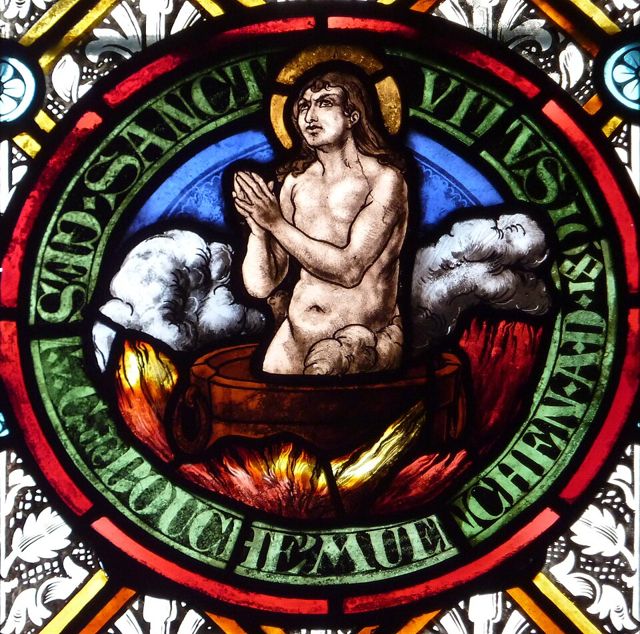
“Bring the gridiron and set fire under, that we may teach this fellow not to blaspheme the great gods,” said Maximus angrily.
Then Dulas said, as they were laying him over the glowing charcoal, “Thy god Apollo sends thee his thanks from hell, where there has been prepared an inextinguishable fire. He thanks thee for having qualified thyself to keep him company for everlasting in that flame. Soon I shall have the laugh on my side.”
After Dulas had been severely scorched, Maximus ordered him back to prison, with a heavy image of Hercules attached to his neck. Next day he was brought before the governor again, and as he began again to mock at the gods, Maximus ordered red-hot coals to be placed on his head, and pepper to be put up his nostrils. “ Shall I tell thee something more about thy goddesses,” asked the martyr. “There is a rare story about three of them going unclothed before Paris, a shepherd lad, to decide which of them was the prettiest” “ Strike him on the mouth,” cried Maximus. Then the governor ordered the meat that had been offered in sacrifice to be brought and forced into the mouth of Dulas. “ You may scour your idol altar, and pour the scourings down my throat, but ye will not thereby injure and pervert Christ’s servant,” said the dauntless confessor [in old usage, a saint who was not martyred, or who suffered for the faith without being killed]. “ Ha ! ha 1 ” exclaimed the prefect; “ see, our man has eaten of the meat offered to the gods ! ”
June *5.J S. Vougas. “That cannot hurt me, execrable governor; for the meats are forced on me. I am ready to die for my faith.” Then Maximus ordered him to be huug up by the wrists, and his body to be tom with iron rakes. When his flesh had been rent, so that his cheeks hung in ribbons, and his bowels were exposed, the prefect ordered him to be removed, and taken with him to Tarsus, whither he was bound that same day. But Dulas died on the road, a few miles out of Zephynum. When the prefect was told that he was dead he said, “Throw him into the ditch/' A sheepdog found the body, and stood over it howling. The fellow dog started off to its master, a shepherd, who was pasturing sheep at some distance, and plucked at his coat, and by signs indicated that it desired him to follow. The shepherd let his dog lead him, and it brought him to the body. He told what he had seen, and it was noised in the city. So die Christians came out and carried off the body, and buried it.
Feast: June 15
One short email a day for nine days. The day's prayer, a line from St. Dulas's story, and a nudge to keep going.
From Sabine Baring-Gould, The Lives of the Saints, new edition in 16 vols. (London: John C. Nimmo, 1897–98); text from the Internet Archive scan (OCR, lightly cleaned; errors possible). Public domain.
From Sabine Baring-Gould, The Lives of the Saints, new edition in 16 vols. (London: John C. Nimmo, 1897–98); text from the Internet Archive scan (OCR, lightly cleaned; errors possible). Public domain in the United States. Reproduced unedited, except for short bracketed notes in grey that we added to explain names and terms (“S.” is the old abbreviation for Saint). Some history and judgments reflect 19th-century scholarship.