A

A shepherd who stayed with his people through hard times.

Read the essentials →
March 1 · Bishop

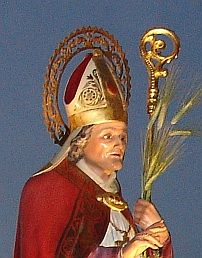
St. Albinus of Angers

St. Albinus of Angers

A shepherd who stayed with his people through hard times.

Traditional feast

March 1
1914 / pre-1969 calendar, per Baring-Gould (1897)

Current feast

Not verified yet

Represents

Bishop

Their story

Adapted in modern English from Alban Butler's Lives of the Saints · Baring-Gould original below · little is known

Albinus, called Aubin in France, came from an ancient and noble family in Brittany. He became a monk at Cincillac, later called Tintillant, near Angers, and lived as a model of prayer, watchfulness and obedience.

At thirty-five, in 504, he was chosen abbot, and twenty-five years later Bishop of Angers. He restored discipline everywhere, kept up his austerities and was never touched by vanity, though honoured even by kings. At the third Council of Orleans in 538 he had a canon against incestuous marriages renewed.

He died on 1 March 549. St Germanus of Paris enshrined his relics in 556, and the famous abbey of St Albinus at Angers was built over his grave.
Early life

The book says little or nothing about early life. This is how the account begins.

Thin entry · the 1897 book gives only 127 words. We have not filled the gap with invented detail.

S. Albinus, or S. Aubin , as he is called in France, belonged to an ancient family at Vannes, in Brittany. He embraced the religious life in the abbey of Cincillac, called afterwards Tintillant, near Angers. At the age of thirty-five, in the year 504, he was chosen abbot, and twenty-five years afterwards, bishop of Angers.

What they represent

How they teach us to live

Drawn from themes in the original account

Learn from the kind of life it was. A shepherd who stayed with his people through hard times.

Keep their day. Remember them on March 1 with a short prayer, and ask for their help.

Read more

The full original · 127 words

Read Baring-Gould’s full account

Baring-Gould’s sources: S. Albinus seems to have enjoyed an amount of popularity as a saint which it is difficult to account for. Besides receiving great veneration at Angers, where his feast is a double, and in Brittany, where it is a semi-double, in Gnesen, in Poland, it was observed as a double. His name appears in most Martyrologies, as those of Usuardus, Hrabanus, Wandelbert, &c. Authority:—His life written by Fortunatus, a priest, his contemporary.

S. Albinus, or S. Aubin , as he is called in France, belonged to an ancient family at Vannes, in Brittany. He embraced the religious life in the abbey of Cincillac, called afterwards Tintillant, near Angers. At the age of thirty-five, in the year 504, he was chosen abbot, and twenty-five years afterwards, bishop of Angers. In the 3rd Council of Orleans, in 538, he caused the thirtieth canon of the Epaone to be revived, which declared excommunication to those who contracted marriage within the first or second degree of consanguinity. His life is singularly devoid of incident which could mark it off from that of many another abbot and bishop, and it is therefore difficult to account for his undoubted popularity in France in ancient times.

Feast days

Feast: March 1

Nine days · Free

Pray the novena
with us.

One short email a day for nine days. The day's prayer, a line from St. Albinus of Angers's story, and a nudge to keep going.

Also on March 1
St. Hesychius

St. Hesychius

March 1 · Bishop, Martyr
St. Eudocia

St. Eudocia

March 1 · Martyr
St. Antonina

St. Antonina

March 1 · Martyr
← All 1726 saints in the library
Sources & notes

Feast-day sources

Story sources

Sources

Credits

From Sabine Baring-Gould, The Lives of the Saints, new edition in 16 vols. (London: John C. Nimmo, 1897), digitized text from Project Gutenberg. Public domain.

From Sabine Baring-Gould, The Lives of the Saints, new edition in 16 vols. (London: John C. Nimmo, 1897), digitized text from Project Gutenberg. Public domain in the United States. Reproduced unedited, except for short bracketed notes in grey that we added to explain names and terms (“S.” is the old abbreviation for Saint). Some history and judgments reflect 19th-century scholarship.