Baring-Gould’s sources: Roman Martyrology, also an ancient addition to the so-called Martyrology of S. Jerome, which addition is earlier than 741. Bede (so-called), Notker, Rabanus, German and Belgian Martyrologies, &c. In the Church of Maestricht, the 6th Feb. is celebrated as the Feast of S. Amandus and the other Bishops of Maestricht, with a double. His ordination and translation are celebrated variously on 26th October, or on 20th, 25th, 27th, and even on the 19th Sept. Various other days commemorate translations of his relics. Authorities:—An ancient anonymous life. Another by Bandemand, monk of Elno, about 680; another by Milo, monk of Elno, d. 871; another by Philip Harveng, d. after 1180; another by Justus, the Archpriest, about 1128.
This great apostle of Flanders was a native of Herbauges, near Nantes. His father, Serenus and his mother, Amantia, were of noble family, and were wealthy. But Amandus, renouncing all these advantages, left his paternal house, in his youth, and retired into the isle of Oye, near La Rochelle, where he embraced the religious life in a monastery which was there. His father, who looked to his worldly advantage, followed him, and threatened to disinherit him, if he did not quit the habit he had assumed. He replied, "My father, I care not for thy property; all I ask of thee is to suffer me to follow Jesus Christ, who is my true heritage."
This reply did not satisfy his father, and Amandus, to escape his solicitations, fled the island, and visited the tomb of S. Martin [St. Martin of Tours (d. 397), soldier turned bishop] at Tours. Kneeling by this shrine, with many tears, he besought God to grant that he might never more return to his native place. Shortly after he received the clerical tonsure [shaving part of the head as a sign of entering the clergy or monastic life]. He soon distinguished himself among the clergy of Tours; but the fame of S. Austragisle drew him to Bourges, when this holy bishop, together with S. Sulpicius, then his archdeacon, and afterwards his successor, received him with great joy. They built him a little cell, near the cathedral, in which he lived as a recluse, to die and be buried to the world. There, lying on ashes, clothed in sack-cloth, and eating only barley-bread, and drinking water alone, he spent fifteen years. It was the preparation for his future apostleship.
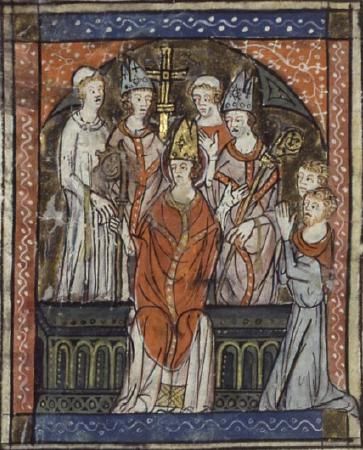
At the end of these years, Amandus felt an inspiration to visit Rome. It was at the tomb of the great Apostles, that he was to receive his call and mission. One night, as he prayed with fervour before the door of the basilica of S. Peter, because it was locked for the night, the prince of the apostles appeared to him, and ordered him to return instantly to Gaul [roughly modern France and Belgium], and to preach the glad tidings of salvation to the heathen there. Amandus obeyed promptly, and on his return, he preached with such success, that King Clothaire II. ordered him to be consecrated bishop, that he might preach with more authority, but without any particular see, over which he was to exercise jurisdiction.
The new apostle maintained his dignity by his virtues. He knew how to make the poor love him, and the rich respect him. He found means of ransoming young slaves, whom he baptized, instructed in letters, and ordained; sending them through the country to minister the Word of God. S. Amandus chose for his mission Belgic Gaul, especially the territory of Ghent, where idolatry still held its sway. The people there had rejected former missionaries; their savage manners, and inflexible obstinacy seemed insurmountable barriers to the stream of Grace. Amandus visited S. Acharius, bishop of Noyon and Tournai in whose diocese Ghent then was; and besought him to obtained for him letters from King Dagobert, to oblige his idolatrous subjects to listen to Christian instruction. The zeal of the prince seconded that of the missionary, who, in spite of this powerful support, had much to endure; but his patience and sweetness triumphed over every obstacle, and his virtues were more efficacious in persuading the people, than all the orders of the king.
Whilst S. Amandus was at Tournai, he learnt that a Frankish Count, named Dotto, had condemned a robber to death. He hastened to implore pardon for the unhappy man, but was unsuccessful, and the robber was executed. But Amandus ran to the gallows and cut down the man, and bore the body home, laid it on his bed, and passed the night in prayer. Next morning, he summoned his clerks, and bade them bring him water. They supposed this was for the purpose of washing the corpse, before burying it; but, what was their surprise on entering the chamber, to find the man, who had been hung, alive and conversing with their bishop. He still bore the marks of the rope, but they disappeared when Amandus had washed them. Bandemand, who relates this incident, says that he heard it from the mouth of an eye-witness. The fame of this miracle spread through the country, and many of the heathen were so convinced thereby, that they cast away their idols, and submitted their necks to the yoke of Christ's commandments.
After having reaped an abundant harvest in Flanders, Amandus resolved to preach the faith to the heathen races in Germany; and he made a second journey to Rome, to obtain approval of his design. Accordingly, armed with the blessing of the successor of S. Peter, he went to the Sclavonic races, hoping to convert them to the Gospel, or to receive the palm of martyrdom. But finding that the people were neither sufficiently docile to receive the Word, nor ferocious to shed the blood of him who declared it, he quitted these ungrateful people, and returned to Gaul, where he found the opportunity of suffering for the truths he announced, which had been denied him among the barbarians. Dagobert, the king, was guilty of gross licentiousness; he had, at once, three wives, not to mention Gomatrudis whom he had repudiated at Reuilli, nor Ragntrudis, the mother of Sigebert III.; and beside these wives he had numerous concubines. S. Amandus boldly rebuked him for the scandal he caused, and for his audacity in so doing was ordered into exile. He retired to the territory of Charibert, who reigned on the further side of the Loire; but was soon recalled. A son was born to Dagobert, in 630, and the king desired to have the child baptized by some holy bishop, who might draw down on it the benediction of heaven. He remembered the fearless Amandus, who alone had had the courage to reprimand him for his iniquities; showing, thereby, that if princes do not always love those who tell them disagreeable truths, they can sometimes respect them. Amandus obeyed, and came to salute the king at Clichy, near Paris. As soon as Dagobert saw him, he cast himself at his feet, to ask him pardon for what was passed. After which he said: "The Lord has given me a son, though I merited it not. I pray thee, baptize him, and regard him as thy spiritual child." Amandus, at first, refused the honour, but at the entreaty of Ouen and Eligius, two pious laymen of his court, he yielded and baptized the child at Orleans, in the year 630; Charibert, his protector in exile, standing as sponsor at the font. The child was called Sigebert, and is reckoned among the Saints. [22]
In the year 647, Sigebert, who loved him as a father, and was now king of Austrasia, obliged him to accept the bishopric of Maestricht, and thenceforth he exchanged his missionary work over scattered districts for the supervision of a single diocese. But he soon found that this was not his vocation, and that it was easier for him to convert the heathen than to discipline the clergy. He therefore visited Rome, after holding his diocese three years, and obtained the sanction of the Pope to his resignation of it into the hands of S. Remacle, then abbot of Stavelot. Amandus, relieved of the burden of his diocese, visited Gascony, to preach to the Basques who were still heathen, but met with little or no success. He therefore returned to Flanders, where he supervised the many monasteries he had founded. The date of his death is very uncertain; some place it in 661, others in 676, and others in 684.