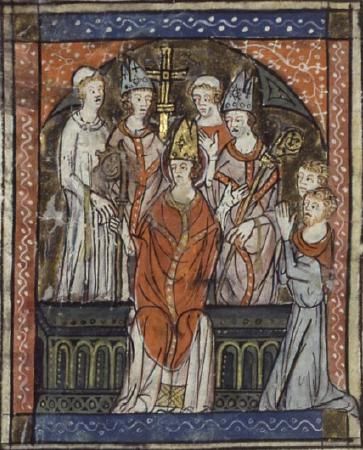
Baring-Gould’s sources: Roman, Gallican, Belgian, and other Martyrologies. Double feast with octave at Arras. In the Salisbury Martyrology, he is inserted on this day under the name of S. Zawster. In many Kalendars, SS. Vedast and Amandus are commemorated together. Authorities:—A very ancient life, published from an imperfect copy by Bollandus. Another life revised or rewritten by Alcuin, (d. 804). Another erroneously attributed to the Venerable Bede.
Clovis, King of the Franks [the Germanic people who ruled Gaul and gave France its name], began his reign in 482, on the decease of his father, Childeric. He extended his dominions in every quarter by force of arms, and in the space of thirty years conquered part of Germany, and nearly the whole of Modern France. In the early part of his career, the King of the Franks signalized himself by repelling with success the attacks of Syagius, the Roman general, who had been ordered to advance and check his progress. This impediment in the path of victory removed, the five ensuing years were actively employed by Clovis in the reduction of Soissons and of Rheims; in a successful expedition against the Thuringians and other neighbouring nations, in the course of which he extended his territories from the Seine to the Loire; and lastly in the conquest of the Alemanni, at that time the possessors of Switzerland. The Alemanni attacked the Franks with the fury of men actuated by despair, and were irrevocably defeated on the field of Tolbiac.
The great soul of Clovis had long been agitated by religious doubts—should he cling to the gods of his family, from whom he claimed to be lineally descended, or should he submit to the faith of Christ which his gentle wife, Clothildis, made so attractive to his better nature? His ancestral gods alarmed him. To their anger he attributed the death of his first-born; he hesitated to abandon them for that "new, unarmed God," said he, "who is not of the race of Thor and Odin." He dreaded also his people, of whose consent he wished to be assured. The peril of the field of Tolbiac constrained him to decide. When the scale of success seemed turned against him, he vowed, if he conquered, to adopt the faith of Christ. The victory remained in his hands, and he hastened to fulfil his vow. On his return from the subjugation of the Alemanni, he passed through Toul, and asked for some priest who might instruct him in the Christian religion. S. Vedast was presented to him for this purpose. Whilst he accompanied the king at the passage of the river Aisne, a blind man begging on the bridge besought the servant of God to restore to him his sight. The saint, divinely inspired, prayed, and made the sign of the cross on his eyes, and he immediately recovered it. The miracle confirmed the king in the faith, and moved several of his courtiers to embrace it.
But Clovis was not a man to yield at once. Nicetius of Trèves, writing to the grand-daughter of Clovis says, "You have learnt from your grandmother of happy memory, Clothildis, how she attracted to the faith her lord and husband, and how he, who was a most shrewd man, would not yield, till he had been thoroughly convinced of the truth." Clovis was baptized at Rheims, whither in after times the kings of France went to be crowned. S. Vedast assisted S. Remigius [bishop of Reims who baptized Clovis, king of the Franks] in converting the Franks, and was consecrated by that prelate bishop of Arras, in the year 500. His diocese, together with that of Cambrai, which was also entrusted to his care, had once been the seat of a flourishing Christian community, but the ravages of the Vandals and Alani had eradicated every trace of Christianity, save that here and there was to be seen a ruined church, overgrown with briars, and nettles waving where the altar had stood. Vedast wept over these sad relics [the bodily remains of a saint, or objects they used, kept with honor], and made earnest supplication to God to enable him faithfully to accomplish his mission, and once more to plant the seed of life in this devastated field.
His own Cathedral Church of Arras he found had become the den of a huge bear, which came shambling towards him, as he knelt weeping over the broken altar stair. The saint started up and drove the wild beast forth, and bade it never again enter to pollute by its presence that holy ground; a type, surely, of that brutality which had invaded and desolated the Church of God in that land, which he had come to exorcise.
He ruled the diocese for forty years, and died on Feb. 6th, in, or near, the year 540. All Martyrologists are agreed as to the day of his death, but historians differ as to the year.
The name of S. Vedast has gone through strange transformation. He is called Vaast, Vaat, Wâst, Wât; and in French, Gaston; in English, Foster, a corruption marked by Foster Lane, (properly S. Vedast's Lane) in the City of London.
Relics at Arras, of which he is patron, and at S. Waast. In Art he appears with a child at his feet, or with a wolf, from whose mouth he saves a goose, a popular tradition being to the effect that he saved the goose belonging to some poor people from the wolf that was running away with it; or, with a bear.