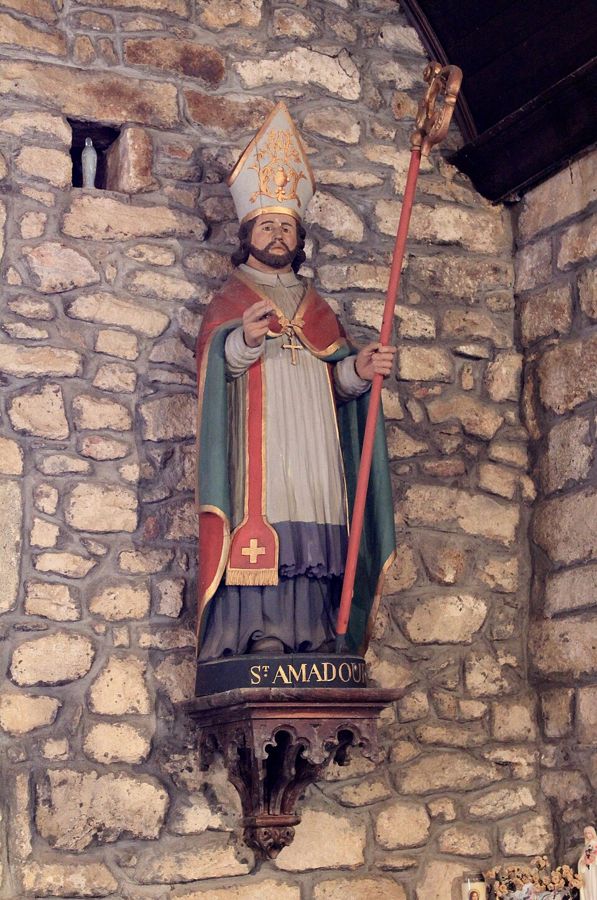
Baring-Gould’s sources: All Latin Martyrologies, Roman included. The life of S. Amator was written by Stephen, an African priest, at the request of S. Aunarius, Bishop of Auxerre, A.D. 580.] Amator was the only son of wealthy and noble parents at Auxerre, brought up in all the accomplishments suited to his birth and future prospects. When he reached manhood he was espoused to a beautiful girl of good family, named Martha. On the wedding day the old bishop of Auxerre, S. Valerian, was invited to give the nuptial benediction1 in 1 Invitatur de more religiosorum, ad introitum thalami, illico Vaierianus Episcopus.
…the house. The historian describes at length the splendour of the adornments of the chamber and of the bride. The aged bishop, now nearly in his second childhood, took his book of prayers, and mumbled the office for the ordination of a clerk, by mistake, and the assistants were none the wiser, except Amator, who was paying close attention to the words of the childish and toothless old man. Then when all had withdrawn, he said to his girlish bride, as he took her hands in his, “ Knowest thou what the bishop read from his book?” “Yes,” she answered, “he blessed our union.” “No, my dear one,” said the young man, “ he consecrated us to the Lord. And now, though he did it unwittingly, he did it not without God’s will, and it may be His purpose that we should serve Him in the highest and holiest estate.” So she cast herself into his arms and said, “What thou wiliest, I will too.” Then they knelt together and offered themselves of their own free-will to serve God. And there came a sweet perfume into the room, as from roses. Then said Martha, “Whence comes this fragrance, my brother?” And he answered, “It is the odour of Paradise, where they neither marry nor are given in marriage, but are as the angels of God.” So they went to rest, and the lamp died out in the socket, and as it became dark, Amator saw the luminous form of an angel growing out of the darkness, holding two lily crowns, which he laid on the heads of the virgin pair. Now during the marriage festivities, which were protracted several days, the old bishop Valerian [Roman emperor 253–260, who persecuted bishops and clergy] died, and in his place was chosen S. Helladius. And when the feasting was at an end, the young couple went to the new bishop, and disclosed to him what was their design, and when he heard them, he was filled with wonder, and he blessed them both, and Amator he consecrated deacon, and then priest, and to Martha he gave the veil, and she became a nun. May i.] S. Amator, 13 After a few years S. Helladius was gathered to his predecessors in the see, and Amator was chosen by the unanimous voice of the clergy and people to fill his vacant chair. The chief man of Auxerre was a certain Germanus, a man of noble qualities, but not attending much to his religious duties. He was passionately fond of hunting, and he was wont to hang up the heads of the wild boars and stags he killed to the branches of a large pear tree that grew in the middle of the town. This was an old heathen custom, and was, in fact, an oblation to Woden; and as such, it gave the bishop great offence. He complained to Germanus, but the sportsman paid no attention to his remonstrances. Then Amator one day, whilst Germanus was abroad hunting, cut down the tree, and threw all the antlers and boar's heads away outside the town. Germanus was greatly incensed, and vowed vengeance against the bishop, who to escape his wrath, fled the town, and made the best of his way to Autun, to count Julius, governor of the province. He now adopted one of those extraordinary expedients to escape from the difficulty in which he had involved himself, which can only be palliated by the customs of the time in which Amator lived. He had, no doubt, formed an high opinion of Germanus, and had conceived an affection for the frank, rough noble. His wealth and position would signally aid the Church at Auxerre if he could be enlisted among the clergy; and the zeal wherewith he had pursued game, might be diverted to enthusiasm in the pursuit of souls. So thought Amator, we may presume, when he abruptly demanded of the governor his sanction to the nomination and consecration of Germanus to the episcopal throne of Auxerre in the room of himself. “ For/7 said S. Amator, “ God has revealed to me that my life draweth to a close." The astonished governor gave his consent, and Amator at once returned to Auxerre, where Germanus was still storming at the destruction of his trophy, and vowing vengeance. Amator at once went to the church, and a crowd of people rushed after him, amongst them Germanus. “ Let everyone divest himself of his weapons, and lay spear and sword outside the doors,55 said the bishop; and he was obeyed. Then at a signal, the gates were closed. Instantly Amator rushed upon Germanus, caught him by the arm, and assisted by some of his clergy, dragged him to the altar steps, and then and there ordained him. Then, when silence was made, Amator called on the people to elect Germanus to be their bishop, as he who spake to them was about to ’ die. And so it was, Amator died a few days after, and Germanus, chosen by the clergy and the people, was consecrated bishop, and ruled the see well.