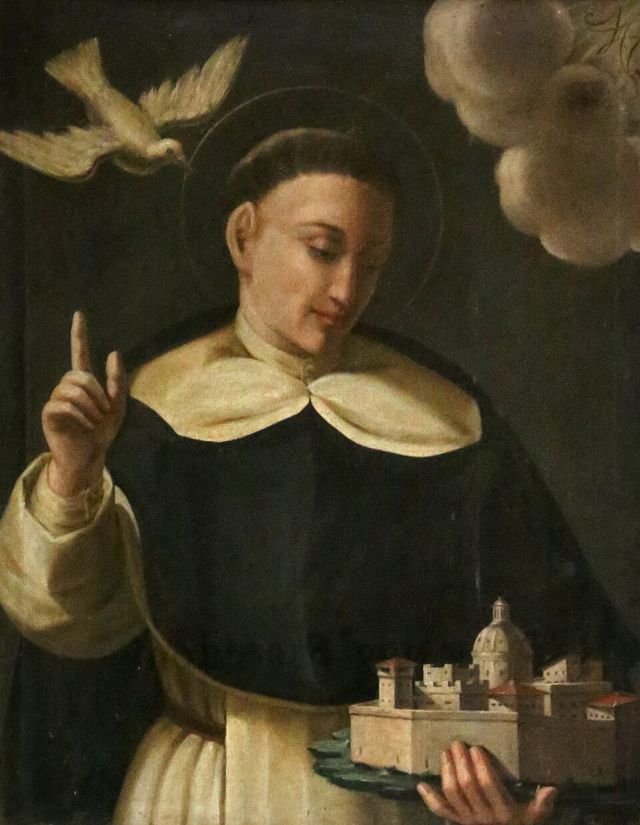
St. Ambrose of Sienna

A life spent serving ordinary people.

Read the essentials →
March 20 · Priest

St. Ambrose of Sienna

St. Ambrose of Sienna

A life spent serving ordinary people.

Traditional feast

March 20
1914 / pre-1969 calendar, per Baring-Gould (1897)

Current feast

October 8
Secondary source · Wikipedia

Represents

Priest

Their story

Adapted in modern English from Baring-Gould (1897) · original text below

Ambrose came from two illustrious Siennese families, the Sansedoni on his father's side and the Stribelini on his mother's. He was born with twisted legs and feet. One holy day his nurse was at Mass in the Dominican (the Order of Preachers founded by St. Dominic) church, praying before relics, when the baby suddenly said the name of Jesus three times, and every trace of the deformity vanished at once.

As a child his games were all about holy things: carving little crosses, building little oratories and staging processions with other children. When he was older his father let him lodge pilgrims. Every Saturday he went to the city gate and brought home the first five pilgrims he met. He washed their feet, cared for them, took them to Mass the next day and showed them the city's shrines. On Sunday evenings he visited the hospital, and on Fridays the prison.

At seventeen he entered the Dominican order and made his profession the following year, 1238. He studied in Paris and Cologne, where he was a pupil of Albertus Magnus alongside St Thomas Aquinas. He taught theology in Paris for two years and then preached in France, Germany and Italy. Sienna had sided with Mansfeld, the illegitimate son of Frederick II, who was at war with the Pope, and had been put under an interdict. Ambrose reconciled the city with the Holy See (the pope and the Vatican's central offices), and in gratitude the Siennese made him their patron.

Through forty-nine years as a friar he kept strict discipline. He never slept more than four hours a night, and after Matins he prayed for two hours in the choir and studied until Prime. He preached with great fire. In Lent of 1286 he burst a blood vessel while preaching. When the bleeding stopped he insisted on finishing his sermon the next day, but the vessel burst again and he lost so much blood that he knew his hour had come. He made his confession, received the last sacraments, and died on 20 March 1286 in his sixty-sixth year.
Early life

Selected sentences from the original account, unaltered.

S. Ambrose was of the family of the Sansedoni, on his father's side, and of the Stribelini on that of his mother, both illustrious in Sienna. He was deformed at his birth, his legs and feet being twisted, but as his nurse was hearing mass one holy-day, in the church of the Dominicans, and was praying before some holy relics, afterwards exposed to the veneration of the faithful, the child suddenly pronounced the name of Jesus thrice, and lost at the same moment every trace of deformity. When he grew older, he obtained his father's consent to his lodging pilgrims.

What they represent

How they teach us to live

Drawn from themes in the original account

Share your faith, in words and by example. Preaching and conversion are central here.

Pray a little every day. Prayer runs all through this account.

Feed your mind with Scripture and good books. Learning and the Scriptures matter in this life.

Learn from the kind of life it was. A life spent serving ordinary people.

Read more

The full original · 478 words

Read Baring-Gould’s full account

Baring-Gould’s sources: At Sienna on the Saturday before Passion Sunday; but by the Dominican Order on March 22nd; the Roman Martyrology on March 20th, the day of his death. He was beatified by Gregory XV. His Acts were written by friars Gisberti, Recuperato di Petromala, Aldobrandini Paparoni, and Olvado, by order of Honorius IV., the then reigning pope, from documents transmitted to them within a month of the decease of S. Ambrose. These originals also exist, and have been printed along with the Acts by the Bollandists.

S. Ambrose [bishop of Milan (d. 397)] was of the family of the Sansedoni, on his father's side, and of the Stribelini on that of his mother, both illustrious in Sienna. He was deformed at his birth, his legs and feet being twisted, but as his nurse was hearing mass one holy-day, in the church of the Dominicans, and was praying before some holy relics [the bodily remains of a saint, or objects they used, kept with honor], afterwards exposed to the veneration of the faithful, the child suddenly pronounced the name of Jesus thrice, and lost at the same moment every trace of deformity.

As he grew up, his play was connected with holy things. Till he was seven, he amused himself with carving little crosses, making little oratories, imitating with other children the processions and psalmody of the Church. When he grew older, he obtained his father's consent to his lodging pilgrims. He furnished for the purpose a room in the house, and went to the gate of the city every Saturday to bring home with him the first five pilgrims whom he encountered. He then washed their feet, and ministered in every way to their comforts. On the morrow he went with them to mass, and guided them about the town to all the places of devotion. Every Sunday evening after vespers he visited the hospital, and every Friday the prison. He continued these holy exercises till he was seventeen, when he entered the Dominican order. He made his full profession next year, in 1238, and was then sent to Paris and to Cologne to prosecute his studies. At Cologne he became the pupil of Albertus Magnus, along with the great S. Thomas Aquinas. When his education was complete, he taught theology in Paris for two years, and then preached in France, Germany, and Italy. The people of Sienna having taken part with Mansfeld, the bastard of Frederick II., who was in hostility with the pope, were placed under an interdict. Ambrose undertook to reconcile them with the Holy See, and was so successful, that the Siennese have chosen him, on account of this eminent service rendered them, as the patron of their city.

During the forty-nine years of his monastic life, he maintained the utmost self-discipline. He never slept more than four hours every night. After matins he remained for two hours in prayer in the choir, and spent the rest of the night in study till prime. He preached with singular fire and action. In the Lent [the forty days of fasting before Easter] of 1286, he broke a blood-vessel as he was preaching, and was obliged to leave the pulpit. The hæmorrhage ceasing next day, he insisted on resuming his sermon, but the vessel burst again, and he lost so much blood that he felt his hour was at hand. He made his general confession, and having received the last sacraments, breathed forth his pure soul in the sixty-sixth year of his age, on March 20th, 1286.

Feast days

Feast: October 8
Traditional: March 20

Nine days · Free

Pray the novena
with us.

One short email a day for nine days. The day's prayer, a line from St. Ambrose of Sienna's story, and a nudge to keep going.

Also on March 20
St. Joachim

St. Joachim

March 20 · Feast
St. Cuthbert of Lindisfarne

St. Cuthbert of…

March 20 · Bishop
W

St. Wulfram of Sens

March 20 · Bishop
← All 1726 saints in the library
Sources & notes

Feast-day sources

Story sources

Sources

Credits

Image: Beato Ambrogio Sansedoni (cropped).jpg · Sailko · CC BY 3.0, via Wikimedia Commons

From Sabine Baring-Gould, The Lives of the Saints, new edition in 16 vols. (London: John C. Nimmo, 1897), digitized text from Project Gutenberg. Public domain.

Image: Sailko, Wikimedia Commons (CC BY 3.0)

From Sabine Baring-Gould, The Lives of the Saints, new edition in 16 vols. (London: John C. Nimmo, 1897), digitized text from Project Gutenberg. Public domain in the United States. Reproduced unedited, except for short bracketed notes in grey that we added to explain names and terms (“S.” is the old abbreviation for Saint). Some history and judgments reflect 19th-century scholarship.