St. Joachim

Nothing whatever is known of S. Joachim, except what is related in the Apocryphal Gospels, whence the name is derived.

Read the essentials →
March 20 · —

St. Joachim

St. Joachim

Nothing whatever is known of S. Joachim, except what is related in the Apocryphal Gospels, whence the name is derived.

Traditional feast

March 20
1914 / pre-1969 calendar, per Baring-Gould (1897)

Current feast

July 26
Verified · General Roman Calendar

Represents

Feast

Their story

Adapted in modern English from the Catholic Encyclopedia (1913) · original text below

Joachim, whose name means 'the Lord prepares', is honoured as the father of the Blessed Virgin Mary. The Gospels do not name him. The tradition that Joachim and Anne were Mary's parents is very old, but it seems to rest finally on apocryphal (outside the Bible and not accepted as Scripture) writings such as the 'Gospel of James', which the source says mix legend with some data from reliable tradition. That book tells how, in their old age, Joachim and Anne received a child in answer to their prayers.

Tradition says Mary's parents lived first in Galilee and later settled in Jerusalem, where she was born and raised and where they died and were buried. A church was built in the fourth century, possibly by St Helena, on the site of their house. Their tombs were honoured there until the late ninth century, and its crypt was rediscovered in 1889. The source warns that claims that he was Heli of Luke's genealogy, Joseph's brother, or rich in flocks are doubtful. The Greeks honoured him very early, the day after Mary's birthday, while the Latin Church was slower to add his feast.

Early life

The book says little or nothing about early life. This is how the account begins.

Thin entry · the 1897 book gives only 39 words. We have not filled the gap with invented detail.

Nothing whatever is known of S. Joachim, except what is related in the Apocryphal Gospels, whence the name is derived. It is probable, however, that the name was traditionally preserved, and adopted by the author of the Apocryphal Gospels.

What they represent

How they teach us to live

Drawn from themes in the original account

Keep their day. Remember them on March 20 with a short prayer, and ask for their help.

From the Catholic Encyclopedia

1913 · 586 words

Joachim (whose name means Yahweh prepares), was the father of the Blessed Virgin Mary.

If we were to obey the warning of St. Peter Damian, we should consider it a blameable and needless curiosity to inquire about those things that the Evangelists did not deem it advisable to relate, and, in particular, about the parents of the Blessed Virgin (Serm. iii de Nativ. B.M.V.). Tradition nevertheless, grounded on very old testimonies, very early hailed Saints Joachim and Anne as the father and mother of the Mother of God. True, this tradition seems to rest ultimately on the so-called "Gospel of James", the "Gospel of the Nativity of the Blessed Mary", and the Pseudo-Matthew, or "Book of the Nativity of the Blessed Virgin Mary and of the Childhood of the Saviour"; and this origin is likely to rouse well-founded suspicions. It should be borne in mind, however, that the apocryphal character of these writings, that is to say, their rejection from the canon, and their ungenuineness do not imply that no heed whatever should be taken of some of their assertions; side by side, indeed, with unwarranted and legendary facts, they contain some historical data borrowed from reliable traditions or documents; and difficult though it is to distinguish in them the wheat from the tares, it would be unwise and uncritical indiscriminately to reject the whole. Some commentators, who believe that the genealogy given by St. Luke is that of the Blessed Virgin, find the mention of Joachim in Heli (Luke, iii, 23; Eliachim, i.e. Jeho-achim), and explain that Joseph had, in the eyes of the law, become by his marriage the son of Joachim. That such is the purpose and the meaning of the Evangelist is very doubtful, and so is the identification proposed between the two names Heli and Joachim. Neither can it be asserted with certainty, in spite of the authority of the Bollandists [Jesuit scholars who since the 1600s have critically studied the lives of the saints], that Joachim was Heli's son and Joseph's brother; nor, as is sometimes affirmed, from sources of very doubtful value, that he had large possessions in herds and flocks. Much more interesting are the beautiful lines in which the "Gospel of James" describes how, in their old age, Joachim and Anne received the reward of their prayers to obtain issue. Tradition has it that the parents of the Blessed Virgin, who, apparently, first lived in Galilee, came later on to settle in Jerusalem; there the Blessed Virgin was born and reared; there also they died and were buried. A church, known at various epochs as St. Mary, St. Mary ubi nata est, St. Mary in Probatica, Holy Probatica, St. Anne, was built during the fourth century, possibly by St. Helena, on the site of the house of St. Joachim and St. Anne, and their tombs were there honoured until the close of the ninth century, when the church was converted into a Moslem school. The crypt which formerly contained the holy tombs was rediscovered on 18 March, 1889.

St. Joachim was honoured very early by the Greeks, who celebrate his feast on the day following the Blessed Virgin's birthday; the Latins were slow to admit it to their calendar, where it found place sometimes on 16 Sept. and sometimes on 9 Dec. Assigned by Julius II to 20 March, the solemnity was suppressed some fifty years later, restored by Gregory XV (1622), fixed by Clement XII (1738) on the Sunday after the Assumption, and finally raised to the rank of double of the second class by Leo XIII (1 Aug., 1879).
Read more

The full original · 39 words

Read Baring-Gould’s full account

Baring-Gould’s sources: Roman Martyrology; by the Greeks on Sept. 9th. The insertion of this name in the Martyrologies is not earlier than the 16th century. The Roman Breviary of 1522, pub. at Venice, contained it with special office, but this was expunged by pope Pius V., and in the Breviary of 1572, neither name nor office are to be found.

Nothing whatever is known of S. Joachim, except what is related in the Apocryphal Gospels, whence the name is derived. It is probable, however, that the name was traditionally preserved, and adopted by the author of the Apocryphal Gospels.

Feast days

Feast: July 26
Traditional: March 20

Nine days · Free

Pray the novena
with us.

One short email a day for nine days. The day's prayer, a line from St. Joachim's story, and a nudge to keep going.

Also on March 20
St. Cuthbert of Lindisfarne

St. Cuthbert of…

March 20 · Bishop
W

St. Wulfram of Sens

March 20 · Bishop
T

Sts. Twenty Monks at S.…

March 20 · Martyrs
← All 1727 saints in the library
Sources & notes

Feast-day sources

Story sources

Sources

Credits

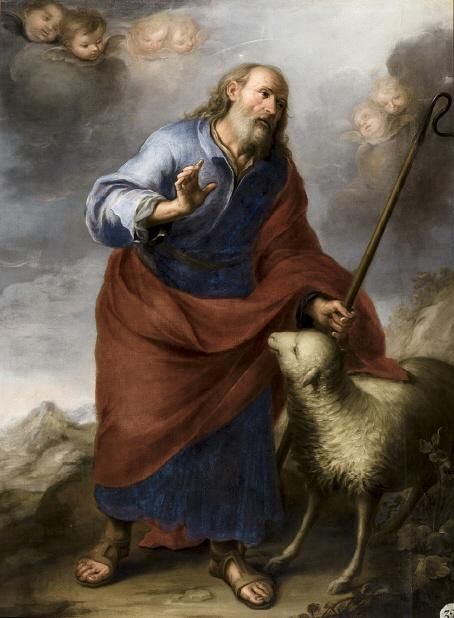
Image: San Joaquín, de Juan Simón Gutiérrez (Museo de Bellas Artes de Sevilla).jpg · Juan Simón Gutiérrez · Public domain, via Wikimedia Commons

From Sabine Baring-Gould, The Lives of the Saints, new edition in 16 vols. (London: John C. Nimmo, 1897), digitized text from Project Gutenberg. Public domain.

Image: Juan Simón Gutiérrez, Wikimedia Commons (Public domain)

From “Catholic Encyclopedia (1913)/St. Joachim,” The Catholic Encyclopedia (New York: Robert Appleton Company, 1907–1914), via Wikisource. Public domain. Matched by name and feast date; text unedited except for our bracketed notes in grey.

From Sabine Baring-Gould, The Lives of the Saints, new edition in 16 vols. (London: John C. Nimmo, 1897), digitized text from Project Gutenberg. Public domain in the United States. Reproduced unedited, except for short bracketed notes in grey that we added to explain names and terms (“S.” is the old abbreviation for Saint). Some history and judgments reflect 19th-century scholarship.