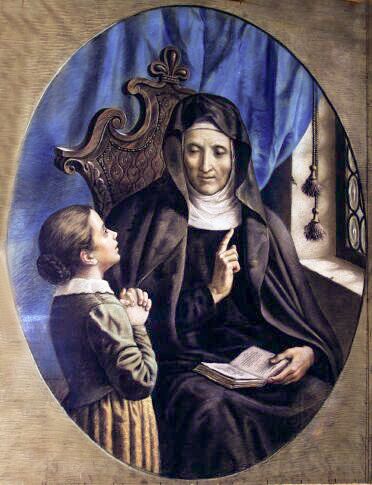
St. Angela of Merici

Angela Merici was born on 21 March 1474 at Desenzano on Lake Garda.

Read the essentials →
May 31 · Virgin

St. Angela of Merici

St. Angela of Merici

Angela Merici was born on 21 March 1474 at Desenzano on Lake Garda.

Traditional feast

May 31
1914 / pre-1969 calendar, per Baring-Gould (1897)

Current feast

January 27
Verified · General Roman Calendar

Represents

Virgin

Their story

Adapted in modern English from the Catholic Encyclopedia (1913) · original text below

Angela Merici was born on 21 March 1474 at Desenzano on Lake Garda. Orphaned at ten, she and her elder sister went to live with an uncle at Salò. When her sister died suddenly without the last sacraments, Angela was deeply distressed. She became a Franciscan (the order of friars founded by St. Francis of Assisi) tertiary (a lay member of a religious order's 'Third Order', living in the world) and redoubled her prayers and penances for her sister's soul, and it is said she was assured in a vision that her sister was among the saints.

At twenty, after her uncle's death, she returned to Desenzano. Convinced that the great need of her time was better religious instruction for girls, she turned her home into a school and taught the little girls of the town. It is said that in an ecstasy she saw that she was to found an association of virgins devoted to this work. She was invited to Brescia to open a similar school. In 1524, on pilgrimage to the Holy Land, she suddenly went blind on Crete but went on to the holy places. On the way home she was cured while praying before a crucifix at the very spot where she had lost her sight. In 1525 Pope Clement VII invited her to stay in Rome, but she avoided publicity and returned to Brescia.

On 25 November 1535 she gathered twelve young women and founded the Ursulines in a small house near St Afra's in Brescia. After five years as superior she died on 27 January 1540 and was buried in St Afra's. She was canonized (officially declared a saint by the pope) in 1807.

Struggles & surrender

What they wrestled with, and how they gave it to God

  • Grief over her sister ·
    When Angela's sister died suddenly without the last sacraments, Angela was deeply distressed. In her anguish she redoubled her prayers and penances for her sister's soul.

Early life

The book says little or nothing about early life. This is how the account begins.

Thin entry · the 1897 book gives only 0 words. We have not filled the gap with invented detail.

What they represent

How they teach us to live

Drawn from themes in the original account

Keep their day. Remember them on May 31 with a short prayer, and ask for their help.

From the Catholic Encyclopedia

1913 · 545 words

​Angela Merici, Saint, foundress of the Ursulines, b. 21 March, 1474, at Desenzano, a small town on the southwestern shore of Lake Garda in Lombardy; d. 27 January, 1540, at Brescia. She was left an orphan at the age of ten and together with her elder sister came to the home of her uncle at the neighbouring town of Salo where they led an angelic life. When her sister met with a sudden death, without being able to receive the last sacraments, young Angela was much distressed. She became a tertiary of St. Francis and greatly increased her prayers and mortifications for the repose of her sister's soul. In her anguish and pious simplicity she prayed God to reveal to her the condition of her deceased sister. ​It is said that by a vision she was satisfied that her sister was in the company of the saints in heaven. When she was twenty years old, her uncle died, and she returned to her paternal home at Desenzano. Convinced that the great need of her times was a better instruction of young girls in the rudiments of the Christian religion, she converted her home into a school where at stated intervals she daily gathered all the little girls of Desenzano and taught them the elements of Christianity.

It is related that one day, while in an ecstasy, she had a vision in which it was revealed to her that she was to found an association of virgins who were to devote their lives to the religious training of young girls. The school she had established at Desenzano soon bore abundant fruit, and she was invited to the neighbouring city, Brescia, to establish a similar school at that place. Angela gladly accepted the invitation. In 1524, while making a pilgrimage to the Holy Land, she became suddenly blind when she was on the island of Crete, but continued her journey to the Holy Places and was cured on her return while praying before a crucifix at the same place where she was struck with blindness a few weeks before. When, in the jubilee year 1525, she had come to Rome to gain the indulgences, Pope Clement VII, who had heard of her great holiness and her extraordinary success as a religious teacher of young girls, invited her to remain in Rome; but Angela, who shunned publicity, returned to Brescia. Finally, on the 25th of November, 1535, Angela chose twelve virgins and laid the foundation of the order of the Ursulines in a small house near the Church of St. Afra in Brescia. Haing been five years superior of the newly-founded order, she died. Her body lies buried in the Church of St. Afra at Brescia. She was beatified in 1768, by Clement XIII, and canonized in 1807, by Pius VII. Her feast is celebrated 31 May.

Heimbucher, Orden und Kongregationen (Paderborn, 1896), I. 511 sqq.; Seebœck, Herrlichkeit der katholischen Kirche (Innsbruck, 1900); Guérin, Les petit Bollandistes (Paris), III, 326 sqq.; Bullarii Romani Continuatio, VII, pt. I; her biography has been written in French by Bauthors (Abbeville. 1894); at Notre Dame d'Alet (1885); Pastel (Paris, 1878); in German by an Ursuline (Innsbruck, 1893); by an Ursuline (Paderborn, 1892); in Italian by Girelli (Brescia, 1871); by Salvatori (Rome, 1807).
Read more

The full original · 0 words

Read Baring-Gould’s full account

Baring-Gould’s sources: Roman Martyrology. Beatified by Pius IV., and canonized by Pius VII. Authority Life by Ottavio Florentino.] Angela was the youngest daughter of a worthy couple who lived at Desenzano, near Brescia, in Lombardy. She was born in 1474, and was left an orphan with an elder sister, when she was ten years old. The two sisters were taken home by an uncle. In his house her sister died suddenly, without receiving the last sacraments. This distressed the little Angela, and she prayed that she might be told the condition of her sister. A few days after, her uncle finding the child greatly depressed, sent her into the country. On her way she saw a luminous haze, and on nearing it, saw the form of her sister. She was satisfied by this vision that her sister was in bliss. On the death of her uncle she returned to her paternal house, and seeing that the great need of her day was instruction for the young girls, she collected children to her, and taught them. Others joined her, and she became the founder of the Ursulines, whose special mission is the education of girls. Under Angela, the society was without vows or peculiar dress, all which it assumed after her death, which took place on the night of the 2 7-28th of January, 1540. Her body was buried in the church of S. Afra, at Brescia. END OF VOL. V.

Feast days

Feast: January 27
Traditional: May 31

Nine days · Free

Pray the novena
with us.

One short email a day for nine days. The day's prayer, a line from St. Angela of Merici's story, and a nudge to keep going.

Also on May 31
St. Petronilla

St. Petronilla

May 31 · Virgin
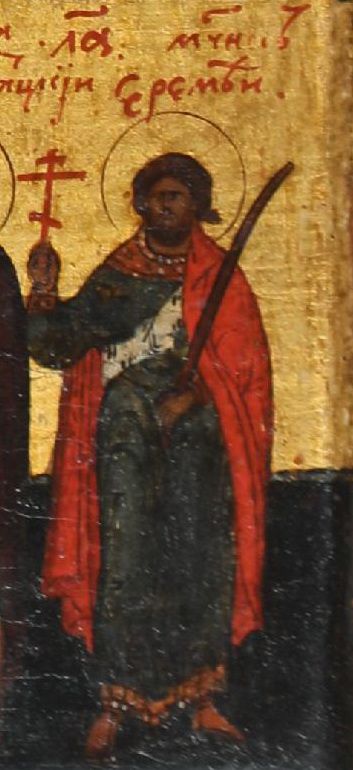
St. Hermias

St. Hermias

May 31 · Martyr
C

Sts. Cantius

May 31 · Martyr
← All 1726 saints in the library
Sources & notes

Feast-day sources

Story sources

Sources

Credits

Image: Saint Angela Merici.jpg · Pietro Calzavacca (1855-1890) · Public domain, via Wikimedia Commons

From Sabine Baring-Gould, The Lives of the Saints, new edition in 16 vols. (London: John C. Nimmo, 1897–98); text from the Internet Archive scan (OCR, lightly cleaned; errors possible). Public domain.

Image: Pietro Calzavacca (1855-1890), Wikimedia Commons (Public domain)

From “Catholic Encyclopedia (1913)/St. Angela Merici,” The Catholic Encyclopedia (New York: Robert Appleton Company, 1907–1914), via Wikisource. Public domain. Matched by name and feast date; text unedited except for our bracketed notes in grey.

From Sabine Baring-Gould, The Lives of the Saints, new edition in 16 vols. (London: John C. Nimmo, 1897–98); text from the Internet Archive scan (OCR, lightly cleaned; errors possible). Public domain in the United States. Reproduced unedited, except for short bracketed notes in grey that we added to explain names and terms (“S.” is the old abbreviation for Saint). Some history and judgments reflect 19th-century scholarship.