St. Anicetus, Pope

Faithfulness to Christ when it cost everything.

Read the essentials →
April 17 · Martyr

St. Anicetus

St. Anicetus, Pope

Faithfulness to Christ when it cost everything.

Traditional feast

April 17
1914 / pre-1969 calendar, per Baring-Gould (1897)

Current feast

April 17 (also listed: April 20)
Secondary source · Wikipedia

Represents

Martyr

Their story

Adapted in modern English from the Catholic Encyclopedia (1913) · original text below

Anicetus succeeded Pius as bishop of Rome around 157 and reigned until about 168. The Catholic Encyclopedia warns that dates in this period cannot be fixed exactly.

In his time the aged Polycarp of Smyrna came to Rome to discuss the date of Easter. The churches of Asia kept it on the 14th of Nisan (the Jewish Passover date), whatever weekday it fell on, while Rome always kept it on Sunday. Neither persuaded the other. Eusebius (bishop of Caesarea, d. c. 339, the first historian of the Church) records that they parted in peace, and Anicetus let Polycarp celebrate the Eucharist in his place as a sign of communion.

The historian Hegesippus also visited Rome then, as did heretical teachers such as Marcion and Valentinus. Anicetus is traditionally counted a martyr, though the CE gives no account of how he died.

Early life

The book says little or nothing about early life. This is how the account begins.

Thin entry · the 1897 book gives only 0 words. We have not filled the gap with invented detail.

What they represent

How they teach us to live

Drawn from themes in the original account

Learn from the kind of life it was. Faithfulness to Christ when it cost everything.

Keep their day. Remember them on April 17 with a short prayer, and ask for their help.

From the Catholic Encyclopedia

1913 · 280 words

​Anicetus, Saint, Pope, the Roman Pontiff who succeeded Pius towards the year 157, and reigned till about 168. According to Duchesne (Origines) the confusion of dates about this period is such that more exact verification is impo.ssible. While Anicetus was Pope, St. Polycarp, then in extreme old age, came to confer with him (160–162) about the Paschal controversy; Polycarp and others in the East celebrating the feast on the fourteenth of the month of Nisan, no matter on what day of the week it fell; whereas in Rome it was always observed on Sunday, and the day of the Lord's death on Friday. The matter was discussed but nothing was decided. According to Eusebius [Eusebius of Caesarea (d. c. 339), the first historian of the Church]: "Polycarp could not persuade the Pope, nor the Pope, Polycarp. The controversy was not ended but the bonds of charity were not broken"; the Pope permitting the aged saint to celebrate on the day he had been accustomed to in the Church of Smyrna.

Hegesippus, the first Christian historian whose writings are of great value, because he lived so near the time of the Apostles, also came to Rome at this time. His visit is recorded by most ecclesiastical authors as noteworthy, inasmuch as it calls attention to the fact that many illustrious men repaired to Rome at that period, thus emphasizing very early the supreme dignity and authority of the Roman Pontiffs. Marcion, Marcellinus, Valentine, and Cerdo were also at Rome, disturbing the Church by their Manichæism. Anicetus suffered martyrdom in 161, but the dates vary between 16, 17, and 20 April.

Acta SS., 11 April; Butler, Lives of the Saints, 17 April; Michaud, Biog. Univ.; Jungmann, Dissert. Hist. Eccl; Moberly in Dict. Christ. Biogr.
Read more

The full original · 0 words

Read Baring-Gould’s full account

Baring-Gould’s sources: Roman Martyrology. Authority Eusebius, Hist Eccl. lib. iv., c. ii. JSEBIUS, the Father of Ecclesiastical History, says that S. Anicetus became bishop of Rome after S. Pius I., i.e. % about a.d. 157. He was called upon to oppose the heresies of Valentine and Marcion. S. Irenaeus, quoted by Eusebius, says that S. Polycarp, B. of Smyrna, the disciple of the apostle S. John “coming to Rome under the episcopate of Anicetus, brought many of these heretics to the Church of God, proclaiming the one and only true faith, which he had received from the apostles, namely, that which had been delivered to the Church.” S. Polycarp held a conference with S. Anicetus, on the question of the right day for celebrating Easter. The bishop of Rome claimed S. Peter as his authority for having instituted it on the day observed at Rome, and the bishop of Smyrna claimed the authority of his own master S. John, for observing Easter as in Asia Minor; neither could convince the other, nevertheless they parted without rupture of the tie of charity.

Feast days

Feast: April 17

Nine days · Free

Pray the novena
with us.

One short email a day for nine days. The day's prayer, a line from St. Anicetus's story, and a nudge to keep going.

Also on April 17
D

St. Domnan and Companions

April 17 · Martyrs
St. Stephen Harding

St. Stephen Harding

April 17 · Abbot
← All 1726 saints in the library
Sources & notes

Feast-day sources

Story sources

Sources

Credits

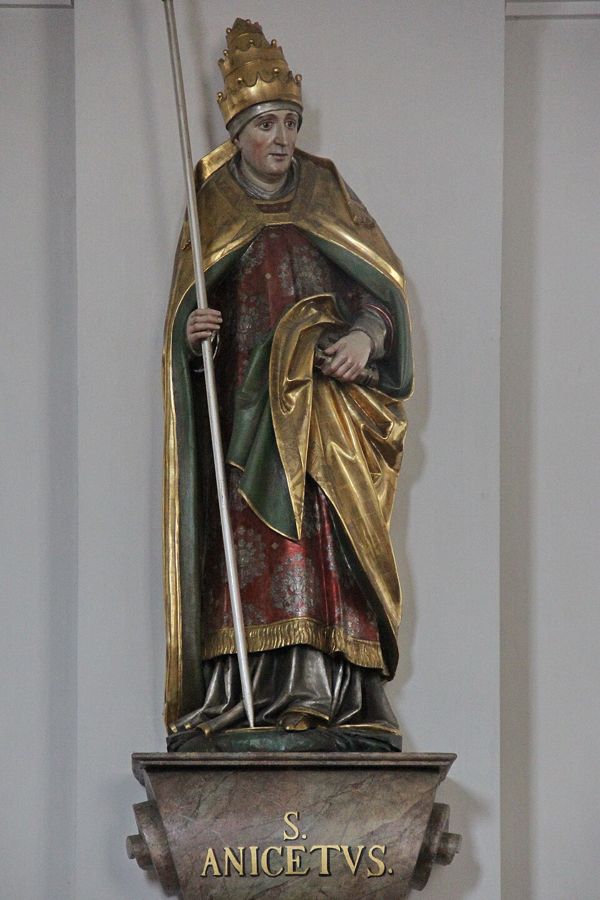
Image: Wolnzach, St Laurentius 017.JPG · Mattana · CC BY-SA 3.0, via Wikimedia Commons

From Sabine Baring-Gould, The Lives of the Saints, new edition in 16 vols. (London: John C. Nimmo, 1897–98); text from the Internet Archive scan (OCR, lightly cleaned; errors possible). Public domain.

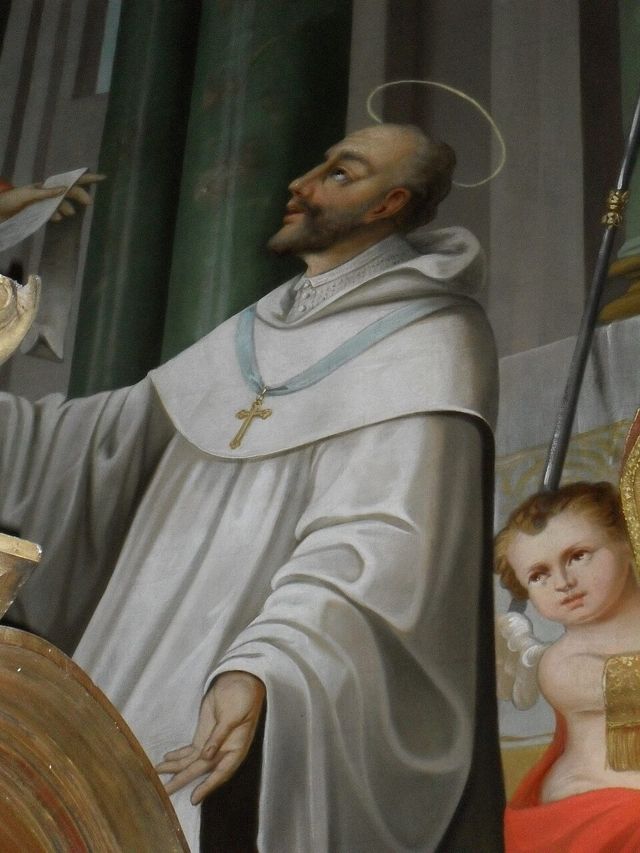
Image: Mattana, Wikimedia Commons (CC BY-SA 3.0)

From “Catholic Encyclopedia (1913)/Pope St. Anicetus,” The Catholic Encyclopedia (New York: Robert Appleton Company, 1907–1914), via Wikisource. Public domain. Matched by name and feast date; text unedited except for our bracketed notes in grey.

From Sabine Baring-Gould, The Lives of the Saints, new edition in 16 vols. (London: John C. Nimmo, 1897–98); text from the Internet Archive scan (OCR, lightly cleaned; errors possible). Public domain in the United States. Reproduced unedited, except for short bracketed notes in grey that we added to explain names and terms (“S.” is the old abbreviation for Saint). Some history and judgments reflect 19th-century scholarship.