St. Anteros

Faithfulness to Christ when it cost everything.

Read the essentials →
January 3 · Priest, Martyr

St. Anteros

St. Anteros

Faithfulness to Christ when it cost everything.

Traditional feast

January 3
1914 / pre-1969 calendar, per Baring-Gould (1914)

Current feast

January 3 (also listed: August 18)
Secondary source · Wikipedia

Represents

Priest
Martyr

Their story

Adapted in modern English from Baring-Gould (1914) · original text below · little is known

Anteros succeeded Pope Pontian as bishop of Rome in 235, after Pontian had been exiled to the mines of Sardinia. Tradition credits him with appointing notaries to write down the words and sufferings of the martyrs, so that faithful records of their acts would be kept. He reigned only a few weeks and died early in 236.

Early life

The book says little or nothing about early life. This is how the account begins.

Thin entry · the 1914 book gives only 46 words. We have not filled the gap with invented detail.

Saint Anteros succeeded S. Pontianus as Bishop of Rome in 235. He instituted the office of notaries in the Church, to take down the sayings and sufferings of the martyrs, so that faithful records of their acts might be preserved. He died, June 18th, a.d. 236.

What they represent

How they teach us to live

Drawn from themes in the original account

Learn from the kind of life it was. Faithfulness to Christ when it cost everything.

Keep their day. Remember them on January 3 with a short prayer, and ask for their help.

From the Catholic Encyclopedia

1913 · 228 words

​Anterus (Anteros), Saint, Pop>e, (21 November, 235–3 January, 236). We know for certain only that he reigned some forty days, and that he was buried in the famous "papal crypt" of the cemetery of St. Calixtus at Rome [Northcote and Brownlow, Roma Sotterranea, (London, 1879) I, 296–300]. The "Liber Pontificalis" (ed. Duchesne I, 147; cf. xcv–vi) says that he was martyred for having caused the Acts of the martyrs to be collected by notaries and deposited in the archives of the Roman Church. This tradition seems old and respectable; nevertheless the best scholars maintain that it is not sufficiently guaranteed by its sole voucher, the "Liber Pontificalis", on account, among other things, of the late date of that work's compilation. (See Papacy, Notaries.) The site of his sepulchre was discovered by De Rossi in 1854, with some broken remnants of the Greek epitaph engraved on the narrow oblong slab that closed his tomb, an index at once of his origin and of the prevalence of Greek in the Roman Church up to that date. For the "Epistola Anteri" attributed to him by Pseudo-Isidore see Hinschius, "Decret. Pseudo-Isidorianae" (Leipzig, 1863), 156–160 and P.G., X, 165-168. Cf. "Liber Pont". (ed. Duchesne), I. 147.

Tillemont, Mémoires (III), 278, 694; De Rossi, Roma Sotterr., II, pl. III, 55–58; Allard, Hist. des Persecutions (Paris, 1886), II, 198-200; Acta SS. (1643), Jan. 1, 127.
Read more

The full original · 46 words

Read Baring-Gould’s full account

Baring-Gould’s sources: Commemorated in the Roman Martyrology, and in that attributed to Bede, that of Usuardus, &c.

Saint Anteros succeeded S. Pontianus as Bishop of Rome in 235. He instituted the office of notaries in the Church, to take down the sayings and sufferings of the martyrs, so that faithful records of their acts might be preserved. He died, June 18th, a.d. 236.

Feast days

Feast: January 3

Nine days · Free

Pray the novena
with us.

One short email a day for nine days. The day's prayer, a line from St. Anteros's story, and a nudge to keep going.

Also on January 3
Z

Sts. Zosimus and…

January 3 · Martyrs
P

St. Peter Balsam

January 3 · Martyr
St. Gordius

St. Gordius

January 3 · Martyr
← All 1727 saints in the library
Sources & notes

Feast-day sources

Story sources

Sources

Credits

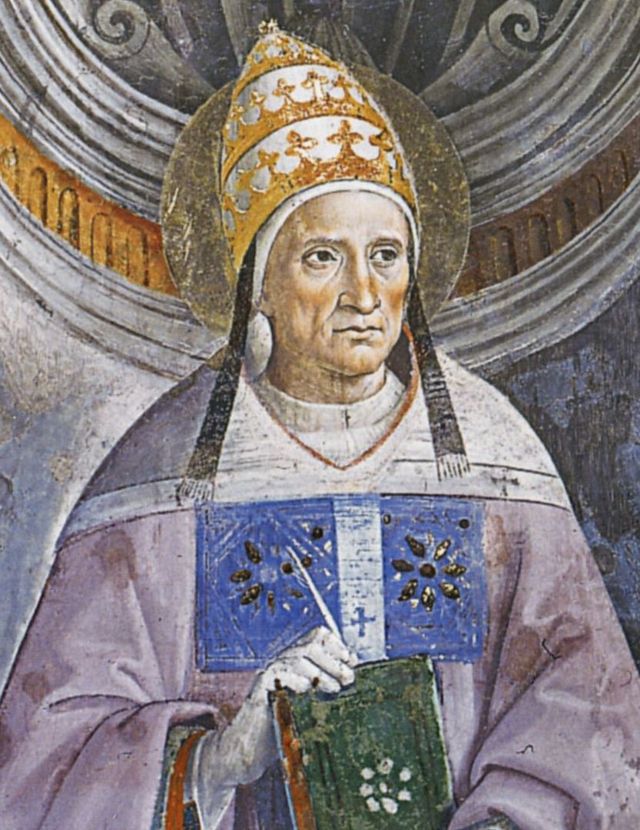
Image: Pietro Perugino – Anterus.jpg · Pietro Perugino · Public domain, via Wikimedia Commons

From Sabine Baring-Gould, The Lives of the Saints, new and revised edition (Edinburgh: John Grant, 1914; first edition 1872). Public domain.

Image: Pietro Perugino, Wikimedia Commons (Public domain)

From “Catholic Encyclopedia (1913)/Pope St. Anterus,” The Catholic Encyclopedia (New York: Robert Appleton Company, 1907–1914), via Wikisource. Public domain. Matched by name and feast date; text unedited except for our bracketed notes in grey.

From Sabine Baring-Gould, The Lives of the Saints, new and revised edition (Edinburgh: John Grant, 1914; first edition 1872). Public domain in the United States. Reproduced unedited, except for short bracketed notes in grey that we added to explain names and terms (“S.” is the old abbreviation for Saint). Some history and judgments reflect 19th-century scholarship.