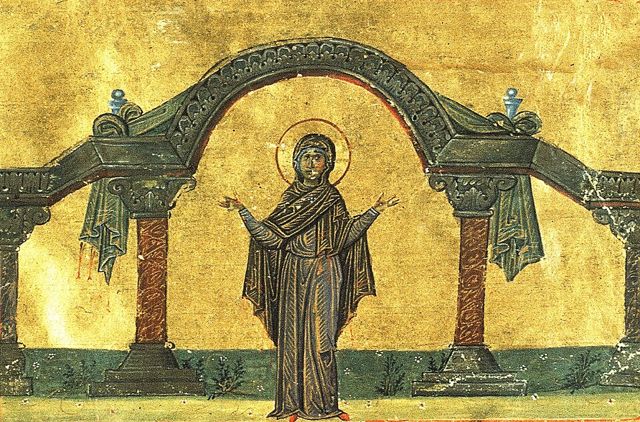
St. Antonina

Faithfulness to Christ when it cost everything.

Read the essentials →
March 1 · Martyr

St. Antonina

St. Antonina

Faithfulness to Christ when it cost everything.

Traditional feast

March 1
1914 / pre-1969 calendar, per Baring-Gould (1897)

Current feast

Not verified yet

Represents

Martyr

Their story

Adapted in modern English from Baring-Gould (1897) · original text below · little is known

Antonina is said to have lived at Nicæa. For refusing to offer incense to the gods she was stripped, hung up, and torn with iron rakes, then put in a sack or a clay jar (the sources differ) and drowned in a lake near the city. A head and body at Bologna are shown as hers, but the Bollandists (scholarly editors of saints' lives) say they cannot tell whether they are this Antonina's.

Her story became evidence of a forgery. An edition of the Greek Menologium misprinted Nicæa as "Cæa." The forger of a chronicle credited to Flavius Dexter, seeing this, placed her death at Ceija in Spain, and that blunder helped expose the forgery.
Early life

The book says little or nothing about early life. This is how the account begins.

Thin entry · the 1897 book gives only 203 words. We have not filled the gap with invented detail.

Antonina is said to have lived in the city of Nicæa, in the reign of Maxentius. On account of her refusal to offer incense to the gods she was stripped of her clothes, hung up, and her sides torn with rakes. Then she was thrust into a sack, or earthen vessel (it is uncertain which), and was drowned in a lake near the city.

What they represent

How they teach us to live

Drawn from themes in the original account

Learn from the kind of life it was. Faithfulness to Christ when it cost everything.

Keep their day. Remember them on March 1 with a short prayer, and ask for their help.

Read more

The full original · 203 words

Read Baring-Gould’s full account

Baring-Gould’s sources: Greek Menæa, and Menologium of the Emperor Basil. Inserted in the Roman Martyrology by Baronius. Authority:—The account in the Menologium.

Antonina is said to have lived in the city of Nicæa, in the reign of Maxentius [rival emperor at Rome 306–312, defeated by Constantine]. On account of her refusal to offer incense to the gods she was stripped of her clothes, hung up, and her sides torn with rakes. Then she was thrust into a sack, or earthen vessel (it is uncertain which), and was drowned in a lake near the city. A head and body are shown at Bologna as those of S. Antonina, "but whether of this one or of another we are not able to divine," say the Bollandists [Jesuit scholars who since the 1600s have critically studied the lives of the saints]. A curious instance of the facility with which some forgeries may be detected is connected with S. Antonina. Canisius published an edition of the Greek Menologium in the 16th century; in it occurred a mistake. S. Antonina was stated to have suffered at Cæa, a misprint for Nicæa. Shortly after, the Jesuit, Hieronymus Romanus de Higuera, forged a chronicle of Flavius Dexter, Bishop of Barcelona, in the 4th century. He had seen the Menologium of Canisius, and, as there was a Ceija in Spain, he inserted S. Antonina in his Spanish Chronicle as having suffered there, and this blunder was partly the means of the detection of the forgery.

Feast days

Feast: March 1

Nine days · Free

Pray the novena
with us.

One short email a day for nine days. The day's prayer, a line from St. Antonina's story, and a nudge to keep going.

Also on March 1
St. Hesychius

St. Hesychius

March 1 · Bishop, Martyr
St. Eudocia

St. Eudocia

March 1 · Martyr
St. Domnina

St. Domnina

March 1 · Virgin, Hermit
← All 1726 saints in the library
Sources & notes

Feast-day sources

Story sources

Sources

Credits

Image: Tchaikovsky with wife Antonina Miliukova.jpg · Ivan Grigoryevich Dyagovchenko · Public domain, via Wikimedia Commons

From Sabine Baring-Gould, The Lives of the Saints, new edition in 16 vols. (London: John C. Nimmo, 1897), digitized text from Project Gutenberg. Public domain.

Image: Ivan Grigoryevich Dyagovchenko, Wikimedia Commons (Public domain)

From Sabine Baring-Gould, The Lives of the Saints, new edition in 16 vols. (London: John C. Nimmo, 1897), digitized text from Project Gutenberg. Public domain in the United States. Reproduced unedited, except for short bracketed notes in grey that we added to explain names and terms (“S.” is the old abbreviation for Saint). Some history and judgments reflect 19th-century scholarship.