Faithfulness to Christ when it cost everything.
Read the essentials →Faithfulness to Christ when it cost everything.
September 2
May 2 (also listed: May 10)
Martyr
Fat the Council of Constantinople in 536; see Labboeus, v. 243. The Greek Menology in Nov. 9. Authorities Mentioned in the Menaea and Menology.] INT ANTONINUS was a stone-cutter in Syria, who, entering an idol temple, rebuked the people for worshipping images of stone.
Stay faithful when it costs you. This account is about holding firm under pressure.
Learn from the kind of life it was. Faithfulness to Christ when it cost everything.
Fat the Council of Constantinople in 536; see Labboeus, v. 243. The Greek Menology in Nov. 9. Authorities Mentioned in the Menaea and Menology.] INT ANTONINUS was a stone-cutter in Syria, who, entering an idol temple, rebuked the people for worshipping images of stone. Then he went away, and for two years lived with a hermit named Theotimus, among the rocks. At the end of this time he returned to the city and temple, and, in a fit of zeal, struck and felled the image of the god in it. He was hustled out, and threatened, but was not injured. It is therefore probable that the period was late, not earlier than the reign of Constantine, or Constantius. He went to Apamaea, where the bishop employed him to build a church to the Holy Trinity. He was killed by the people in a riot, for they were incensed at the erection of a church, and propably at the compulsory closing of the temples. By a curious mistake, the people of Pamiers in the south of France, have thought that Apamsea meant their city, and have, therefore, constituted S. Antoninus [Antoninus Pius, Roman emperor 138–161] their patron. They have composed for him a harrowing martyrdom, and have succeeded in discovering his bones at Pamiers. The body is now at Palencia, translated thither from Pamiers. I SS. ZENO, CONCORDIUS, AND OTHERS, MM. [Roman Martyrology. Authorities: — The purely fabulous Acts.] Zeno and his two sons, Concordius and Theodore, Paternus, a tribune, and his wife Theodota, sixty-eight soldiers, a mother and her two little children, Serapion and seventytwo soldiers, Cusconus, Menalippus and Joseph, are said by the apocryphal acts to have suffered at Nicomedia, under the apostate Julian. As Julian did not persecute the Church, such martyrdoms could not have taken place under him. The Greeks know nothing of the story. A certain Zeno is said by them to have been killed in boiling lead, but there is no reason for supposing him to have been the same as the Zeno who, it is fabled, suffered under Julian. A Melanippus is also commemorated, but where he suffered is not stated. In the acts Zeno is executed with the sword. S. Nonnosus.
Feast: May 2
Traditional: September 2
One short email a day for nine days. The day's prayer, a line from St. Antoninus's story, and a nudge to keep going.
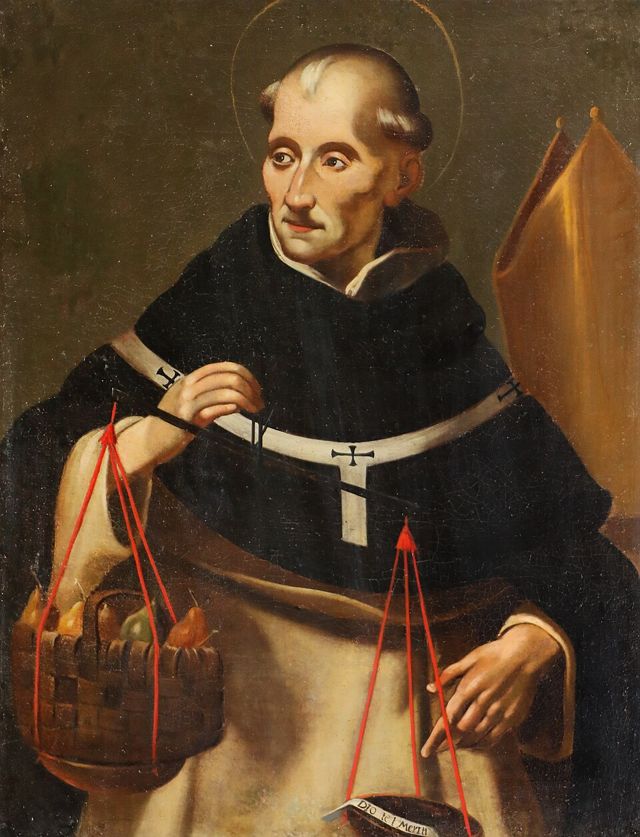
Image: Sant'antonino pierozzi (cropped).jpg · Sailko · CC BY-SA 4.0, via Wikimedia Commons
From Sabine Baring-Gould, The Lives of the Saints, new edition in 16 vols. (London: John C. Nimmo, 1897–98); text from the Internet Archive scan (OCR, lightly cleaned; errors possible). Public domain.
Image: Sailko, Wikimedia Commons (CC BY-SA 4.0)
From Sabine Baring-Gould, The Lives of the Saints, new edition in 16 vols. (London: John C. Nimmo, 1897–98); text from the Internet Archive scan (OCR, lightly cleaned; errors possible). Public domain in the United States. Reproduced unedited, except for short bracketed notes in grey that we added to explain names and terms (“S.” is the old abbreviation for Saint). Some history and judgments reflect 19th-century scholarship.