St. Apollinaris of Valence

Apollinaris was consecrated bishop of Valence in 499 by his brother St. Avitus.

Read the essentials →
October 5 · Bishop

St. Apollinaris of…

St. Apollinaris of Valence

Apollinaris was consecrated bishop of Valence in 499 by his brother St. Avitus.

Traditional feast

October 5
1914 / pre-1969 calendar, per Baring-Gould (1897)

Current feast

Not verified yet

Represents

Bishop

Their story

Adapted in modern English from Baring-Gould (1897–98) · original text below

(The surviving account on this page begins partway through the story.)

Apollinaris was consecrated bishop of Valence in 499 by his brother St. Avitus. Both worked against Arianism (the belief that Christ is not fully God), which persisted among the people of Burgundy though King Sigismund had given it up.

At the Council of Epaon in 517, Stephen, a royal official, was excommunicated for marrying his dead wife's sister. Sigismund, furious, banished the bishops. After a year near Lyons, Apollinaris was recalled when the king fell ill with fever and saw it as a punishment for how he had treated them. Meanwhile eleven exiled bishops met at Lyons and renewed the sentence. Late in life he travelled to Arles and Marseilles to see relatives, then fell ill at home. He later died at Valence; his relics were thrown into the Rhone by the Huguenots.

Early life

The book says little or nothing about early life. This is how the account begins.

…secrated Bishop of Valence in 499 by his brother Avitus, the Metropolitan. The two brothers had hard work in their Burgundian dioceses to contend against and root out the popular Arianism. Sigismund, king of Burgundy, had renounced this heresy, but it prevailed amidst his subjects.

What they represent

How they teach us to live

Drawn from themes in the original account

Stay faithful when it costs you. This account is about holding firm under pressure.

Keep their day. Remember them on October 5 with a short prayer, and ask for their help.

Read more

The full original · 262 words

Read Baring-Gould’s full account

Baring-Gould’s sources: Gallican and Roman Martyrologies, Ado, Usuardus, Hrabanus, &c. confound him with S. Apollinaris of Ravenna. Authorities: — Mention in the Chronicle of Ado of Vienne, and Agobard of Lyons in his book, “ De Judaicis Superstitionibus. ” Also a life of the saint by a deacon of S. Apollinaris, who died not many years later. His name was probably Eladius.] Apollinaris, Bishop of Valence, in Gaul, was bom of noble parents at Vienne. His brother was the more famous S. Avitus, Archbishop of Vienne after the death of S. Isichius, his father, who occupied the see till a.d. 494. The mother of S. Avitus and S. Apollinaris, and wife of S. Isichius, was named Audentia. A sister named Fuscina is praised for her virtues by S. Avitus, in one of his poems. The family was noble and splendid, and was apparently that of Avitus the emperor, and S. Sidonius Apollinaris. 1 Apollinaris was conS. Apollinaris of Valence.

…secrated Bishop of Valence in 499 by his brother Avitus, the Metropolitan. The two brothers had hard work in their Burgundian dioceses to contend against and root out the popular Arianism [followers of Arius, who taught that the Son is a created being, not fully God]. Sigismund, king of Burgundy, had renounced this heresy, but it prevailed amidst his subjects.

In 517 assembled the Council of Epaon, 1 convened by Sigismund to ameliorate the morals of the clergy in his realm, and to put in force the ancient disciplinary canons. In this council, which was attended by S. Avitus and S. Apollinaris, Stephen, fiscal prefect of Burgundy, was excommunicated for having married Palladia, his sister-in-law, on his wife’s death. This so exasperated Sigismund that he banished the bishops from his realm. Eleven of the exiled bishops thereupon assembled again in synod at Lyons, under the presidency of Virentiolus the archbishop, and renewed their sentence of excommunication. Apollinaris spent a year in exile, in the neighbourhood of Lyons, and was then recalled by the Burgundian king, who having been attacked by fever, thought it was sent him in punishment for his treatment of the bishops.

Not long after his return to Valence, S. Apollinaris started on a journey to Arles and Marseilles, to visit some of his relations. After his return to his see, he sickened and died. The relics [the bodily remains of a saint, or objects they used, kept with honor] of S. Apollinaris were thrown into the Rhone by the Huguenots, in the 16th century.

1 The position of Epaon is not known for certain, any more than our English Goveshoe; but Epaon is thought to be represented by the modern Yenne, at the mouth of the Flon.

Feast days

Feast: October 5

Nine days · Free

Pray the novena
with us.

One short email a day for nine days. The day's prayer, a line from St. Apollinaris of…'s story, and a nudge to keep going.

Also on October 5
St. Charitina

St. Charitina

October 5 · Virgin, Martyr
Sts. Placidus, Eutychius and Others

Sts. Placidus

October 5 · Martyrs
G

St. Galla

October 5 · Widow
← All 1726 saints in the library
Sources & notes

Feast-day sources

Story sources

Sources

Credits

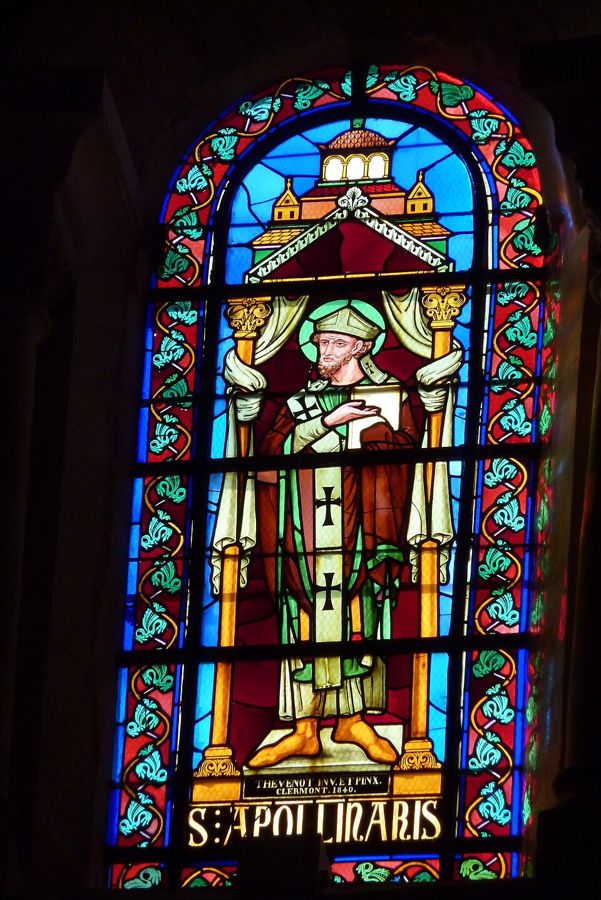
Image: Valence Cathédrale Saint-Apollinaire 150343.JPG · GFreihalter · CC BY-SA 3.0, via Wikimedia Commons

From Sabine Baring-Gould, The Lives of the Saints, new edition in 16 vols. (London: John C. Nimmo, 1897–98); text from the Internet Archive scan (OCR, lightly cleaned; errors possible). Public domain.

Image: GFreihalter, Wikimedia Commons (CC BY-SA 3.0)

From Sabine Baring-Gould, The Lives of the Saints, new edition in 16 vols. (London: John C. Nimmo, 1897–98); text from the Internet Archive scan (OCR, lightly cleaned; errors possible). Public domain in the United States. Reproduced unedited, except for short bracketed notes in grey that we added to explain names and terms (“S.” is the old abbreviation for Saint). Some history and judgments reflect 19th-century scholarship.