Baring-Gould’s sources: Commemorated in the Latin Martyrologies on this day, but by the Greeks on Jan. 4th. Her life, written by one who lived at the same time, is given by Metaphrastes. This life represents her as daughter of Anthemius, the Emperor. Metaphrastes concludes, but wrongly, that she was daughter of Anthemius, who was appointed Emperor of the West by Leo I. But it appears more probable that she was the daughter of Anthemius, consular prefect of the city, who acted as regent after the death of Arcadius, during the minority of Theodosius the younger. This Anthemius was grandfather of the Emperor Anthemius. It is quite possible that the regent may have received imperial honours. The narrative in one place, speaking of the expedition of Apollinaris to the Holy Land, says, "A few days after, when we had found companions, we went on to the Holy City. And when, at a certain place, we turned aside, on account of our burdens, and the slaves and serving maids who were with us, we rested awhile." This is the only allusion to himself made by the writer, and it is so casual, that it is difficult not to regard it as an evidence of the authenticity of the piece. The story is, however, so much like a romance, and is open to so many critical objections, that it is difficult to accept it exactly as it is.
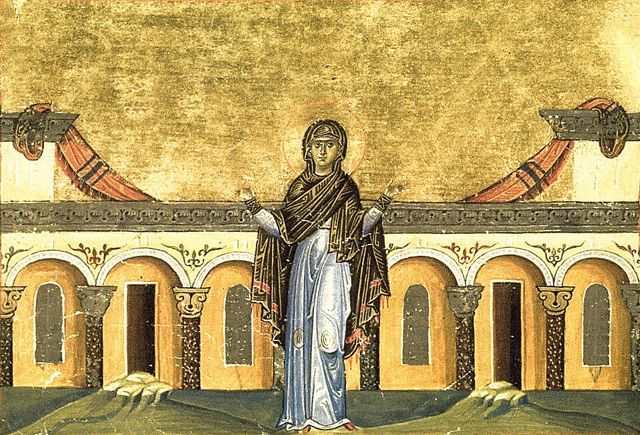
Saint Apollinaris, called from her high rank Syncletica, was the daughter of Anthemius. She had a sister of a different spirit from herself. The parents of Apollinaris desired to unite her in marriage, at an early age, to some wealthy noble, but she manifested such a fixed resolution to remain single, that they yielded to her wish. In her heart she desired to retire completely from the world; having heard of the wondrous lives of the recluses in Egypt, she longed greatly to see and imitate them. Her parents having consented to her making a pilgrimage to Jerusalem, she visited the holy places, and in Jerusalem she liberated all the slaves who had been sent to bear her company, and dismissed them with liberal gifts, retaining in her service only an eunuch and an old man to prepare her tent. In Jerusalem, she bribed an aged woman to procure for her, secretly, the habit of a recluse, and this she kept by her for a proper moment. On her way back she visited the tomb of S. Meria, on the Egyptian coast; and after prayer retired to her sleeping tent, when she assumed the monastic habit, and cast aside her worldly dress, with all its ornaments. Then, in the night, when the two men were asleep without, she stole from her tent, and fled into the desert, and took refuge in a morass. Next morning the servants were filled with consternation, and sought her everywhere in vain. Then they appeared before the governor of the city Lemna (?) where they were; and he assisted in the search, but all was in vain; so the governor sent a letter to the parents of Apollinaris, with her clothes and baggage, narrating the circumstances. Anthemius and his wife wept when they heard of the loss of their daughter, but consoled themselves with the belief that she had entered some community of religious women.
However, S. Apollinaris made her way into the desert of Scété, where lived S. Macarius of Alexandria, at the head of a large monastery of recluses in cells and caves. Apollinaris, having cut off her hair, and being much tanned by exposure to the sun, and wasted with hunger in the marsh, where she had lived on a few dates, passed as a man, and was supposed, from being beardless, to be an eunuch. She spent many years there under the name of Dorotheus. Now it fell out that her sister, being grievously tormented with a devil, Anthemius bethought himself on sending her to Macarius to be healed, for the fame of his miracles had spread far and wide. But when the young girl was brought to Macarius, the aged abbot, moved by some interior impulse, conducted her to Dorotheus, and bade him heal the possessed by prayer. Then S. Apollinaris earnestly, and with many tears, besought Macarius not to tempt her thus, for God had not given to her the gift of performing miracles. Nevertheless he persisted; then the possessed woman was shut into the cell of Dorotheus for several days, that he might, by prayer and fasting, cast the demon forth. And when, after a while, the virgin seemed to be healed, she was restored to the attendants, who conducted her to her parents with great joy.
Some months after, the maiden suffered from an attack of dropsy, and the parents, in shame and grief, supposing her to be pregnant, questioned her closely thereabout. But she could not account for her size, and when they pressed her more vehemently, moved by the evil spirit, she declared that Dorotheus, the hermit, had seduced her. On hearing this, Anthemius sent to Scété, that Dorotheus should be brought before him. The holy congregation was filled with horror and dismay on hearing the charge, and they went with one accord and cried to God to put away from them so grievous a reproach. Then said Dorotheus, "Be of good courage, my brethren, the Lord will reveal my innocence." And when she was brought before Anthemius, she said, "I am your daughter, Apollinaris." Then they fell on her neck and wept, and she prayed to God, and kissed her sister, and the Lord heard her cry, and healed the damsel of her disease. And after having tarried with them a few days, she returned to the desert once more.