St. Apollinaris

Faithfulness to Christ when it cost everything.

Read the essentials →
July 23 · Bishop, Martyr

St. Apollinaris

St. Apollinaris

Faithfulness to Christ when it cost everything.

Traditional feast

July 23
1914 / pre-1969 calendar, per Baring-Gould (1897)

Current feast

July 20
Verified · General Roman Calendar

Represents

Bishop
Martyr

Their story

Adapted in modern English from the Catholic Encyclopedia (1913) · original text below

According to tradition, St Peter made Apollinaris Bishop of Ravenna. His miracles and preaching won converts and enraged the pagans. They beat him and drove him out. He was found half dead on the seashore and hidden by Christians. He was later made to walk on burning coals and expelled again.

The story says he kept returning to Ravenna. Each time he was tortured, imprisoned or exiled, once even to Greece, where the oracles fell silent in his presence. Under Vespasian he was caught at the city gate and savagely beaten. He lived seven days, foretelling that persecution would grow but the Church would triumph.

The Catholic Encyclopedia gives this account as tradition. It notes that his birthplace, probably Antioch, and whether he was one of the seventy-two disciples, are uncertain. It says he was Bishop of Ravenna for twenty-six years.

Early life

The book says little or nothing about early life. This is how the account begins.

He was first burried at Classis, the ancient port of Ravenna, now choked with sand. In 549 his relics were translated to a vault under a church dedicated to him at Classis. Venantius Fortunatus (d. c. 600) exhorts the faithful to make pilgrimages to his tomb, and S. Gregory the Great (d. 604) ordered oaths in doubtful lawsuits to be taken before the tomb of S. Apollinaris Pope Honorius built a church under his name in Rome The apocryphal Acts are as dull as they are devoid of historical value.

What they represent

How they teach us to live

Drawn from themes in the original account

Learn from the kind of life it was. Faithfulness to Christ when it cost everything.

Keep their day. Remember them on July 23 with a short prayer, and ask for their help.

From the Catholic Encyclopedia

1913 · 347 words

One of the first great martyrs of the church. He was made Bishop of Ravenna by St. Peter himself. The miracles he wrought there soon attracted official attention, for they and his preaching won many converts to the Faith, while at the same time bringing upon him the fury of the idolaters, who beat him cruelly and drove him from the city. He was found half dead on the seashore, and kept in concealment by the Christians, but was captured again and compelled to walk on burning coals and a second time expelled. But he remained in the vicinity, and continued his work of evangelization. We find him then journeying in the province of Æmilia. A third time he returned to Ravenna. Again he was captured, hacked with knives, had scalding water poured over his wounds, was beaten in the mouth with stones because he persisted in preaching, and then, loaded with chains, was flung into a horrible dungeon to starve to death; but after four days he was put on board ship and sent to Greece. There the same course of preachings, and miracles, and sufferings continued; and when his very presence caused the oracles to be silent, he was, after a cruel beating, sent back to Italy. All this continued for three years, and a fourth time he returned to Ravenna. By this time Vespasian was Emperor, and he, in answer to the complaints of the pagans, issued a decree of banishment against the Christians. Apollinaris was kept concealed for some time, but as he was passing out of the gates of the city, was set upon and savagely beaten, probably at Classis, a suburb, but he lived for seven days, foretelling meantime that the persecutions would increase, but that the Church would ultimately triumph. It is not certain what was his native place, though it was probably Antioch. Nor is it sure that he was one of the seventy-two disciples of Christ, as has been suggested. The precise date of his consecration cannot be ascertained, but he was Bishop of Ravenna for twenty-six years.

Read more

The full original · 332 words

Read Baring-Gould’s full account

Baring-Gould’s sources: Roman Martyrology, and almost all Latin Martyrolpgies.] B AINT APOLLINARIS was the first bishop of Ravenna, sent there, according to the apocryphal Acts, by S. Peter. From a very early period S. Apollinaris has been reverenced at Ravenna. S. Peter Chrysologus, in a sermon on his festival, styles him a martyr, not because he died for Christ, but because on several occasions he was called to shed some of his blood in testimony of his faith.

He was first burried at Classis, the ancient port of Ravenna, now choked with sand. In 549 his relics [the bodily remains of a saint, or objects they used, kept with honor] were translated to a vault under a church dedicated to him at Classis. Venantius Fortunatus (d. c. 600) exhorts the faithful to make pilgrimages to his tomb, and S. Gregory the Great (d. 604) ordered oaths in doubtful lawsuits to be taken before the tomb of S. Apollinaris Pope Honorius built a church under his name in Rome The apocryphal Acts are as dull as they are devoid of historical value.

J See lulv q, r. an The body of S. Apollinaris is still at Classis. It has been repeatedly examined, and all the bones are there. Nevertheless a head of the saint is shown in the church of S. Apollinare Nuovo at Ravenna, four miles off; another head at Cisoin, near Lisle, in France; one of the arms in the church of S. Martin [St. Martin of Tours (d. 397), soldier turned bishop] des Pres at Paris; an arm at Floreffe, near Namur; several relics at Fulda; others at S. Apollinaris, above Andernach, on the Rhine; others at Bologna, in the churches of S. Peter and S. John “ in Monte others at Catania in Sicily, a part of the thigh and of another head at Cologne. Other relics at Dijon, Brindisi, &c. But as there were some five or six other saints of the same name, it is probable that some of these skulls and arms belong to them, but have been mistaken for those of the better known Apollinaris of Ravenna.

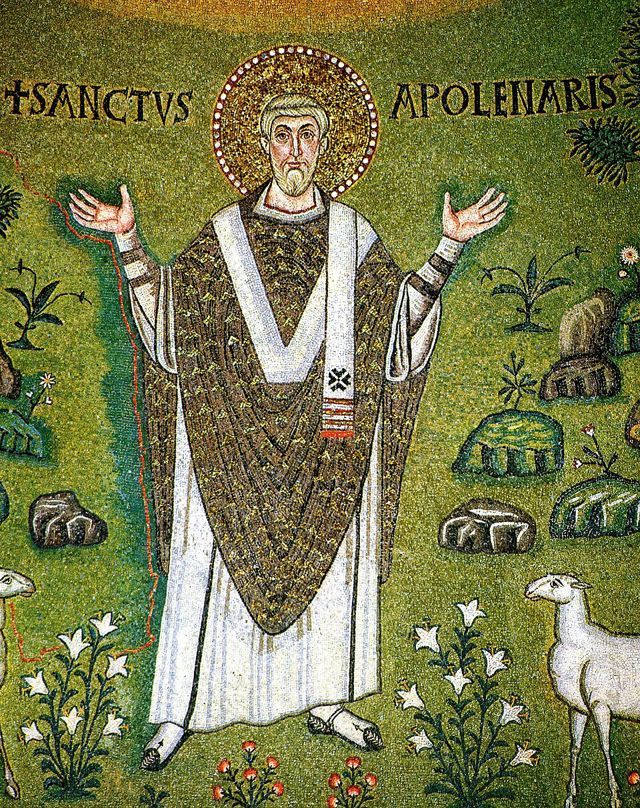
According to Nieremberg, 1 on the feast of S. Apollinaris, such swarms of ravens arrive at Ravenna, that the inhabitants kill and throw out a horse to feed these black pilgrims. But the story, no doubt, arose in Germany, from the name Ravenna bearing some resemblance to the word Raben, a raven. S. Apollinaris is usually represented as a bishop, holding a sword or a club; and in Germany, with a raven at his side. •S’. John Cassian.
Feast days

Feast: July 20
Traditional: July 23

Nine days · Free

Pray the novena
with us.

One short email a day for nine days. The day's prayer, a line from St. Apollinaris's story, and a nudge to keep going.

Also on July 23
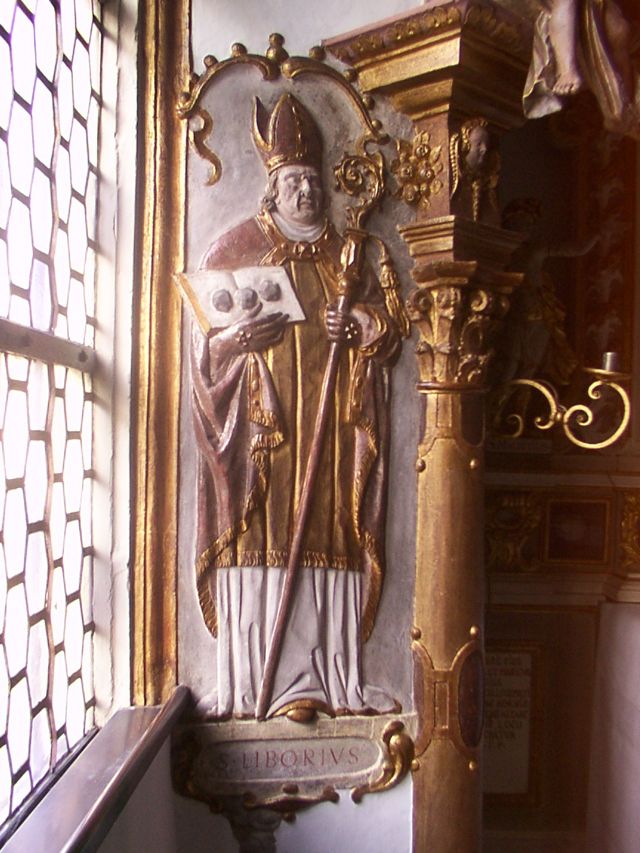
St. Liborius

St. Liborius

July 23 · Bishop
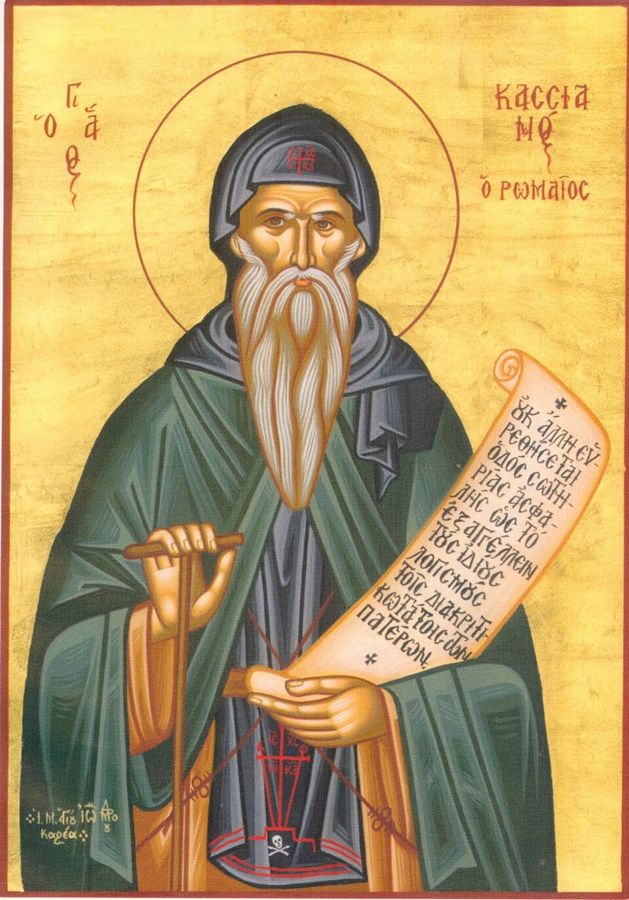
St. John Cassian

St. John Cassian

July 23 · Abbot
R

St. Romula

July 23 · Virgin
← All 1726 saints in the library
Sources & notes

Feast-day sources

Story sources

Sources

Credits

Image: Saint Apollenaris.jpg · Unknown · Public domain, via Wikimedia Commons

From Sabine Baring-Gould, The Lives of the Saints, new edition in 16 vols. (London: John C. Nimmo, 1897–98); text from the Internet Archive scan (OCR, lightly cleaned; errors possible). Public domain.

Image: Unknown, Wikimedia Commons (Public domain)

From “Catholic Encyclopedia (1913)/St. Apollinaris (1),” The Catholic Encyclopedia (New York: Robert Appleton Company, 1907–1914), via Wikisource. Public domain. Matched by name and feast date; text unedited except for our bracketed notes in grey.

From Sabine Baring-Gould, The Lives of the Saints, new edition in 16 vols. (London: John C. Nimmo, 1897–98); text from the Internet Archive scan (OCR, lightly cleaned; errors possible). Public domain in the United States. Reproduced unedited, except for short bracketed notes in grey that we added to explain names and terms (“S.” is the old abbreviation for Saint). Some history and judgments reflect 19th-century scholarship.