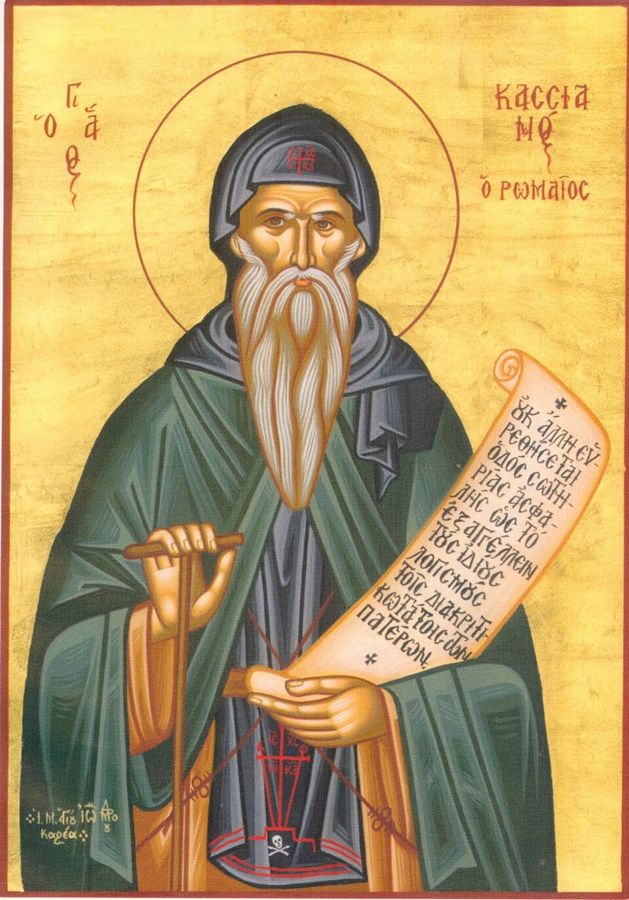
A monk and ascetic writer of Southern Gaul [roughly modern France and Belgium], and the first to introduce the rules of Eastern monasticism into the West, b. probably in Provence about 360; d. about 435, probably near Marseilles. Gennadius refers to him as a Scythian by birth (natione Scytha), but this is regarded as an erroneous statement based on the fact that Cassian passed several years of his life in the desert of Scete (heremus Scitii) in Egypt. The son of wealthy parents, he received a good education, and while yet a youth visited the holy places in Palestine, accompanied by a friend, Germanus, some years his senior. In Bethlehem Cassian and Germanus assumed the obligations of the monastic life, but, as in the case of many of their contemporaries, the desire of acquiring the science of sanctity from its most eminent teachers soon drew them from their cells in Bethlehem to the Egyptian deserts. Before leaving their first monastic home the friends promised to return as soon as possible, but this last clause they interpreted rather broadly, as they did not see Bethlehem again for seven years. During their absence they visited the solitaries most famous for holiness in Egypt, and so attracted were they by the great virtues of their hosts that after obtaining an extension of their leave of absence at Bethlehem, they returned to Egypt, where they remained several years longer. It was during this period of his life that Cassian collected the materials for his two principal works, the "Institutes" and "Conferences". From Egypt the companions came to Constantinople, where Cassian became a favourite disciple of St. John Chrysostom. The famous bishop of the Eastern capitol elevated Cassian to the diaconate, and placed in his charge the treasures of his cathedral. After the second expulsion of St. Chrysostom, Cassian was sent as an envoy to Rome by the clergy of Constantinople, for the purpose of interesting Pope Innocent I in behalf of their bishop. It was probably in Rome that Cassian was elevated to the priesthood, for it is certain that on his arrival in the Eternal City he was still a deacon. From this time Germanus is no more heard of, and of Cassian himself, for the next decade or more, nothing is known. About 415 he was at Marseilles where he founded two monasteries, one for men, over the tomb of St. Victor, a martyr of the last Christian persecution under Maximian [Diocletian’s co-emperor in the West, 286–305] (286-305), and the other for women. The remainder of his days were passed at, or very near, Marseilles. His personal influence and his writings contributed greatly to the diffusion of monasticism in the West. Although never formally canonized, St. Gregory the Great regarded him as a saint, and it is related that Urban V (1362-1370), who had been an abbot of St. Victor, had the words Saint Cassian engraved on the silver casket that contained his head. At Marseilles his feast is celebrated, with an octave, 23 July, and his name is found among the saints of the Greek Calendar.
The two principal works of Cassian deal with the cenobitic life and the principal or deadly sins. They are entitled: "De institutis coenobiorum et de octo principalium vitiorum remediis libri XII" and "Collationes XXIV". The former of these was written between 420 and 429. The relation between the two works is described by Cassian himself (Instit., II, 9) as follows: "These books [the Institutes] . . . are mainly taken up with what belongs to the outer man and the customs of the coenobia [i.e. Institutes of monastic life in common]; the others [the "Collationes" or Conferences] deal rather with the training of the inner man and the perfection of the heart." The first four books of the "Institutes" treat of the rules governing the monastic life, illustrated by examples from the author's personal observation in Egypt and Palestine; the eight remaining books are devoted to the eight principal obstacles to perfection encountered by monks: gluttony, impurity, covetousness, anger, dejection, accidia (ennui), vainglory, and pride. The "Conferences" contain a record of the conversations of Cassian and Germanus with the Egyptian solitaries, the subject being the interior life. It was composed in three parts. The first instalment (Books I-X) was dedicated to Bishop Leontius of Fréjus and a monk (afterwards bishop) named Helladius; the second (Books XI-XVII), to Honoratus of Arles and Eucherius of Lyons; the third (Books XVIII-XXIV), to the "holy brothers" Jovinian, Minervius, Leontius, and Theodore. These two works, especially the latter, were held in the highest esteem by his contemporaries and by several later founders of religious orders. St. Benedict made use of Cassian in writing his Rule, and ordered selections from the "Conferences", which he called a mirror of monasticism (speculum monasticum), to be read daily in his monasteries. Cassiodorus also recommended the "Conferences" to his monks, with reservations, however, relative to their author's ideas on free will. On the other hand, the decree attributed to Pope Gelasius, "De recipiendis et non recipiendis libris" (early sixth century), censures this work as "apocryphal", i.e. containing erroneous doctrines. An abridgment of the "Conference" was made by Eucherius of Lyons which we still possess (P. L., L, 867 sqq.). A third work of Cassian, written at the request of the Roman Archdeacon Leo, afterwards Pope Leo the Great, about 430-431, was a defence of the orthodox doctrine against the errors of Nestorius [Nestorius (d. c. 451), whose teaching split Christ into two persons; condemned at Ephesus in 431]: "De Incarnatione Domini contra Nestorium" (P. L., L, 9-272). It appears to have been written hurriedly, and is, consequently, not of equal value with the other works of its author. A large part consists of proofs, drawn from the Scriptures, of Our Lord's Divinity, and in support of the title of Mary to be regarded as the Mother of God; the author denounces Pelagianism [followers of Pelagius, who taught people could be good without God’s grace] as the source of the new heresy, which he regards as incompatible with the doctrine of the Trinity.
Yet Cassian did not himself escape the suspicion of erroneous teaching; he is in fact regarded as the originator of what, since the Middle Ages, has been known as Semipelagianism. Views of this character attributed to him are found in his third and fifth, but especially in his thirteenth, "Conference". Preoccupied as he was with moral questions he exaggerated the rôle of free will by claiming that the initial steps to salvation were in the power of each individual, unaided by grace. The teaching of Cassian on this point was a reaction against what he regarded as the exaggerations of St. Augustine in his treatise "De correptione et gratia" as to the irresistible power of grace and predestination. Cassian saw in the doctrine of St. Augustine an element of fatalism, and while endeavouring to find a via media between the opinions of the great bishop of Hippo and Pelagius, he put forth views which were only less erroneous than those of the heresiarch himself. He did not deny the doctrine of the Fall; he even admitted the existence and the necessity of an interior grace, which supports the will in resisting temptations and attaining sanctity. But he maintained that after the Fall there still remained in every soul "some seeds of goodness . . . implanted by the kindness of the Creator", which, however, must be "quickened by the assistance of God". Without this assistance "they will not be able to attain an increase of perfection" (Coll., XIII, 12). Therefore, "we must take care not to refer all the merits of the saints to the Lord in such a way as to ascribe nothing but what is perverse to human nature". We must not hold that "God made man such that he can never will or be capable of what is good, or else he has not granted him a free will, if he has suffered him only to will or be capable of what is evil" (ibid.). The three opposing views have been summed up briefly as follows: St. Augustine regarded man in his natural state as dead, Pelagius as quite sound, Cassian as sick. The error of Cassian was to regard a purely natural act, proceeding from the exercise of free will, as the first step to salvation. In the controversy which, shortly before his death, arose over his teaching, Cassian took no part. His earliest opponent, Prosper of Aquitaine, without naming him, alludes to him with great respect as a man of more than ordinary virtues. Semipelagianism was finally condemned by the Council of Orange in 529.
Read the rest of the article
The best edition of the works of Cassian is that of PETSCHENIG (Vienna, 1886-1888); a tr. of his writings by GIBSON is published in the series of the Nicene and Post-Nicene Fathers (Oxford and New York, 1894), XI. See also HOLE in Dict. of Christ. Biog. I, 414 sqq. (London, 1877); GODET in Dict. de théol. cath. (Paris, 1906), II, 1824 sqq. BARDENHEWER, Les Pères de l'église (Paris, 1905), II; GRÜTZMACHER in Realencyklopädie f. prot. Theol. (Leipzig, 1897), III, 746 sqq.; POHLE in Kirchenlex., II, 2021 sqq.; HOCH, Lehre des Johannes Cassianus von Natur und Gnade, etc. (Freiburg, 1896); CHEVALIER, Rep. bio-bibliogr. (Paris, 1905), 796-97.