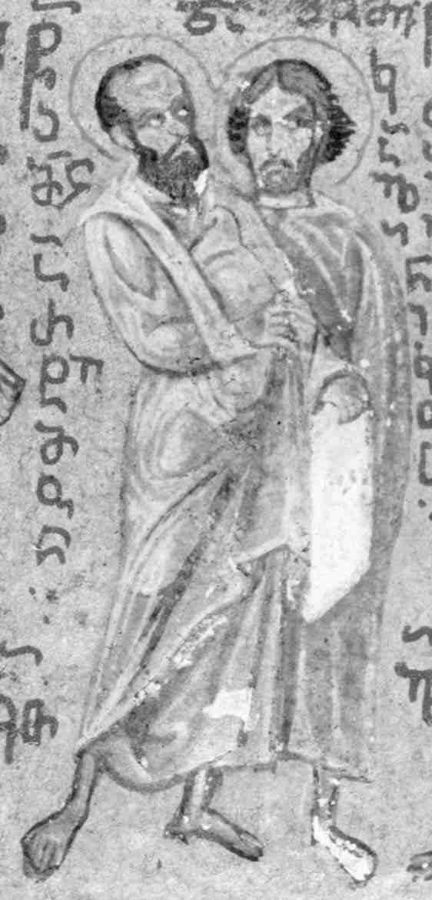
Baring-Gould’s sources: Commemorated on this day by Greeks and Latins alike, though some Latin Martyrologies note him on the 18th April. Authorities: his life by Palladius in the Hist. Lausiaca; and Sozomen, lib. iii. c. 14, who calls him Apollonius. Palladius is an excellent authority, for during his residence among the hermits of the Thebaid, he was personally acquainted with Apollo.
This illustrious hermit began his discipline of himself by a solitary life in the desert, at the age of fifteen. He spent forty years by himself, and then, called by God to guide the souls of others, he became head of a congregation of monks in Upper Egypt. In the reign of Julian the Apostate [Roman emperor 361–363 who tried to restore paganism], hearing that his brother, who was in the army, was imprisoned for his religion, he went at the head of his monks to visit him. The tribune entering the prison shortly after, and seeing so many monks within, ordered the gates to be closed, and vowed he would enlist them all as soldiers. But in the night an angel came, bearing a lamp, and opened the doors of the prison and led them forth, and they escaped with great joy to their beloved desert. About fifty monks obeyed him; but he did not confine his sympathies to them. Hearing that the country people were about to fight one another about some trifling subject of contention, Apollo rushed from his rocks, and flinging himself amongst them, conjured them not to shed one another's blood. One party promised to retire, but the other, headed by a redoubted robber, confident in his powers, held out. Then Apollo turned to the chief and said, "My son, lay down thine arms, and I will pray God to pardon thy many offences." The man cast away his weapons, and threw himself at the feet of the abbot. On another occasion he heard that a village procession of a famous wooden idol was about to take place; he went down, and kneeling, prayed God to prevent it. Then the image became immovable, so that neither priest nor people could take it from its place in the temple. The priests said, "A Christian has done this." "Yes," said Apollo, "I have done it by my prayers," and he exhorted the people to forsake the worship of such vain gods.
One Easter day the community had only some old stale loaves and a few dried olives, and they lamented that on so great a day they must fast, as in Lent [the forty days of fasting before Easter]. "Be of good cheer," said the abbot, "let each ask for what he likes best, and on such a day the loving God will give it him." But they would not ask, thinking themselves unworthy of such a favour. But he said, "Fear not, I will pray." Then they all knelt down, and Apollo asked, and they said Amen. Now as this response came, behold there arrived men and asses bringing a present to the monks, and it consisted of fresh loaves, pomegranates, citrons, honey in the comb, nuts, and a pitcher of fresh milk, grapes and figs, and large luscious dates ( nicolai ).
The monks of Apollo communicated every day, and some ate nothing from communion to communion, living only on this heavenly food. These were some of the pieces of advice Apollo gave to his monks:—"It behoves us to be ever joyous, for we ought not to be sad about our salvation. The Gentiles are sad, the Jews weep, and sinners mourn, all those whose affections are fixed on earthly things have cause to be agitated in mind, but not we." And it was so, that the monks were always cheerful and gay, and if any appeared sad, the abbot knew the cause must be sin, and he sent for him. "Let the monks communicate every day, for those who withdraw from the Sacraments, from them God withdraws Himself. But he who approaches them assiduously receives the Saviour. That is a salutary saying, 'He that eateth my flesh and drinketh my blood dwelleth in Me, and I in him.' Daily, therefore, let the monks prepare themselves, and daily let them receive it." "Let asceticism," he added, "be secret. I do not like those who put chains on their necks,—they do it to be seen of men; let them rather fast in their cells, where no one will know anything about it."