St. Asaph

A shepherd who stayed with his people through hard times.

Read the essentials →
May 1 · Bishop

St. Asaph

St. Asaph

A shepherd who stayed with his people through hard times.

Traditional feast

May 1
1914 / pre-1969 calendar, per Baring-Gould (1897)

Current feast

May 1 (also listed: May 5, May 11)
Secondary source · Wikipedia

Represents

Bishop

Their story

Adapted in modern English from the Catholic Encyclopedia (1913) · original text below

No Welsh life of Asaph survives. Local tradition still points out his ash tree, church, well and valley near Holywell, which suggests he once had a hermitage there. What is known of him comes from Jocelyn of Furness's life of St Kentigern (Mungo). During his exile, around 545, Kentigern founded the monastery of Llanelwy in Wales, now the town of St Asaph. It had 965 disciples, divided between farming, work around the monastery and the divine services, which went on without a break as one choir followed another.

Like other Celtic saints, Kentigern often prayed standing in the icy river. Once, after suffering badly from the cold, he sent the boy Asa, who was attending him, to fetch firewood. Asaph came back carrying live coals in his apron, and the miracle showed Kentigern how holy his disciple was. When Kentigern was recalled to Strathclyde after the battle of Arthuret in 573, Asaph was consecrated bishop in his place and became the first Welsh bishop of the see. His feast is kept on 1 May. Nothing more is known of his life, and the year of his death is unknown.

Early life

Selected sentences from the original account, unaltered.

Thin entry · the 1897 book gives only 193 words. We have not filled the gap with invented detail.

“ Among these was one named Asaph, more particularly illustrious for his descent and his beauty, who from his childhood shone forth brightly, both with virtues and miracles.

What they represent

How they teach us to live

Drawn from themes in the original account

Share your faith, in words and by example. Preaching and conversion are central here.

Build up the community you belong to. This life was lived with and for a community.

Learn from the kind of life it was. A shepherd who stayed with his people through hard times.

From the Catholic Encyclopedia

1913 · 392 words

First Bishop of the Welsh See of that name (second half of the sixth century). No Welsh life of him is extant, but local tradition points out the site of his ash tree, his church, his well, and his valley, Onen Asa, Fynnon Asa, Llanasa, Pantasa. All these sites are in Tengenel, near Holiwell indicating probably that the saint once had hermitage in that neighbourhood. The want of a Welsh life, however, is in part compensated for by Jocelyn of Furness's life of St. Kentigern, or Mungo, the founder of the Diocese of Glasgow. This saint during his exile (c. 545) betook himself to Wales and there founded the Celtic Monastery of Llanelwy (the church on the Elwy), as the Welsh still call the town of St. Asaph. Of the building and government of few Celtic monasteries do we know so much as about Llanelwy. The church was built "of smoothed wood, after the fashion of the Britons, seeing that they could not yet build of stone". The 965 disciples, of whom Asa was one, were divided into three groups: 300 of the unlettered farmed the outlying lands, 300 worked in the offices around the monastery, and 365 (the number corresponds to the days of the year) attended to the divine services. Of these the oldest assisted Kentigern in the government of the diocese, and the rest were subdivided into three choirs. "As soon as one choir had terminated its service in church, immediately another entering commenced it: and that again being concluded another entered to celebrate." The founder, after the manner of other Celtie saints, used frequently to pray standing in the icy cold river, and once, having suffered very severely under this hardship, he sent the boy Asa, who was then attending him, to bring a fagot to burn and warm him. Asaph brought him live coals in his apron, and the miracle revealed to Kentigern the sanctity of his disciple. So when the old man was recalled to Strathclyde, after the battle of Ardderyd, in 573 (the only definite date we have in the life), Asaph was consecrated bishop to succeed him, and became the first Welsh bishop of the see. The feast of his deposition is kept on 1 May, but we possess no further details of his life, nor do we know the year of his death.
Read more

The full original · 193 words

Read Baring-Gould’s full account

Baring-Gould’s sources: Roman Martyrology, Aberdeen Breviary. Authority: — Mention in the life of S. Kentigern.] S. Kentigern having been expelled his see in Scotland, founded a monastery at Llan-Elwy, in North Wales. “ There were assembled in this monastery/7 says John of Tynemouth, “no fewer than 995 brethren, who all lived under monastic discipline, serving God in great continence. Of which number, 300, who were illiterate, he appointed to till the ground, to take care of the cattle, and do other works outside the sanctuary. Other 300 he appointed to prepare the food, and perform other necessary works within the monastery, and 365 who were learned, he deputed to say the daily offices. Of these he would not suffer any, without great necessity, to leave the monastery; but appointed them to attend there continually, as in God's sanctuary. Now this part of the community he divided in such manner into companies, that when one company had finished the divine service in the church, another presently entered, and began it anew; and these having ended, a third immediately succeeded them. So that by this means prayer was offered up in the church without intermission, and the praises of God were ever in their mouths.

May i.J kS1. Sigismund. “ Among these was one named Asaph, more particularly illustrious for his descent and his beauty, who from his childhood shone forth brightly, both with virtues and miracles. He daily endeavoured to imitate his master, S. Kentigem, in all sanctity and abstinence; and to him the man of God bore ever a special affection, insomuch that to his prudence he committed the care of the monastery.” The story is told that one frosty bitter night, Kentigern had performed his usual discipline by standing in the cold river whilst he recited certain psalms, and when he crawled to his cell, he was so numb with cold that he thought to die. Then Asaph ran to fetch fire, that the saintly bishop might warm himself. But finding no pan in which to bring the burning charcoal, and fearing to delay, he raked the fire into the lap of his woollen habit and ran and cast them down in the hearth before the frozen saint. S. Asaph became abbot, when S. Kentigern returned to Glasgow, and was also consecrated bishop, and converted Llan-Elwy into the seat of his diocese in North Wales.

Feast days

Feast: May 1

Nine days · Free

Pray the novena
with us.

One short email a day for nine days. The day's prayer, a line from St. Asaph's story, and a nudge to keep going.

Also on May 1
St. Philip

St. Philip

May 1 · Apostle, Martyr
St. James the Less

St. James the Less

May 1 · Apostle
St. Amator of Auxerre

St. Amator of Auxerre

May 1 · Bishop
← All 1726 saints in the library
Sources & notes

Feast-day sources

Story sources

Sources

Credits

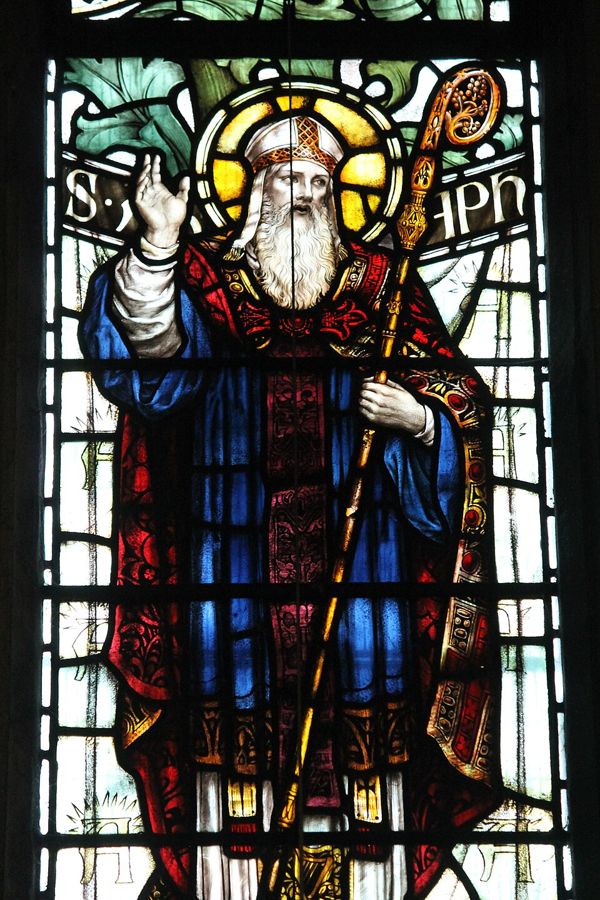
Image: Sant Silyn, Wrecsam Parish Church of St. Giles, Wrexham, Wales xz 48.jpg · Llywelyn2000 · CC BY-SA 4.0, via Wikimedia Commons

From Sabine Baring-Gould, The Lives of the Saints, new edition in 16 vols. (London: John C. Nimmo, 1897–98); text from the Internet Archive scan (OCR, lightly cleaned; errors possible). Public domain.

Image: Llywelyn2000, Wikimedia Commons (CC BY-SA 4.0)

From “Catholic Encyclopedia (1913)/St. Asaph,” The Catholic Encyclopedia (New York: Robert Appleton Company, 1907–1914), via Wikisource. Public domain. Matched by name and feast date; text unedited except for our bracketed notes in grey.

From Sabine Baring-Gould, The Lives of the Saints, new edition in 16 vols. (London: John C. Nimmo, 1897–98); text from the Internet Archive scan (OCR, lightly cleaned; errors possible). Public domain in the United States. Reproduced unedited, except for short bracketed notes in grey that we added to explain names and terms (“S.” is the old abbreviation for Saint). Some history and judgments reflect 19th-century scholarship.