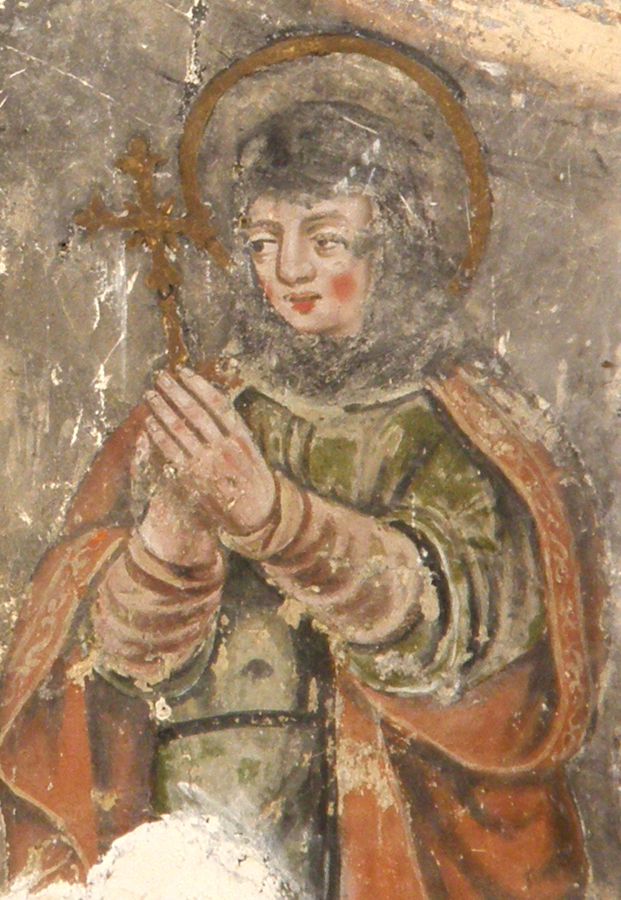
Baring-Gould’s sources: Usuardus and the Gallican Martyrologies. Modem Roman Martyrology. Saussaye, on Oct. 4, and again on Oct. 5. The Acts are so wholly fabulous that the Bollandists have declined to publish them.] If we had only the legendary life of the saint, we should probably doubt the existence of such a person; but two writers, S. Ouen, in his life of S. Eligius, and Jonas oi S. A urea.
Bobbio, in his life of S. Eustace, both writers living at the time, mention Aurea as abbess at Paris, in the 7 th century. S. Ouen says she was the daughter of Maurinus and Quiria, and that when Dagobert I. built a nunnery at Paris at the advice of S. Eligius, Aurea was made abbess of the virgins placed in it. Jonas of Bobbio adds that the rule observed in this house under Aurea was that which S. Caesarius of Arles gave to his sister Caesaria for the government of the great nunnery he had erected at Arles. This is all that is known of S. Aurea which can be relied upon. Now hear her Acts. Aurea was a Syrian maiden, who came from the East to Paris, and there was constituted superior of three hundred virgins. One day she was at a country house belonging to the abbey, when she heard that her cellaress was dead. She hastened back to Paris, found that this was true, and that the dead maiden grasped the cellar keys so tightly in her hand that they could not be got from her. Aurea therefore called her back to life again, to surrender the keys of the cellar, and after she had given them up dismissed her again to the realms of death. On another occasion the oven was red hot, but there was no bread to be put into it Aurea got into the oven, and swept the red-hot ashes out with the sleeves of her gown. At that moment, miraculously, all the bells of the convent began to ring. The sisters rushed tumultuously to church and sang “Te Deum.” When this hymn of praise was ended they returned to the oven, and found it full of wellbaked loaves.
After the death of Aurea, a Syrian maiden, who was bom blind, was informed in a dream that if she could touch the relics [the bodily remains of a saint, or objects they used, kept with honor] of Aurea, a Syrian damsel who had become abbess at Paris, she would obtain her sight. She announced this to the bishop of the city where she lived, and persuaded him to start off with her to Gaul [roughly modern France and Belgium] in quest of the body of this Aurea. The blind girl got tired of the society of the bishop, or the bishop had had enough of the girl's company, before they reached Gaul, so they parted, the bishop promising to rejoin his fair companion with a leg or an arm of the saintly abbess. He pushed on to Paris, and there begged so earnestly for a piece of the dead Aurea, that the clergy of Paris consented to cut off an arm. As they did so, the blood spouted forth in volumes. Delighted with his miraculously bleeding treasure, the oriental prelate returned to the spot where he had left the Syrian maiden, applied the bleeding stump to her eyes, and she saw instantly. The pair then returned to Syria, where they built and endowed a monastery in honour of the arm of Aurea. S. Aurea is said to have pulled the stole off a deacon during the divine office because he sang out of tune; but was reproached for her conduct by an angel, and in selfpunishment shut herself up for seven years in a cell, and lived on only bread and water.
The relics of S. Aurea are in the church of S. Eloi, at Paris, under the custody of the Bamabite fathers.