P
St. Paul of Narbonne
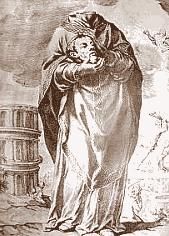
St. Aphrodisius of…
D
Faithfulness to Christ when it cost everything.
March 22
Not verified yet
Priest
Martyr
S. Basil was a priest of Ancyra, very fervent in spirit, zealous in upholding the Catholic faith, and combating the Arian heresy foot to foot. An Arian synod of bishops ordered his degradation from his office, in 360, and appointed Eudoxius, a bishop, and an Arian, in his place. But Basil encouraged by the Catholic bishops refused to budge, but maintained his ground, and was indefatigable in stimulating the courage of the faithful, and encouraging the half-hearted.
Pray a little every day. Prayer runs all through this account.
Stay faithful when it costs you. This account is about holding firm under pressure.
Learn from the kind of life it was. Faithfulness to Christ when it cost everything.
S. Basil was a priest of Ancyra, very fervent in spirit, zealous in upholding the Catholic faith, and combating the Arian [followers of Arius, who taught that the Son is a created being, not fully God] heresy foot to foot. An Arian synod of bishops ordered his degradation from his office, in 360, and appointed Eudoxius, a bishop, and an Arian, in his place. But Basil encouraged by the Catholic bishops refused to budge, but maintained his ground, and was indefatigable in stimulating the courage of the faithful, and encouraging the half-hearted. He was the means of restoring large numbers of those who had been taught by the Arians to disbelieve in the consubstantiality of the Son with the Father to full Catholic faith, thereby exasperating the heretics against him. He was one of those fiery enthusiasts of resistless energy, uncompromising with himself and others, a type as needful as the soft and gentle saint, winning through love. The burning faith of Basil carried him dauntless into danger, and made him regardless of opposition, and those spirits which looked to a strong nature for support found a rock in Basil.
As soon as Julian assumed the purple, paganism was revived; and if the Christians were not openly persecuted, every means which craft could devise of breaking their resolution were resorted to, and with such success that the mild measures of Julian proved more dangerous to the Church than the fiery persecution of Decius [Roman emperor 249–251, who ordered everyone to sacrifice to the gods]. But the patience of Julian gave way towards the end of his career, and it is certain that in some cases he encouraged, and in others connived at the resort to violence to punish the most zealous upholders of Christianity. The charges against those most obnoxious were not always their religion, but contempt of the edicts or seditious conduct. Basil worked so effectually in Ancyra to counteract the imperial policy that the pagan priests and governor were resolved to destroy him, hoping that, if the prop of the Ancyran Christians were removed, their faith would yield with a crash. Macarius, one of the priests of the idols, laid hold of Basil as he was publicly denouncing heathen worship, and drew him before the magistrate, Saturninus, on the charge of stirring up the people against the established religion. "What meanest thou," cried Macarius, "going to and fro in the city, agitating the people against the religion established by the emperor?" "God break thy jaws, thou bondslave of Satan!" answered Basil. "It is not I who ruin thy religion, but He who is in Heaven who confounds thy counsel and dissipates thy lies."
Then Macarius cried out to the proconsul, "I charge this fellow with making sedition in the city, stirring up the people to overthrow our altars and defy the emperor." "Who art thou," asked Saturninus, "who art so audacious as to do these things?" Basil replied, "I am the best of everything,—a Christian."
"Then why, if thou art a Christian, dost not thou behave as a Christian?" "I do," answered Basil; "it behoves every Christian to make bare all acts."
"Why dost thou make revolt in the city, transgressing good laws, and blaspheming the emperor?"
"I do not blaspheme the emperor or his religion. God is my emperor, and He will bring your petty established religion to naught in no time."
"So the religion of the emperor is not true!"
"How can I regard that religion as true, and that worship as true which consists in men running howling about the streets like rabid dogs with raw flesh in their mouths."
"Hang him up and scrape him," said the proconsul. So Basil was suspended by his wrists and ankles, and his flesh was torn with rakes. And as he suffered he cried, "Lord God of ages, I thank thee that I am deemed worthy to enter into the way of life through these torments, walking through which I may behold the heirs of thy promises!" Then he was taken down and cast into prison. And after that the proconsul sent to the emperor Julian, to announce what had taken place, and to ask further orders. Then the emperor sent three renegade Christians, and advised the proconsul to endeavour by all means to persuade and flatter Basil into apostasy. But though all efforts were used to shake his resolution they failed, and Basil remained in chains till Julian himself passed through Ancyra on his way east to the Persian war. Then Basil was summoned before the emperor, and Julian endeavoured to persuade him to conform to his religion, but the holy martyr blazed forth in righteous zeal against the apostate. "Thou renegade hast abdicated the throne prepared for thee in heaven," he said; "And verily I believe that Christ whom thou hast abjured will take thee and pluck thee out of thy dwelling, that thou mayest know how great is that God whom thou hast offended. Thou hast not thought of His judgments, nor venerated His altar where thou wast given salvation; thou hast not kept His law which often thou didst declare with thy lips; wherefore the great emperor Christ will not remember thee, but will take from thee speedily thy earthly empire, and thy body shall be deprived of a sepulchre, and thou shalt breathe forth thy soul in greatest anguish."
Then Julian ordered him to be taken away, and seven thongs to be cut daily from his skin. This command was given to Frumentinus, Count of the Squires (Comes Scutariorum.) And when this had been done, the martyr gathered up one of the strips of skin cut off him, in his hand, and besought that he might be conducted before the emperor. And as Frumentinus believed that he was about to make adjuration of his religion, he brought him into the council hall before Julian. Then he cried, "Dumb and deaf and blind are thy idols, Apostate! To me to live is Christ, and to die is gain. He is my helper in whom I trust, and for whom I suffer. Here is meat for thee, Julian!" and he flung the strip of skin in his face.
Then the count, alarmed at having occasioned this scene, by suffering Basil to return into the emperor's presence, hurried him out and cast him into prison. On the morrow Julian departed for Antioch, without having seen the count, who feared that he had fallen into disgrace, and therefore vented his spleen on the martyr. He had iron spikes heated red-hot, and Basil thrown upon them, so that they burnt into his bowels. But Basil prayed, "Christ is my light, and Jesus is my hope, a calm port in tempest. I give Thee thanks, Lord God of my fathers, because thou hast saved my soul from the abyss; keep Thy Name inviolate in me, and make me an heir of eternal quiet, for the promise made unto my fathers by the great High Priest, Jesus Christ, our Lord; through whom I pray Thee receive my spirit into peace, persevering in my confession; for Thou art merciful and long-suffering and full of compassion; who livest and abidest through ages of ages. Amen." And when he had ended his prayer, as one overcome with slumber, he ceased and gave up his spirit.
Feast: March 22
One short email a day for nine days. The day's prayer, a line from St. Basil at Ancyra's story, and a nudge to keep going.
From Sabine Baring-Gould, The Lives of the Saints, new edition in 16 vols. (London: John C. Nimmo, 1897), digitized text from Project Gutenberg. Public domain.
From Sabine Baring-Gould, The Lives of the Saints, new edition in 16 vols. (London: John C. Nimmo, 1897), digitized text from Project Gutenberg. Public domain in the United States. Reproduced unedited, except for short bracketed notes in grey that we added to explain names and terms (“S.” is the old abbreviation for Saint). Some history and judgments reflect 19th-century scholarship.